Western Australia's horticulture industry has expanded over the past three and a half years, according to new figures from the Department of Primary Industries and Regional Development (DPIRD). The department's Value of Horticulture from Western Australia 2023-24 report shows the sector's real value increased by 9.6 per cent since 2020 after adjusting for inflation. The report outlines production and export trends across fruit, vegetables, wine grapes, and amenity horticulture. The data is used by industry and government to support planning for supply, market access, and long-term production capacity.
 © Department of Primary Industries and Regional Development’
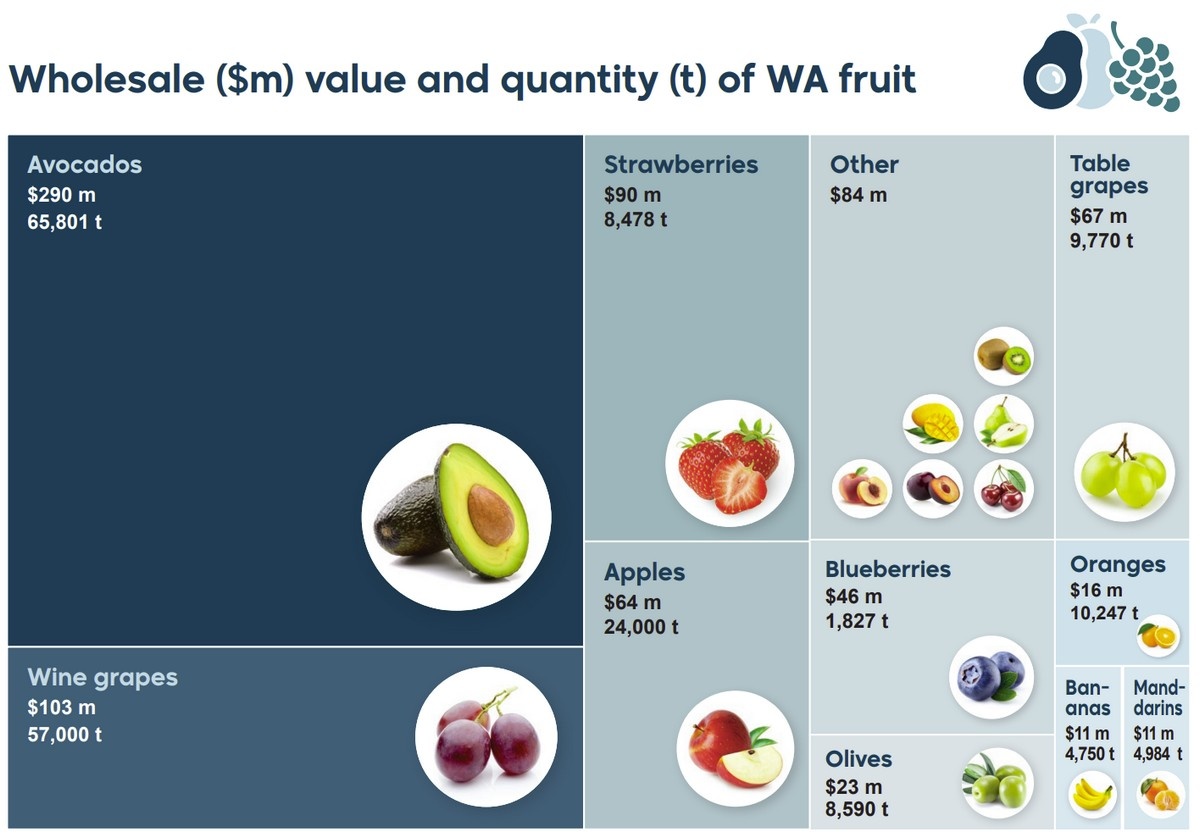
In 2023-24, horticulture production in the state reached a value of $1.92 billion, including fruit, nuts, vegetables, and amenity crops. Avocados accounted for the largest share of fruit value at $290 million, followed by wine grapes at $103 million, strawberries at $90 million, table grapes at $67 million, and apples at $64 million. In the vegetable category, ware potatoes were valued at $136 million, followed by carrots at $82 million, cucumbers at $61 million, melons at $55 million, and tomatoes at $50 million.
Most of the state's produce is consumed domestically, with horticultural imports falling by 8 per cent between 2020 and 2023-24. Fruit and vegetable exports reached $187 million during the 2023-24 period. Vegetables made up $96 million of export value, fruit $91 million, and wine $35 million. Amenity horticulture exports, largely cut flowers, were valued at $3 million.
 © Department of Primary Industries and Regional Development’
Click to enlarge
Avocado exports recorded the strongest growth, rising 646 per cent since 2020 to $36 million. Apple exports increased 157 per cent to $1 million, and strawberry exports rose 12 per cent to $26 million. Carrots remained the state's largest vegetable export at $61 million. Exports of onions grew 18 per cent to $9 million, truffles increased 69 per cent to $8 million, and ware potatoes reached $6 million. Seed potato exports rose 29 per cent to $5 million.
DPIRD senior economist Manju Radhakrishnan said the three-year trend shows mixed performance across individual crops but overall growth in the broader sector. She noted that increases in fruit and amenity horticulture have compensated for small declines in vegetables and nuts.
According to Radhakrishnan, export development continues to be strongest in high-value crops such as avocados, grapes, and strawberries, supported by improved product quality and demand in domestic and international markets.
DPIRD recently hosted the Western Australian Horticulture Updates 2025 event, where more than 200 growers and industry representatives discussed production challenges, future opportunities, and ongoing research initiatives.
To view the full report, click here.
For more information:
Megan Broad
DPIRD (Australia)
Tel: +61 8 9368 3937
Email: [email protected]
www.wa.gov.au