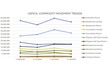
Cameroon's pineapple exports fell by an average of 18.1 per cent between 2020 and 2025, according to a report released by the Competitiveness Committee of the Ministry of Economy. Shipments to the European Union, which remains Cameroon's main export destination for pineapples, declined by 19.5 per cent over the same period. The committee stated, "The pineapple sector is seeing a drop in total exports (-18.1 per cent) and an even sharper fall to the EU (-19.5 per cent). This suggests competitiveness issues or problems with meeting standards that market access alone cannot resolve."
The continued decline recorded in 2024 reduced Cameroon's already limited presence in the global pineapple market. Since 2019, the country's market share has remained at 0.1 per cent, compared with Côte d'Ivoire's 0.9 per cent. This stagnant position prevented Cameroon from taking advantage of the 7.3 per cent rise in global pineapple demand in 2023. Although the country is described as having recognised production potential, it remains largely absent from growth in the international pineapple trade.
According to the Competitiveness Committee, low productivity and smaller planted areas compared with other producing countries continue to constrain the industry. In its analysis, the committee cited FAO data showing that Cameroon's yields per hectare are roughly half of those achieved in Costa Rica. Costa Rica remains the world's largest pineapple exporter, followed by the Philippines. In 2023, Costa Rica and the Philippines accounted for 49.2 per cent and 14.8 per cent of the global market, respectively. Between 2019 and 2023, Costa Rica maintained a market share slightly above 47 per cent, indicating its ability to retain its position while Cameroon struggles to increase its share.
The committee's report highlights the gap between Cameroon's current production model and the higher-yielding systems used in leading exporting countries. For growers and exporters operating in controlled-environment agriculture or greenhouse-adjacent supply chains, the challenges outlined in the report centre on productivity, planted area, and meeting market specifications for the EU. Without gains in these areas, Cameroon is expected to remain a marginal player in the global pineapple trade as demand continues to grow.
Source: Business in Cameroon