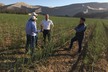
In the agricultural desert of La Joya, 1,600 meters above sea level and surrounded by mountains in the south of Peru, a team of professionals is helping hundreds of small-scale farmers become competitive suppliers to markets in Chile, China, and even Europe. At the center of this transformation is Inka Select Fruit, a company founded in 2019 with a clear mission that its leadership continues to repeat without hesitation: "To help small farmers export directly, without intermediaries," says Job Estaban Olave Silva, the company's commercial manager.
 © Inka Select Fruit
The journey began just before the pandemic with a single container of Red Globe grapes. Today, Inka Select exports around seven million kilos of fruit annually.
The story of Inka Select is deeply tied to La Joya, a district with 30,000 hectares of irrigated land and a climate that seems tailor-made for fruit production. "It's like having a natural greenhouse all year round," says operations manager Cristopher Andrés Colarte Núñez. And he's not exaggerating: volcanic soils, a relative humidity of around 20%, twelve hours of intense sunlight per day, and large temperature shifts between day and night create ideal conditions for growing black-skinned, creamy Hass avocados that can compete with those from Mexico and Chile. The region also produces firmer, more transport-resistant table grapes than those grown in northern Peru.
Thanks to ongoing technical support in irrigation, nutrition, pruning, and soil and water analysis, farmers working with Inka Select have boosted their avocado yields from 6–7 tons per hectare to 22–27 tons. "We're not miracle workers," says Álvaro Santiago Zegarra Tirado, head of operations, "but we know how to provide support and bring consistency to production, even on plots as small as half a hectare." Farmers receive free support to obtain GlobalG.A.P. certification, a strategic investment that gives them access to demanding but high-paying markets.
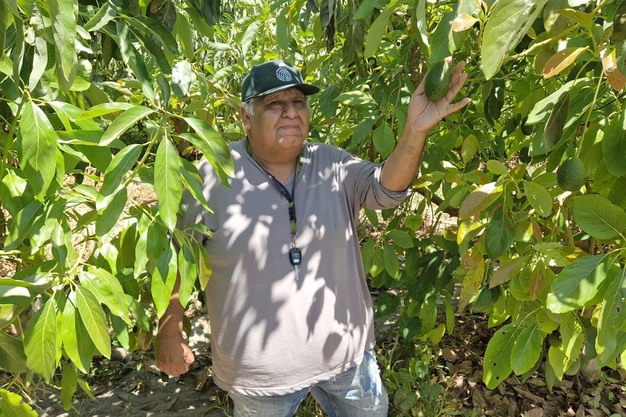 © FreshPlaza
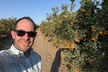
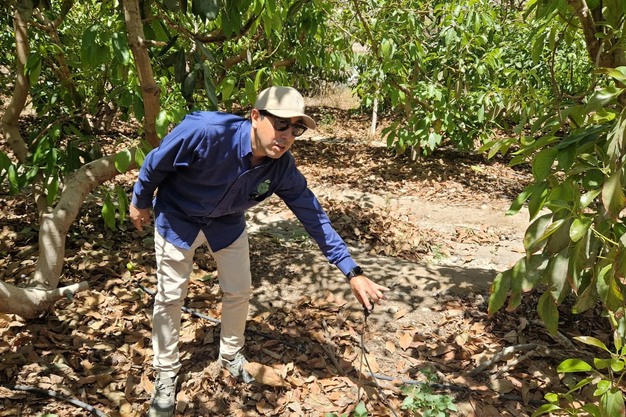
Carlos Cornejo, a producer associated with Inka Select Fruit, poses next to a five-year-old tree whose avocados will be harvested next March. Carlos was the first producer whose fruit Inka Select exported to China.
The company currently works with 540 producers, many of whom own just 0.3 hectares. Inka Select buys 100% of its production, including smaller fruit sizes or second-grade produce. The strategy is simple: nothing goes to waste; every size has its market.
This approach has allowed Hass avocados from the Arequipa region to reach quality-focused buyers. Roughly 50% is exported to Chile, 30% to China, and 25% to Europe, with the remaining 5% split between the U.S., South Korea, and Central America. Despite this market diversity, the long-term focus is on Asia. "If just 1% of China's population consumed avocado, it would absorb all of Peru's output," says Olave. Inka Select has managed to establish itself in China after years of reputational issues related to dry matter content in exports from Peru. "We set a minimum of 23% dry matter," adds Colarte. "That changed everything. Now we have zero complaints."
 © Inka Select Fruit
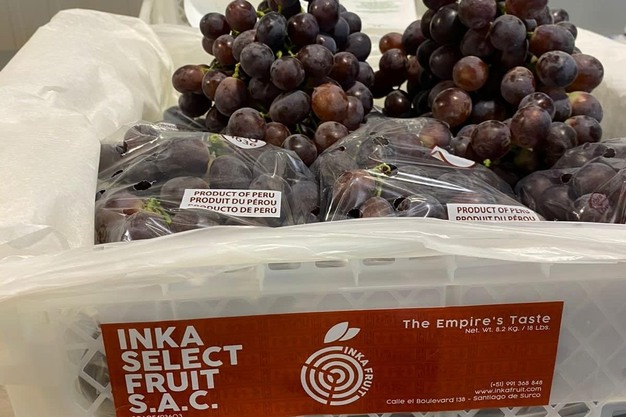
Table grapes are another success story. Buyers are willing to pay one to two dollars more per box for fruit from Arequipa, that's the name of the Peruvian department of which La Joya is part, where the dry climate and low presence of fungi extend shelf life. Looking ahead, the Majes Siguas II project, a place nearby which will add 40,000 hectares of irrigated land, could open a unique production window from April to July, a time when Peru currently has no domestic supply. "This project could turn southern Peru into a major agricultural powerhouse," says Olave.
 © Inka Select Fruit
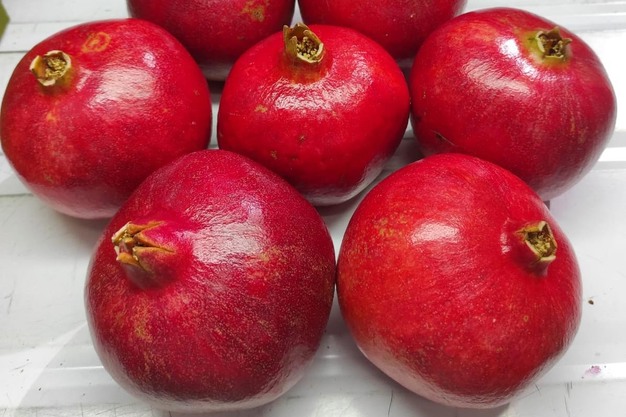
Rounding out the core portfolio is the Wonderful pomegranate. In Arequipa, this variety develops a deep red color, both in the peel and the arils, that doesn't occur in other regions. Harvested between December and February, when Israel and South Africa are out of season, it fetches high prices. This year, Costa Rica paid the best rates of all the company's markets. Inka Select is now planning a processing facility for arils destined for air freight to the U.S.
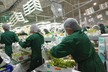
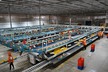
Growth has pushed the company to innovate in post-harvest handling and packaging. Though they still use a regional government packing facility, plans are underway for their own site, complete with sulfur dioxide chambers that extend grape shelf life, preserve green stems, and prevent fungal spread. They're also investing in controlled atmosphere systems to keep fruit in top condition and clamshell packaging lines, replacing traditional bags. "Globally, everything is shifting to clamshells: ready-to-eat snacks," explains Olave.
The biggest challenge, however, isn't in the fields or packing, but on the road. Exporting from Arequipa means a 14-hour truck ride to the port of Callao, where they compete with exporters located much closer to the port infrastructure. Political instability adds risk, with frequent road blockades and strikes. The new port of Chancay has helped, during the last season, 50% of their containers to Asia went through it, saving ten days of transit to China, but it quickly became congested and less efficient. That's why hopes are high for the future port of Corío, a U.S.-backed project just two hours by truck from Inka Select's packing station. Combined with Majes Siguas II, Corío could fully integrate Arequipa into global trade routes.
 © FreshPlaza
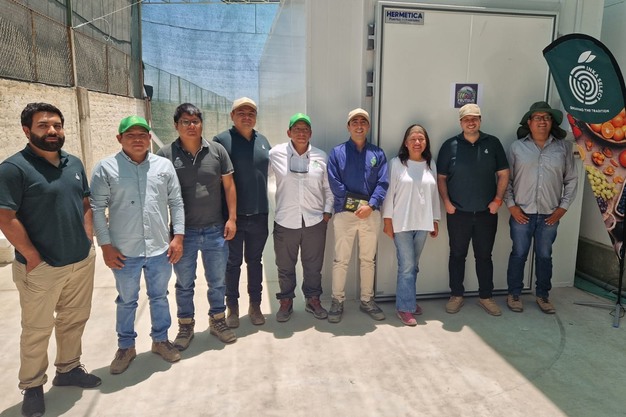
The Inka Select Fruit team
Inka Select also stands out for its social commitment. In a region where low-labor crops like cochineal, used to produce natural dyes, are gaining ground, the company encourages growers to stick with avocados, grapes, and pomegranates, which generate far more employment. "When the farmer grows, we all grow," says Olave. "We have 540 bosses and feel like one big family, spread across hundreds of hectares."
Still, generational transition and land fragmentation are growing concerns. "Many of the founding farmers in Arequipa and the broader south are over 60," says Olave. "Some of their children are getting involved, but we still need to make farming more appealing to the next generation." That perception, however, is beginning to shift. Young people with technical or university training are returning to agriculture with a more entrepreneurial and tech-savvy mindset, focused on water efficiency, quality control, traceability, exports, and sustainability. "At Inka Select Fruit, we believe Peru's agricultural future depends on exactly this: combining the older generation's experience with the younger generation's innovation."
Land ownership is another issue. "It's true that small plots risk being fragmented even further when passed down to heirs. But we're also seeing movement in the other direction: associations, cooperatives, and alliances with companies such as Inka Select that help maintain production scale," he explains. "Our goal is to support collaborative models where farmers keep ownership of their land but gain access to markets, technical assistance, and long-term profitability."
 © FreshPlaza
Job Estaban Olave Silva, commercial manager of Inka Select Fruit
Perhaps the company's boldest bet is in new crops. Like others in the sector, Inka Select is running pilot projects for cherry cultivation in Ayacucho and Huancavelica. If successful, Peru could enter the Chinese market in October, a month ahead of Chile, hitting the premium window. "The potential is huge," says Olave, "but we need virus-free planting material and solid logistics in these remote areas." They're also testing raspberries, blueberries, and sugar plums, always sticking to the principle of only growing what they know how to sell, with a clear focus on Asia.
Today, Inka Select handles about 300 containers annually, with ambitions to grow to 500 — or even 1,000. "As long as we maintain the same quality," says Olave. Together with his team, he has proven that export agriculture doesn't have to be the exclusive domain of large estates.

For more information:
Job Esteban Olave Silva (commercial manager)
Inka Select Fruit
Av. El Polo 401
Lima (Peru)
Tel.: +51 960 523 997
[email protected]