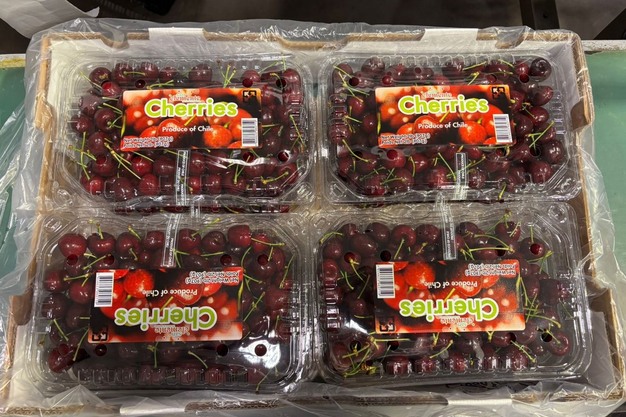
The 2025 Chilean cherry season started earlier than usual amid varied weather conditions across different production areas. Martín Toro, the commercial manager of San Clemente, noted that the first harvests included early varieties like Frisco and Nimba, followed by Santina, which is establishing itself as the preferred variety because of its firmness and post-harvest resilience.
"Investing in management and technology to improve a good Santina is currently more effective than betting on new varieties that have yet to prove themselves in the market," Toro stated.
 © San Clemente
The initial estimate from the Cherry Committee suggests that the 2025-2026 season might reach approximately 131 million 5-kilo boxes. However, recent rains have led to more conservative projections of around 120-125 million, similar to last season's levels. The three primary varieties, Santina, Lapins, and Regina, are expected to account for over 70% of the total exports, with figures of 44.5, 43, and 21.2 million boxes, respectively.
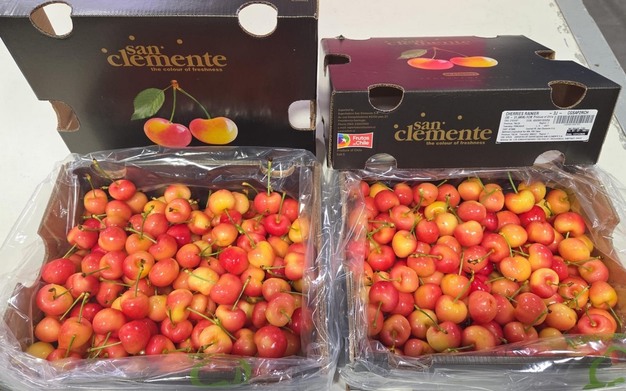
The main destination remains China, which accounts for over 95% of Chilean shipments. San Clemente expects to export 2 million boxes, equal to 11.5 million kilos, driven by new orchards and producers. However, the company aims to diversify markets again, targeting 30% of its exports outside Asia. "We continue to focus on China, where we have our own office (SVA Fruits) and a local team led by Max Leiva, but we are also resuming commercial connections in other destinations," Toro said.
 © San Clemente
The early harvest start and the late Chinese New Year (17 February) might prolong the fruit distribution period. However, Toro emphasized that the Chilean industry "must uphold quality standards and only send fruit meeting Chinese market demands to preserve its reputation for quality."
The executive estimates returns will be 10-15% higher than last year, but remains cautious after a previous season to forget. Initial prices at source are lower than in 2024 for the same weeks, reflecting a supply-and-demand-sensitive market.
 © San Clemente
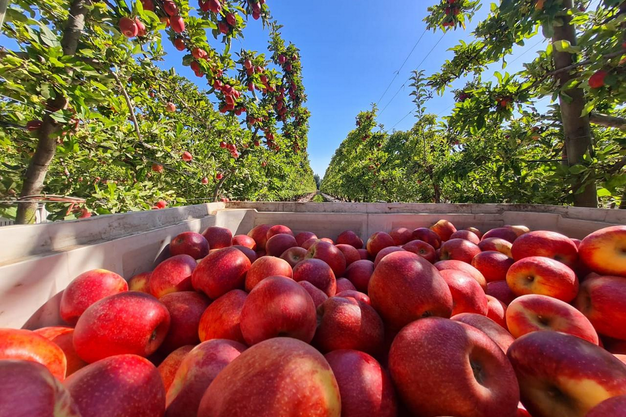
San Clemente also works with apples, grapes, clementines, mandarins from Chile, blueberries from Peru, and cherries from England, completing its annual calendar. The company finished apple shipments in November. Toro called the season "positive, although with lower returns than in 2024."
"The increase in maritime tariffs directly affected the results, with logistics costs increasing by nearly a dollar per box," he explained. Nevertheless, he emphasized that the entire volume was sold successfully and was well received in the main destinations.
 © San Clemente
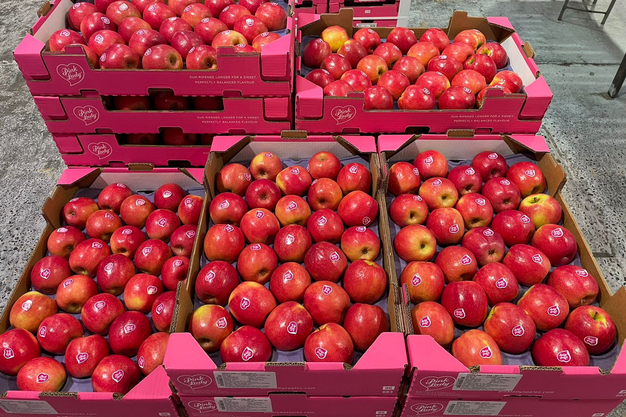
The Royal Gala, Pink Lady, and Fuji remain the company's most important varieties. Royal Gala, thanks to its versatility, is exported to Europe, North America, Asia, and Latin America, which helps it maintain stable prices and returns. Conversely, Pink Lady, primarily exported to Europe, faces a shrinking commercial window due to competition from Italy and France, which is putting additional pressure on prices.
"Monomarket varieties like Fuji, which are mainly exported to Taiwan, encounter increased competition from New Zealand, leading to reduced margins," Toro added.
"Finally, we anticipate a 20% increase in table grape volume due to new orchard ripening in the Ovalle area. Favorable winter and spring weather conditions are expected to ensure high quality, uniform sizes, and ideal export conditions," he concluded.
 For more information:
Martín Toro
San Clemente
Chile
Email: [email protected]
www.sclem.cl