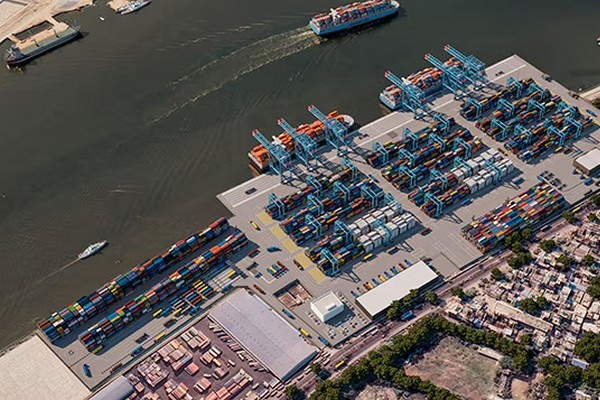
Bangladesh has signed a concession agreement for the development of the Laldia Container Terminal in Chattogram, a project valued at more than US$550 million. The terminal will be developed under a Public-Private Partnership between the Chittagong Port Authority (CPA), APM Terminals, and local partner QNS Container Services Ltd. The agreement grants APM Terminals a 30-year operating concession, with the option for extension based on key performance indicators. The investors will design, finance, build, and operate the facility, marking the first project of this model for Bangladesh's port sector.
Keith Svendsen, CEO of APM Terminals, said the project will allow the company to "support the growth of the local manufacturers, exporters, importers and the broader Bangladeshi economy" and that it aims to create "a safe and efficient terminal" with future employment opportunities.
 © APM Terminals
The development falls under the Sustainable Green Framework Engagement between Denmark and Bangladesh, which focuses on green investment, job creation, and economic cooperation. Honourable Chief Adviser Professor Muhammad Yunus stated that the project reflects Bangladesh's commitment to "reform, transparency and investment-friendly growth" and that Laldia would become "the country's first green port." He stated that the facility is expected to expand its export capacity and alleviate logistics bottlenecks.
Denmark's Minister of Foreign Affairs, Lars Løkke Rasmussen, noted that Maersk already handles about 30 percent of Bangladesh's containerised trade and described the investment as an indicator of ongoing cooperation between the two countries. CPA Chairman Rear Admiral S. M. Moniruzzaman stated that the terminal will enhance capacity and efficiency at Chittagong Port. Nurul Qayyum Khan of QNS Container Services Ltd. said the project will bring together international expertise and local enterprise, adding that it could reduce the cost of trade for exporters and importers.
Once operational in 2030, the terminal is expected to increase Bangladesh's annual container handling capacity by more than 800,000 TEUs and support export sectors including textiles, apparel, and manufacturing. The deep-water facility is projected to allow the port to handle vessels of up to 6,000 TEU, compared to the current limit of 2,800 TEU, which may reduce congestion and logistics costs.
The construction phase is expected to generate over 1,000 jobs, with more than 500 jobs projected during full operation. Additional indirect employment is anticipated in logistics and manufacturing. APM Terminals has indicated that training and apprenticeship programs will be part of the workforce development plan.
The terminal is planned as an energy-efficient, low-emission facility aligned with Bangladesh's climate objectives. Design elements include electrified cargo handling equipment, solar power installations, and shore-power-ready systems intended to reduce emissions, noise, and air pollution.
 © APM TerminalsFor more information:
Sissel Christine Søe
APM Terminals
Tel: +45 3010 0292
www.apmterminals.com