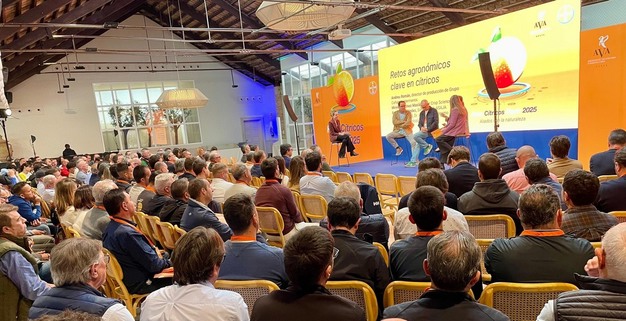
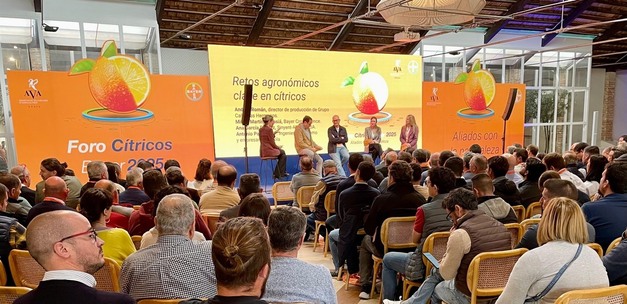
Valencia hosted the 2025 Citrus Forum, organized by Bayer and AVA-ASAJA. Over 300 growers, researchers, technicians, and institutional representatives from the citrus industry gathered to discuss future challenges, opportunities, and sustainable solutions under the theme "Allied with nature."
In her opening speech, M.ª Ángeles Ramón-Llín, Director General of Agricultural and Livestock Production for the Generalitat Valenciana, emphasized "the need for public-private collaboration so that growers have the necessary tools to make agriculture a profitable and competitive activity, which is attractive to young people, thus encouraging generational change."
 © Bayer
At the opening conference, Cristóbal Aguado, President of AVA-ASAJA, discussed the current and future outlook of the sector, emphasizing that citrus cultivation "can reach fair and sustainable profitability if we address political issues and industry-specific challenges." He identified key challenges such as "regulating reciprocity with third countries, enhancing pest and disease management, encouraging R+D+i and rapid adoption of new technologies, adapting to climate change, and utilizing new genomic techniques (NTG) to develop more resilient varieties."
Pierre Larrieu, the general manager of Bayer Crop Science Iberia, emphasized Bayer's dedication to citrus growers and outlined the company's goal of transforming the citrus industry into a more sustainable and profitable model that meets market needs. "We are dedicated to regenerative agriculture that integrates chemical, biological, and digital tools to enhance crop quality and yield while minimizing environmental impact," he stated.
 © Bayer
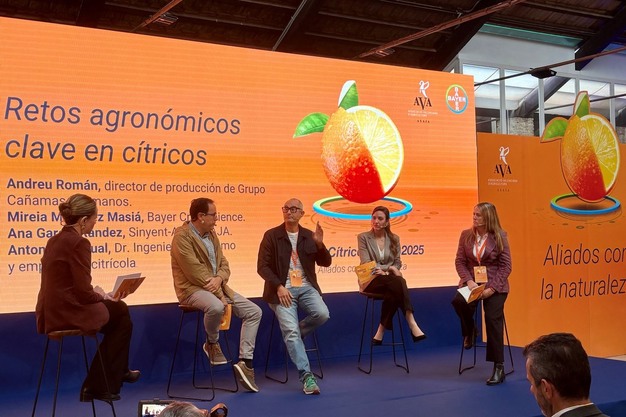
A round table featuring Andreu Román, production director at Grupo Cañamás; Mireia Martínez, Bayer sales delegate; Ana García, director of the Sinyent experimental farm; and citrus businessman Antonio Pascual discussed the main agronomic challenges facing their farms. They agreed that the sector is undergoing a significant transformation due to European regulatory pressures, technological advancements, and the impact of imports on the competitiveness of local products. They stressed the urgency of adopting biotechnological tools and sustainable, integrated management strategies to sustain productivity and plant health, ensuring efficiency and resilience against new pests and diseases.
Bayer experts showcased the company's solutions for increasing pest pressure and the decreasing availability of active ingredients. Victor Garasa, Bayer's Head of Citrus Crops, highlighted the importance of a comprehensive approach to resistance management, including: the biotechnological device Vynyty Citrus, which uses attraction and death techniques to control pests like cotonet and red louse; the systemic insecticide Sivanto Prime, effective against sucking insects and safe for auxiliary fauna; Flipper, a contact-based biological insecticide; and the digital tool Cropping View, which tracks pest levels and determines the best timing for treatment. Additionally, José Mª Soler, an agronomy expert, emphasized biological control methods such as conservation or releasing natural enemies of pests.
The importance of improving soil health and promoting biodiversity through the use of cover crops, a key part of the regenerative agriculture model, was also highlighted. "The first results of the trials we have conducted this year with the DeTerra group in Valencia have shown a high abundance and diversity of beneficial auxiliary insects for natural pest control (thrips)," explained Santiago Cerdá, an agronomy specialist.
 © Bayer
Vicente Navarro, a researcher at the Polytechnic University of Valencia (UPV), and Vicente Dalmau, head of the Plant Health Service of the Generalitat Valenciana, focused their speeches on emerging pest threats and strategies to combat them with pheromones. They emphasized the importance of biotechnological and integrated solutions as the foundation for more sustainable citrus farming. Navarro highlighted the potential of semiochemicals and pheromones as natural, selective tools to decrease the use of phytosanitary products through methods like sexual confusion, attraction, and eradication. Dalmau discussed the progress of the Citrus Phytosanitary Surveillance Plan, which has helped control the South African coccid and manage emerging thrips with biological control strategies and plant cover management.
José Luis Robles, head of digital tools at Bayer, highlighted technological innovation in his speech, introducing ResiYou. This digital platform uses artificial intelligence to predict phytosanitary residues, helping producers meet food chain and consumer expectations. "Resiyou is currently available for strawberry, tomato, grape, as well as stone and pome fruit trees. We are also collaborating with Valencian producers on a citrus fruit pilot, targeting a commercial launch in 2026," he concluded.
For more information:
Bayer
www.bayer.com