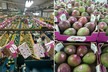
The Greek kiwi season got off to a strong start this year. "In the run-up to harvest, everything was just right: the amount of sunshine and rainfall was ideal and, combined with the cold nights, resulted in excellent brix values," says Thanos Motsiopoulos, commercial manager at German company Nutrifrucht GmbH.
The export season also began exceptionally early this year. "From the end of August, there was already demand for Greek kiwis, which led to exports of the early variety Tsechelidis. Retailers, and we at Nutrifrucht, were waiting as usual for the first Hayward kiwis, which also came onto the market in mid-October this year. Partly due to the early end of the Chilean season, demand was particularly high in the first weeks. Prices were about 10 to 15 per cent higher than last year's starting level for that reason. However, due to reduced demand in the first weeks, we are now seeing the market correct itself quickly," Thanos explains.
European and North American retail
Besides its headquarters in the Munich region, Nutrifrucht, which evolved from the firm Oettle & Griesmeyer several years ago, has an international sales team with employees in Lithuania, southern Italy, the Netherlands, and, of course, Greece itself. As for kiwis, the company cooperates with growers in all the main production regions: Macedonia, Epirus, and Thessaly. Thanos says, "As a result, we have ample available volumes and a wide range of sizes."
From week 42, the first larger programs began in European retail. Meanwhile, the growing company has also gained access to Dutch retail, Thanos confirms. "Besides retail customers in numerous European countries, we also export our kiwis to North America."
 © Nutri Frucht GmbH
Consolidating lead
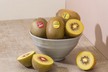
Greek kiwis are generally available until the end of April, competing mainly with Italian products. "We see Italy becoming more active in the Greek market in recent years, especially as Italian growers have largely switched to kiwi gold, while Greek kiwi cultivation is still dominated by the Hayward variety. Although kiwi gold is also grown to a limited extent in Greece, I personally believe that acreage should be expanded more rapidly."
This also relates to the growing competition from Turkey and Iran, which are also primarily focusing on the Hayward variety. "Of course, Greece is still ahead when it comes to post-harvest technology, including storage and preservation, but it's only a matter of time before these emerging countries catch up. In my view, we should not wait for that to happen, but take action now."
 © Nutrifrucht GmbH
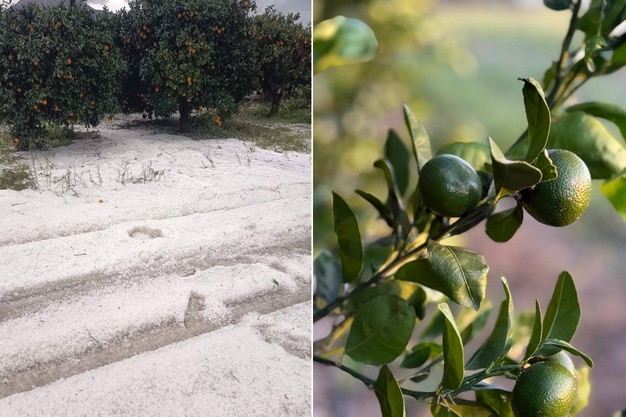
Left: Hail plagues Greek citrus crop
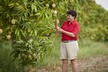
Right: Since this year, Nutrifrucht, as a joint venture with a Greek grower, has 10 hectares of mandarins of a new club variety. The official launch and announcement of the name will follow later this year.
Hail and rain plague citrus crop
The Greek citrus season also began in the first week of November with the first deliveries of Navelina oranges and Clemenules mandarins. "We see a very clear divide in Europe, with Eastern Europe showing a strong preference for Greek citrus, while Western Europe is mainly supplied by Spain and, additionally, Italy. Germany, therefore, acts as a transitional area, with Greek citrus appearing here and there. We aim to strengthen our position in the German sales market again in the coming years."
Despite the good prospects, this year's citrus harvest has been somewhat delayed due to rain and even hail. "In recent days, it has rained continuously in the main growing areas in the north and west of the Peloponnese as well as along the west coast of the mainland. Under these conditions, harvesting is obviously difficult. Fortunately, weather forecasts are now looking somewhat better, so we are not expecting any significant volume losses for the time being. Overall, the acreage has remained fairly stable in recent years," Thanos concludes.
More information:
Thanos Motsiopoulos
Nutrifrucht GmbH
Münchner Str. 18
85774 Unterföhring
+31 6 53821842
[email protected]
www.nutrifrucht.de