Using AI to predict when and which volumes will be available. It may sound futuristic, but the Belgian company Möbius has developed a solution for this, initially for Coöperatie Hoogstraten. "As a trader, you have to decide every week how much to promote, when to start campaigns, and how much stock to keep. By combining different data sources, we have developed an AI model that can predict overall volumes quite accurately, days, weeks, and even months ahead," explained Cynthia Hadinoto and Jonathan Aelterman of Möbius.
 © Mobius
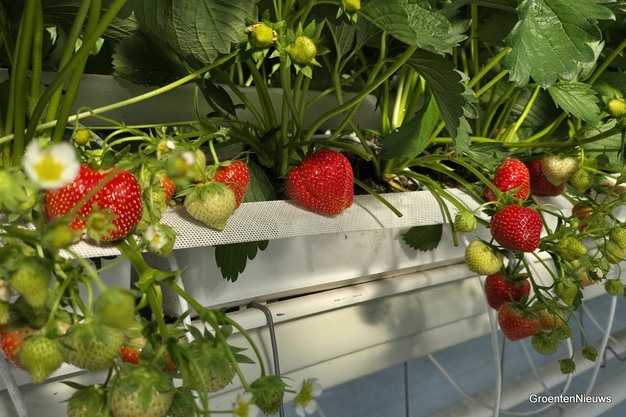
For the implementation at Coöperatie Hoogstraten, the focus was specifically on strawberries, but the company emphasises that the technology can be applied to many other products as well. "When we talk about strawberries, we're not only talking about one of the most delicate and valuable crops, but also one of the most unpredictable," Jonathan points out. "Predictability is the keyword here. In strawberries, we see that production volumes fluctuate significantly from year to year: there are peaks and troughs, and every year is different. Moreover, it is becoming increasingly difficult to make reliable forecasts. Small differences in weather have a big impact on yields. And because strawberries have a short shelf life, it's crucial to have a clear idea of what to expect."
"If you underestimate the yield, you end up with overcapacity and price drops. If you overestimate, you risk empty shelves and lost sales. So it all comes down to predictability. The central question was: what if you could predict the unpredictable? And that's where artificial intelligence and machine learning come in."
AI as a tool
Cynthia adds: "By combining various internal and external data sources, we developed an AI model that can predict overall volumes quite accurately. Suppose you're responsible for commercial planning. Traditionally, you base promotions or target stock levels on last year's figures or on intuition, but weather conditions, crop yields, and market dynamics are constantly changing. An AI system can integrate all that information and update it daily, so that decisions are based on the most current reality. Machine learning uses historical data to recognise patterns and predict the future. The model keeps learning, so accuracy improves continuously."
 © Thijmen Tiersma | FreshPlaza.com
This is how Möbius built the model. "Everything starts with, in this case, time series data. We use historical data such as production volumes, plant varieties, and cultivation methods, but also external sources such as weather data, solar radiation, and temperature. Based on these, we generate hundreds of derived time series, ultimately resulting in more than 500 input variables. You can think of these as 500 clues in a riddle, some obvious, others less so. The model learns which signals are most important and when. To optimise the model, we use genetic algorithms. The system tests strategies, selects the best one, and improves itself with each iteration. The result is a model that predicts with increasing accuracy, until the predicted line almost matches reality."
Weather app, but for business management
"Over time, the model produces forecasts up to seven weeks ahead, which are updated daily with the latest data. You can compare it to a weather app, but for business management," Jonathan continues. "Since April, the system has been running live at Coöperatie Hoogstraten, and the results are promising. Depending on the time frame, the model achieves an accuracy of around 90%. One example: in May, the model predicted a strong production peak. Hoogstraten anticipated this by launching a timely promotion with a major retailer. Thanks to that promotion, they managed to sell 10 times more volume than in a normal week, at a price 50% higher than the average market price. A win-win for both growers and the trade. It shows that artificial intelligence and machine learning can bring real added value to the agricultural sector, both for large-scale and smaller producers."
For more information:
Cynthia Hadinoto / Jonathan Aelterman
Möbius 
+32 9 280 74 20
[email protected]
www.mobius.eu