Banana production worldwide continues to face major losses from Fusarium wilt, caused by Fusarium oxysporum f. sp. cubense (Foc) tropical race 4 (TR4). Management options remain limited, and resistant Cavendish varieties are still unavailable. Increasing evidence suggests that fungal pathogens deliver small RNAs into host cells to suppress plant immune responses through cross-kingdom RNA interference, though the mechanisms behind this process have remained largely unclear.
 © Oxford Academic
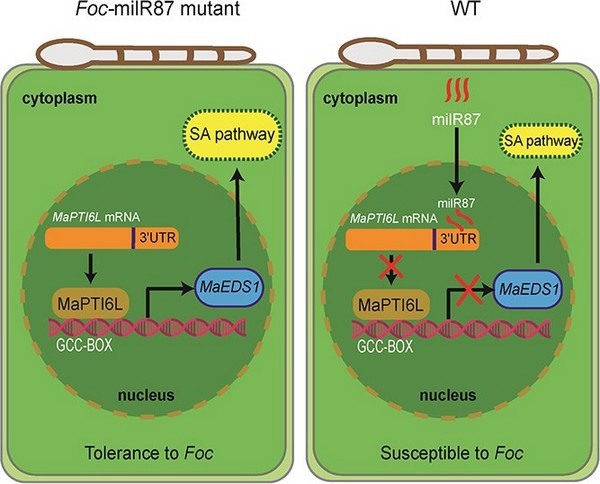
Researchers from the College of Plant Protection at South China Agricultural University have identified how TR4 uses a specific fungal small RNA molecule to suppress banana immunity. The study, published in Horticulture Research (DOI: 10.1093/hr/uhae361) on April 1, 2025, describes how the fungal small RNA Foc-milR87 targets the banana gene MaPTI6L, reducing immune signaling and promoting pathogen virulence.
The research shows that Foc-milR87, produced by F. oxysporum f. sp. cubense, is released during early infection and transferred into banana root cells. Inside the host, it binds to the 3′ untranslated region (3′UTR) of MaPTI6L mRNA, suppressing its translation. The MaPTI6L gene, part of the AP2/ERF transcription factor family, normally activates the salicylic acid (SA) defense pathway by inducing expression of MaEDS1, a key immune regulator. When MaPTI6L was overexpressed in tobacco and Arabidopsis plants, it triggered immune responses such as reactive oxygen species production, callose deposition, and activation of defense-related genes. These effects were reduced when Foc-milR87 was co-expressed, indicating that the fungal RNA disrupts this defense mechanism.
Further analyses revealed that MaPTI6L functions in the plant cell nucleus and that this localization is necessary for activating immunity. Sequence comparisons across 19 banana cultivars showed that resistant varieties contain single-nucleotide polymorphisms (SNPs) in the Foc-milR87 binding site, decreasing the pathogen RNA's silencing efficiency. Plants with this SNP maintained higher MaPTI6L expression and exhibited smaller lesion areas after infection, suggesting a genetic basis for resistance.
The study concludes that Foc-milR87 functions as a virulence effector, using cross-kingdom RNA interference to weaken banana immunity. The identification of resistance-associated SNPs in MaPTI6L provides a potential genetic marker for developing TR4-resistant bananas through breeding or genome editing.
The findings contribute to a broader understanding of how fungal small RNAs manipulate host defenses and may support future research into RNA-based disease resistance strategies for other crops.
To view the full report, click here.
For more information:
Oxford University Press
Tel: +86 (0)10 8515 1678
www.academic.oup.com