In the Pará district, about an hour's drive from Paramaribo, something beautiful is growing, literally. Between secondary rainforest and savanna soils, small-scale indigenous farmers are advancing the cultivation of organic pineapples. Modest production for personal use is expanding into an ambitious commercial project under the wings of the United Nations. "We are not just selling a fruit," says ASTA project coordinator Swami Girdhari. "We are selling a story."
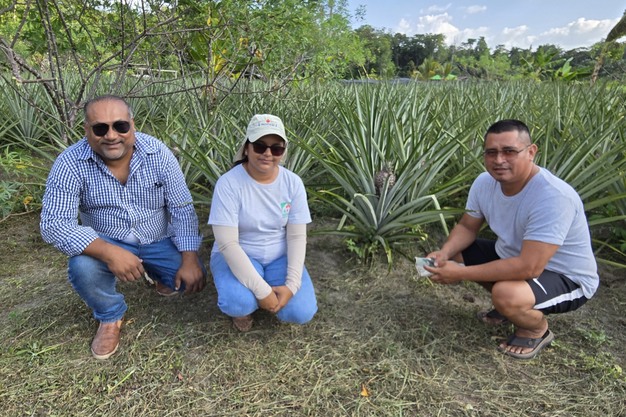 © Pieter Boekhout | FreshPlaza.comSwami Girdhari (project coordinator), Nisha Goeptar (agronomist associated with the project), Cyrell Sabayo (pineapple grower on whose land a test field has been established)
In 2022, the Agrifood Systems Transformation Accelerator (ASTA) project for Suriname was officially launched. This pineapple initiative is supported by the Surinamese government and the UN organizations FAO and UNIDO, and funded with 2.2 million dollars from the UN Joint SDG Fund.
The first step was a detailed analysis of the pineapple value chain in Suriname. It revealed something striking: 95% of cultivation is in the hands of indigenous communities in the Pará district, where fruit has traditionally been grown for personal use for generations. "That traditional craftsmanship is wonderful," says Nisha Goeptar, an agronomist with the project. "But if Suriname wants to be self-sufficient in pineapples and also target exports, the cultivated area and yield per hectare need to increase."
Vision 2030: Ambition in the tropics
Together with the growers, a future plan was outlined: Vision 2030. By that year, the project aims to make Suriname a producer of high-quality, organically grown pineapples and processed pineapple products that meet international standards. The strategy rests on three pillars: the Horticulture Innovation Hub (HIH), a national pineapple cooperative, and the Collateral Financial Facility (CFF).
"The HIH is a kind of knowledge center where we introduce modern but feasible cultivation techniques. Think of the more efficient row planting instead of the traditional staggered pattern, and using the right combination of organic fertilizers," says Swami.
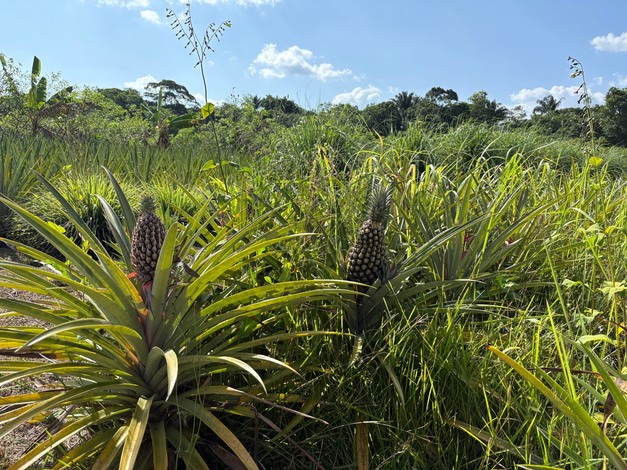
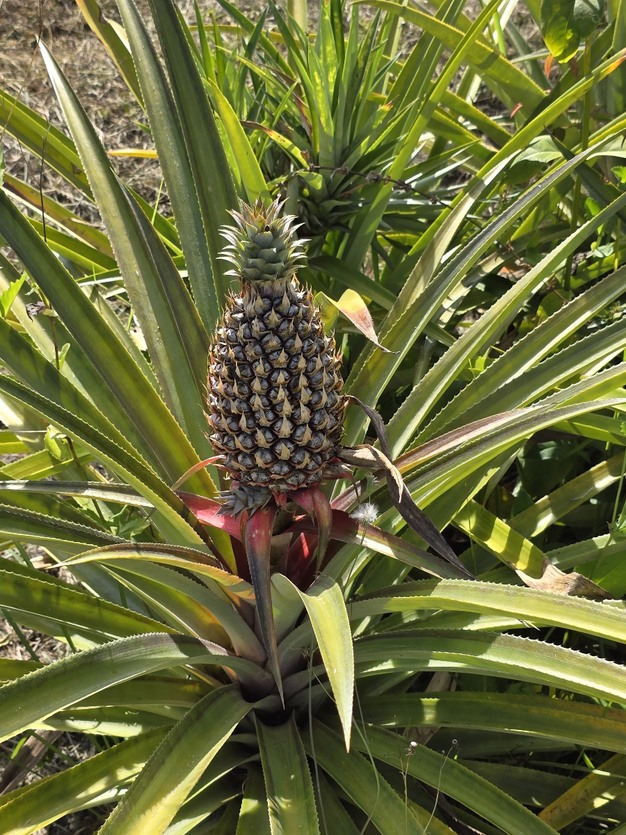 © Pieter Boekhout | FreshPlaza.comThe entire project is strictly organic, at the explicit wish of the indigenous growers and organizations.
"If you want to supply seriously, you also need volume and consistency. That's why a cooperative is being established to bring pineapple growers together and promote cooperation. This enables continuous supply, both for the local market and for potential export to the Caribbean, and who knows, even Europe. We are already dreaming out loud about participating in Fruit Logistica in Berlin."
A major obstacle for many growers is financing. "Because they cultivate on collective lands and therefore do not hold individual property rights, they cannot offer the land as collateral and cannot obtain loans to scale up or professionalize their cultivation," Swami explains. The CFF provides a solution by acting as cash collateral, as long as the grower can demonstrate their commitment and land area. This facility was launched in early October.
 © Pieter Boekhout | FreshPlaza.com
Common sense and science
Currently, various fertilizer combinations are being tested on three trial fields in the country to find the best balance between yield and affordability. "Not everything that is agronomically optimal is also economically viable," Nisha says soberly. "Sometimes you have to choose the suboptimal solution."
Tests are also underway with artificial flower induction. "We apply a substance when the plant is nine months old," Nisha explains. "This forces flower formation, allowing us to harvest outside the natural season. On its own, the flower does not form during the months when the temperature drops."
And successfully so: "On our test fields, it worked 100%. This way, we can deliver pineapples year-round. According to the natural cycle, there are only two harvest periods—from the end of April to the end of July, and again from November to December. Consumers, according to our research, now demand pineapples year-round." Bird and sun protection nets are installed just after flower induction.
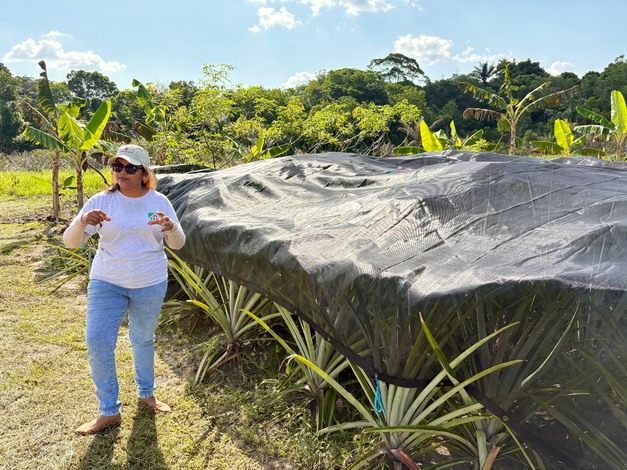 © Pieter Boekhout | FreshPlaza.com Suriname has about 15 local pineapple varieties. Blind taste tests show that these are often found to be more aromatic and tastier than the globally popular MD2 variety
Everything organic — no discussion
The entire project is strictly organic, at the explicit wish of the indigenous growers and organizations. "They have never used chemicals," says Swami. "We want to keep it that way." Therefore, a process has been initiated to obtain both organic and Rainforest Alliance certification—not for the domestic market, where it is not required, but for potential export.
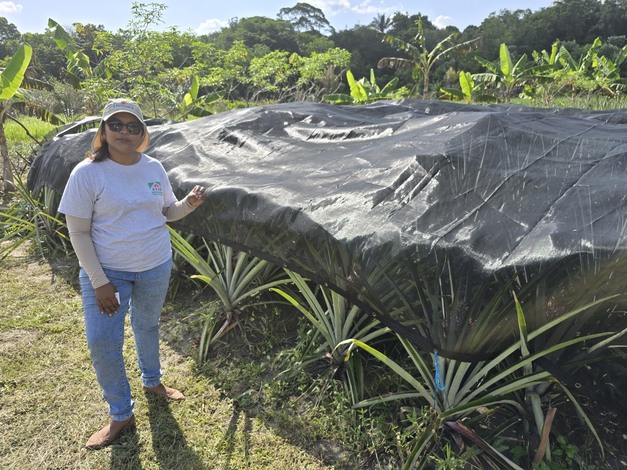
Of course, challenges remain, especially in organic cultivation. "Weeds are a major problem in the tropics," says Nisha. "That's why we want to invest in plastic mulch." Expanding the area requires clearing land. If you leave a plot alone for a few weeks, it becomes overrun, but the agreements are clear: no primary forest may be cut; only secondary forest or overgrown plantation land can be used.
Despite the many small-scale growers, the project hopes to have 200 affiliated growers by 2030, and the goal is a uniform product of 1.2 to 1.4 kilograms per fruit. This will be achieved through centralized control of planting material and strict cultivation guidelines.
 © Pieter Boekhout | FreshPlaza.com
"Weeds are a major problem in the tropics," says Nisha. "That is why we want to invest in plastic mulch."
The conscious consumer
Interestingly, Suriname has about 15 local pineapple varieties. Blind taste tests show that these are often considered more aromatic and flavorful than the globally popular MD2 variety, typically from Costa Rica. Yet, the Surinamese pineapple costs more. "But we don't target the supermarket price," Swami says definitively. "We target the conscious consumer, especially in Europe, someone willing to pay a little more for a product with a story, sustainably grown by indigenous farmers in the Amazon. By scanning a QR code, the consumer will know which grower their pineapple comes from."
For the local market, the hub offers an advantage: The legal resale margin of 25%. "Growers can ask for a little more, while the consumer still pays less than now when ripeners double their price."
Although the focus is currently on fresh pineapples, there are also plans for processing—such as juice, syrup, and dried fruit. Swami notes: "In Europe, you easily pay five euros for 100 grams of dried pineapple. That's added value."
Cautious trust
The biggest challenge, according to Swami, is earning the trust of the growers. "The indigenous communities have received many promises in the past from outsiders that were never fulfilled. That explains their reluctance to join new initiatives. But if you develop the project together, respect their village structures, and show small successes among other farmers, interest naturally grows."
Yet, it's not all smooth sailing. "We're not exactly on schedule," Swami admits. "Due to circumstances beyond our control, we've had some delays. But no harm done. As long as we keep communicating, everything will be fine."
The project currently runs until March 2026. But Swami is clear: "We aim for an extension. We want to move toward certification, value addition, and the independent operation of the three entities, until the farmers and other value chain actors can continue autonomously, and Suriname becomes an important pineapple producer."
For more information:
Swami Girdhari (manager)
Nisha Goeptar (agronomist)
Horticulture Innovation Hub
Margarethalaan 13
Paramaribo (Suriname)
Tel:+597 8876966
[email protected]
www.horticulturehub.org
This special featured:
1. Suriname offers many opportunities: plenty of water, land, sun
2. Photo report at the only two supermarket chains in Paramaribo
3. "The acerola supply cannot keep up with European demand"
4. "There will always be demand for fresh Surinamese vegetables and fruit from the Netherlands"
5. Import in tropical Suriname replaced by local lettuce, peppers, and tomatoes from the greenhouse
6. Export of Surinamese bananas to Europe comes back into view
7. Dutch fruit importer starts large avocado plantation in Suriname
8. From greenhouse dream to knowledge need: Surinamese growers seek a way out of uncertainty
9. Suriname invests in small-scale passion fruit cultivation for export
10. Greater demand than supply leads to modern lettuce cultivation project
If you want to know more about cultivation and trade in Suriname, contact Anilkumar Padarath from the Chamber of Commerce and Factories: [email protected]