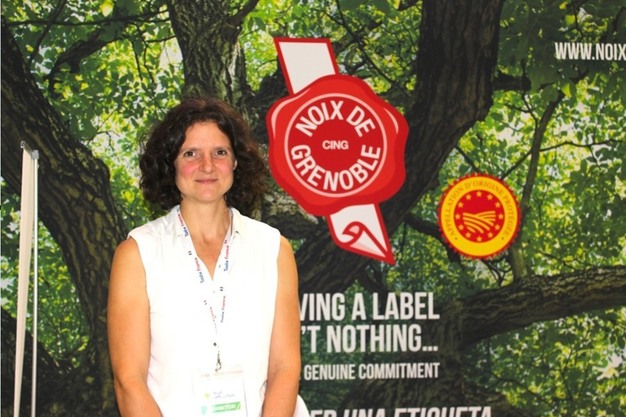
The harvest of the famous Grenoble walnut began on September 23rd. Nathalie Gaillard, coordinator of CING, gives us the first details of the campaign.
"This year will be neither exceptional nor catastrophic"
According to Nathalie Gaillard, "this year will be neither exceptional nor catastrophic. The harvest is likely to be fairly average in terms of volume, at 11,000/12,000 tons (as a reminder, the 2024 harvest was almost back to normal with 10,000 tons after a historically low year in 2023). The lack of water in May/June of this year is likely to result in a majority of small sizes." Quality, on the other hand, seems to be on target. "Some early varieties like the Lara are very pretty, which could be a good indicator for Grenoble walnuts. Feedback from the first harvests is also good, which suggests that there will be little sorting, unlike last year when almost 30% of the crop was discarded."
 © FreshPlaza
"We do not really know what to expect in terms of trade"
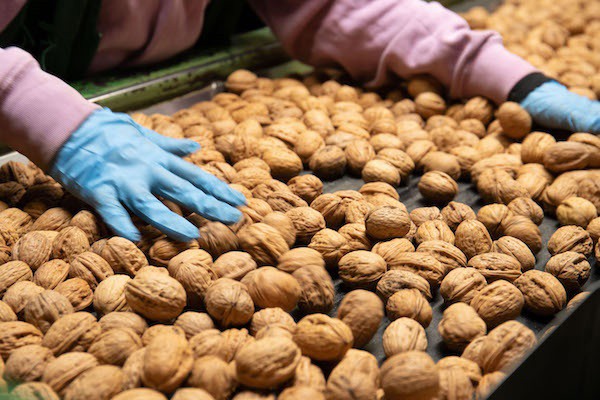
Uncertainty remains in terms of trade. Prices could hold up, but a trade agreement signed this summer between the United States and the European Union could darken the picture. Signed in August, this framework agreement aims to ease tariff tensions between Brussels and Washington, at a time when the United States was threatening to overtax European products. In return, the European Union has undertaken to open up its market to a wide range of American products: nuts, fresh and processed fruit, dairy products, meat (pork, bison), seeds, and soya oil. In concrete terms, these products could enter the European market with customs duties reduced to 0%, compared with 4% currently. Although the text has not yet come into force, it could be applied from next January. "But with a quota of 500,000 tons of American nuts authorized to enter at 0%, this represents an estimated loss of 10 eurocents per kilo [0.12 USD/kg] for French producers," explains Nathalie Gaillard.
 © Ginette
Strong demand for kernels from distributors
Although the Grenoble walnut PDO currently only covers walnuts in shell, CING's desire to focus on kernels remains strong, and the project is still underway. This is all the more important given that 95% of the walnut kernels consumed in France are imported (mainly from Chile, the United States, and Eastern Europe) and that the volume of walnut kernels consumed in France is high, particularly among young people. Walnuts in shell are mainly consumed by consumers over 50 years of age. This trend is in line with the snacking trend, whose market share is multiplying. "Walnuts in shells remain the core of our market, but we realize that we need to diversify and segment the market. In fact, we have very strong demand from our operators and retailers for walnut kernels." Another avenue being explored by CING is the Canadian market, which is also very keen on walnut kernels, with consumption reaching no less than 13,000 tons, compared with 1,000 tons for walnuts in shells.
A 4th variety soon to be added to the Grenoble walnut PDO specifications
Since 1938, the specifications for the Grenoble walnut PDO have accepted only three local varieties: the most famous being the Franquette, accounting for 90% of PDO production, as well as the Mayette and Parisienne varieties. But CING wants to revise the specifications to include the Fernor variety. "Already planted in the region, Fernor is the result of a cross between Franquette and Lara (an American variety). It is said to be more profitable than other varieties. With this in mind, CING submitted an official application to INAO in 2022. The application is still in progress, but this 4th variety should be available by 2027."
 © Ginette
A new communication campaign
For this new campaign, the Grenoble walnut has also chosen to evolve its communication strategy. "We are trying to change our approach," explains Nathalie Gaillard. Until now, CING has mainly communicated at harvest time, when the fresh walnuts were not yet available on the shelves. "The drying and packaging process means that it takes another three weeks for the first nuts to replace the old crop on the shelves." This year, the campaign will therefore be refocused on marketing, with an operation called "New walnuts" to be launched on November 6th. The aim is to let consumers know that the new crop is finally available in the stores. Point-of-sale activities are planned for this date, as well as an event at the Grand Séchoir in Vinay (Isère), the museum dedicated to walnuts.
For more information:
Nathalie Gaillard
CING
[email protected]
www.aoc-noixdegrenoble.com