Aphids attacking lettuce fields in England are displaying regional patterns that could influence pest management strategies for one of the country's major salad crops.
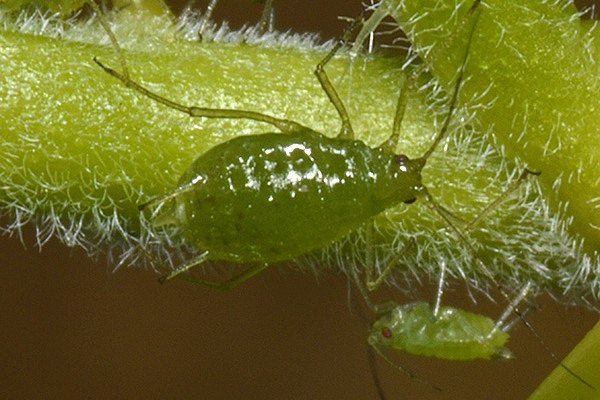
The currant-lettuce aphid, Nasonovia ribisnigri, is a destructive pest of outdoor lettuce. A new analysis, based on data from the Rothamsted National Insect Survey and the University of Warwick Crop Centre, found that aphid populations are divided between the east and west of England. The research, covering nearly two decades of genetic sampling, indicates that the pest's movements are closely tied to lettuce production regions and are less widespread than previously assumed.
 © Plantwise
The study analysed insects collected from ten monitoring sites between 2003 and 2020. Results showed that aphids migrate from the west into eastern lettuce fields but rarely move in the opposite direction. Researchers link the pattern to the insect's reliance on blackcurrant and related Ribes plants as its winter host, with lettuce as the main summer host.
Traditional measures against the pest, including resistant lettuce varieties, have weakened in recent years, leaving growers with fewer options for control. Despite this, N. ribisnigri populations have remained stable, even under conditions of rising temperatures and variable weather that support their spread.
Dr Dion Garrett, who led the study, noted that the insects are highly inbred and reproduce largely in seasonal cycles, which may account for their persistence. "The clear geographic divide we see has major implications for how we monitor and control N. ribisnigri," Garrett said, pointing to the need for region-specific approaches in managing lettuce crops.
With lettuce production representing a substantial part of the UK fresh produce sector, the findings underline the importance of adapting pest management strategies to regional differences in aphid movement and host availability.
 © PlantwiseFor more information:
Rothamsted Research
Tel: +44 (0) 1582 763 133
Email: [email protected]
www.rothamsted.ac.uk