"What consumers want is strongly reflected in international trade flows," said Anouk Sijmonsma of the International Fresh Produce Association (IFPA) during her presentation at the International Strawberry Congress. Using three regions- the US, Germany, and South America- she illustrated how health and sustainability drive premium pricing and where opportunities still exist.
"The global import market for strawberries is worth $4.4 billion and is growing at 7% annually, faster than the overall food industry," Anouk explained. "This growth is driven by rising awareness around health: 75% of consumers see fruits and vegetables as essential for a healthy lifestyle. This translates into a high willingness to pay, especially in Asia, where consumers sometimes pay three times the global average price."
 © Jannick Flach | FreshPlaza.com
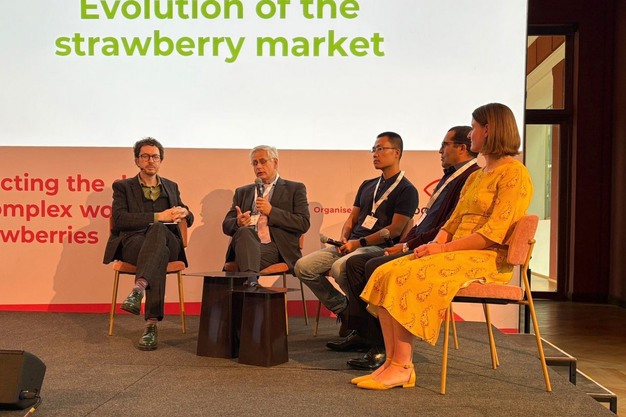
Moderator Michael Barker in conversation with, among others, Anouk Sijmonsma (right) on trends and developments in the labour market
United States: Health and convenience lead the market
To show where the opportunities lie, Anouk presented three case studies. "With an import value of $1.2 billion, the US is the largest strawberry market in the world. Mexico supplies as much as 97% of those imports, meaning there is a heavy reliance on one supplier. However, the growth is not coming from volume but from added value. Consumers prefer fresh fruit over processed, and 40% actively seek ready-to-eat or 'fresh-cut' products. Health and convenience are at the core of their buying behaviour.
Small suppliers demonstrate that quality pays off: Canada receives a 23% higher price per tonne than Mexico, while Japan and South Korea achieve more than $11,000 per tonne, almost three times the global average. Producers focusing on quality, health, and convenience in the US can therefore realise higher margins than those competing only on volume."
Germany: Sustainability sets the price
German consumers show the strongest preference worldwide for local and sustainable products, Anouk pointed out. "Eighty per cent are willing to pay more for local produce, and this attitude is clearly reflected in trade data. Spain supplies 56% of German imports, but at a low price of $3,300 per tonne. The Netherlands, which focuses on sustainability and short supply chains, achieves a 45% price premium. Greece is also growing rapidly as a supplier, with annual growth of 28%."
"In Germany, sustainability and transparency are not marketing options but market requirements. Suppliers who live up to these values are rewarded with structurally higher prices."
South America: Untapped counter-seasonal potential
In South America, particularly Brazil and Peru, domestic demand for healthy and organic products is exceptionally strong, Anouk noted. "Ninety per cent of Brazilians see fruit and vegetables as essential for a healthy lifestyle. Eighty-nine per cent are willing to pay more for organic produce, the highest percentage in the world."
"Yet exports from the region remain minimal: Peru exports only $850,000 worth of strawberries, and Brazil just $160,000. Strong domestic consumption limits export capacity. This presents an opportunity. The South American harvest season (November–March) coincides with the low-production period in the northern hemisphere, making it ideal for counter-seasonal exports. With investment in export logistics and certification, South America could benefit from high winter prices in markets such as the US and Germany."
Taking advantage of growing strawberry market
"Demographically, we see the same patterns everywhere: young people aged 18–24 eat the most berries, and women buy them more frequently than men. This group is the structural growth engine of the market. In short, consumer preferences not only drive trends but also represent direct and profitable trade opportunities. Those who understand and position themselves accordingly can profit in the fast-growing strawberry market."
For more information:
Anouk Sijmonsma
IFPA
www.freshproduce.com