That remark from Halil Beskardesler, Co-Founder of Plant Factory in Turkey, set the tone for the second day of the Vertical Farming World Congress in Amsterdam. While day one centered on the industry's challenges, day two focused on solutions, new models, and creative approaches that connect vertical farming to society, technology, and other industries.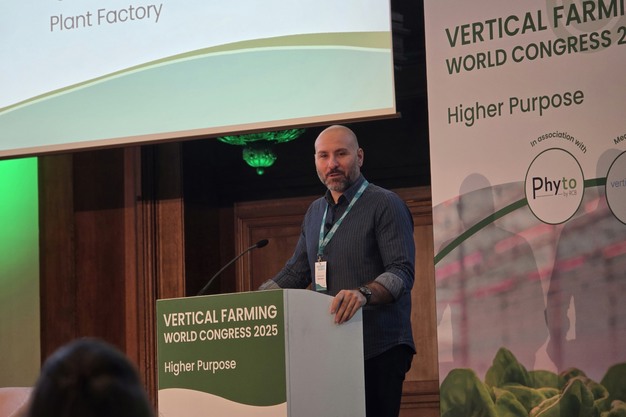 © Rebekka Boekhout | FreshPlaza.com
Halil Beskardesler, Co-Founder of Plant Factory
Retail, risk, and accessibility
Chris Davies, CEO of Harvest London, opened the morning session on retail partnerships by sharing insights into the company's different farm models across the London area, including its newest project at Corner Corner.
"When selling to retail, challenges are inevitable," Beskardesler said during his presentation. "Retailers have strict packaging demands, a wide variety of crops, and each store requires individual optimization."
Plant Factory is currently supplying eight stores, each with tailored assortments and logistics models. Beskardesler highlighted the financial and operational realities of vertical farming. For them, vertical farming is only 50% of the work. "The other half is selling and marketing," he said, explaining that average harvest and sorting losses can reach 20%, with an additional 5% unsold and 10% returned produce, significant figures that stress the need for cost optimization. "We sell 60% to HoReCa and 40% to retail. Retail has higher margins, but only if you manage your costs strategically. We want vertical farming to be accessible to everyone, not just high-income households."
Endre Harnes, Chief Commercial Officer of Avisomo, stressed that we should view retailers as clients, noting that they will play a crucial role in future expansion. "Vertical farms, ideally, could be co-located at their distribution centers. That would give them full control of their supply chain and help them achieve real efficiency." Avisomo and Coop will launch produce from their new facility by Christmas.
Both Plant Factory and Harvest London have adopted a more public approach to farming, allowing visitors to experience their farms firsthand. "Corner Corner is not just a production site," Davies said. "It's a space where people can interact with vertical farming and see what we're doing." Others, like Avisomo, have chosen a different route, focusing on closed, large-scale facilities through joint ventures. Both models, they agree, have their advantages: visibility and education versus scale and mass production.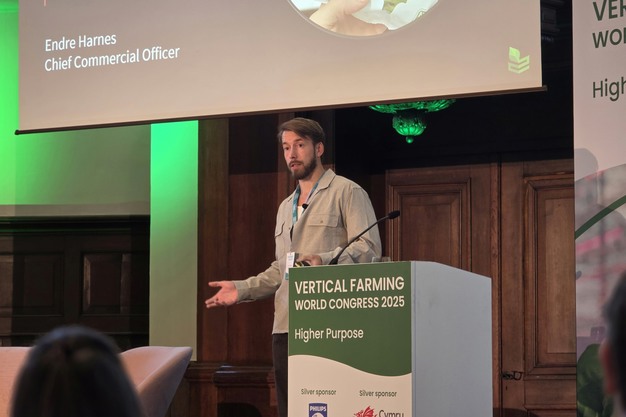 © Rebekka Boekhout | FreshPlaza.com
Endre Harnes, Chief Commercial Officer of Avisomo
Spinach and -ponics
A favorable crop today was spinach. Dr. Celine Nicole of Maastricht University presented research on hydroponically grown spinach, known as a difficult crop for vertical farming. "It's not the easiest relationship," she joked, "but AI helped us make it work." Her team tackled common issues like germination, bolting, fusarium, and irrigation sensitivity. By using AI to monitor irrigation data, they detected irregularities in plant growth and used that information to predict yield and improve performance.
Coincidentally, LettUs Grow had been working on spinach cultivators across the pond, with their Aeroponic Rolling Benches. Jack Farmer, Chief Scientific Officer and Co-Founder of the company, shared his findings that showcased no diseases in the crops when using aeroponics, due to more robust and condensed root growth.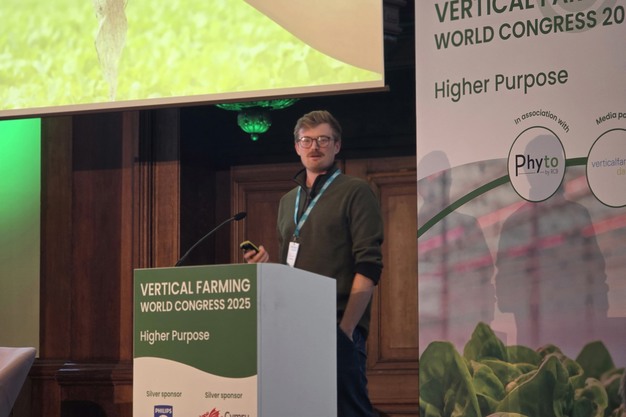 © Rebekka Boekhout | FreshPlaza.com
Jack Farmer, Chief Scientific Officer and Co-Founder of LettUs Grow
Is hybrid going to make it work?
Jean-Pierre Coene, CEO of Urban Crop Solutions, presented results from their Agrotopia hybrid system, which merges natural and artificial light. "We only use artificial light when the plant actually needs it," he said. With their 10-meter-high rotating system, each plant receives even exposure to light, leading to strong, uniform growth. "We can reduce energy costs by 60-70% compared to fully vertical systems."
Whether through the use of AI, hybrid systems, co-location with other industries, or creative retail models, the sector is actively moving forward. As Beskardesler put it best, the light at the end of the tunnel might just be sunshine after all.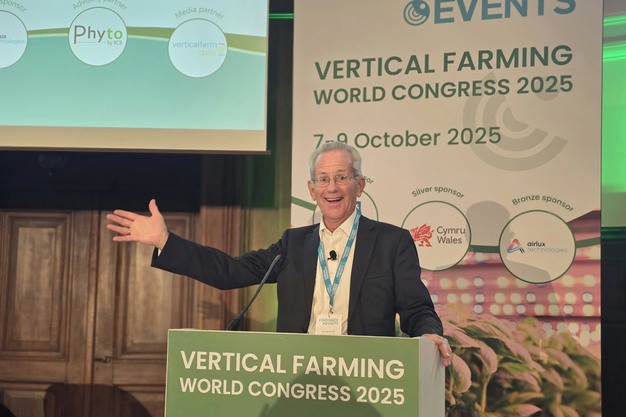 © Rebekka Boekhout | FreshPlaza.com
Richard Hall, organizer of the Vertical Farming World Congress, looking as sprightly as ever
For more information:
Foodbev Media
[email protected]
www.foodbevevents.com