A 1.5-hectare smart greenhouse dedicated to strawberry production has been launched in Uzbekistan's Yukorichirchik district, representing a targeted effort to modernise underutilised greenhouse assets. Developed by a Korean smart farm company, the project is based on the conversion of an idle facility, aligning with a broader strategy to reduce capital expenditure while accelerating deployment.
Approximately 75,000 plants of the Korean-bred variety (Permit1943) have been established, with production focused on export markets including Russia and Kazakhstan. The variety is selected for its firmness, uniform fruit size, and suitability for long-distance transport.
 © Firmmit
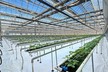
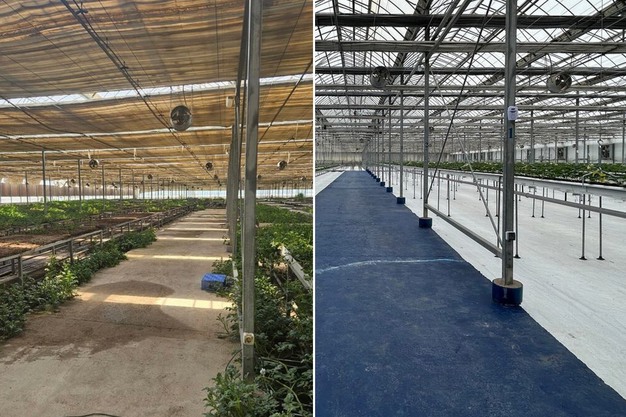
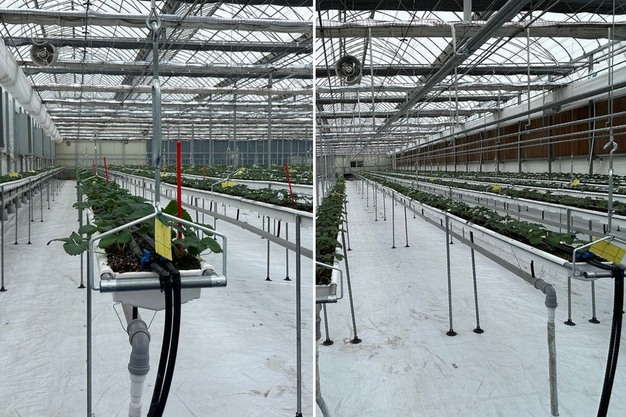
Greenhouse interior: left side is still in idle state, right side is after remodeling
Hydroponic cultivation for uniform quality
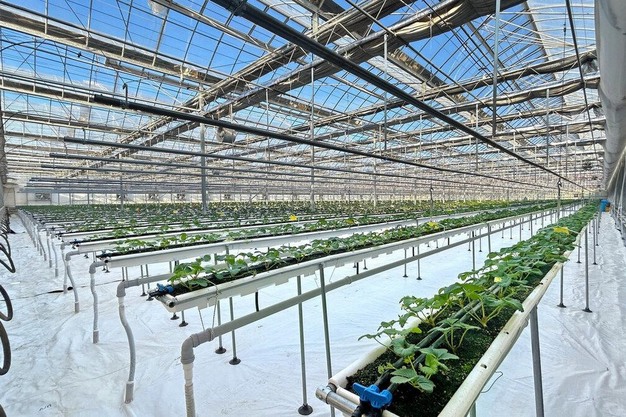
Hydroponics forms the technical foundation of the greenhouse system, enabling precise control over plant nutrition and irrigation. The system uses coco peat substrate and drip irrigation to deliver water and nutrients directly to the root zone.
According to Sun Kee Park, CEO of Firmmit, "With hydroponics, uniform flavour and berry size are achieved through balanced plant nutrition. Water and fertiliser volumes are fully controlled, and the process is managed centrally via software."
This approach eliminates soil-borne diseases and mitigates challenges related to salinity and inconsistent field conditions, which are common constraints in the region.
 © Firmmit
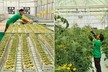
Cultivation bed system replacement and nutrient supply system & transplanting completed
Integrated ICT and AI-based crop management
The greenhouse is operated using a proprietary ICT platform, integrating a network of IoT sensors that continuously monitor environmental and substrate conditions. Parameters such as temperature, humidity, CO₂ concentration, and light intensity are tracked in real time.
"All environmental and nutrient data are integrated into a single platform, enabling remote monitoring and control from Korea," he explains.
At the core of this system is FINO (Firmmit Intelligent Nutrient Optimizer), an AI-based nutrient management program. It calculates precise fertigation strategies based on local water quality and solar radiation, ensuring that nutrient delivery is dynamically adjusted throughout the crop cycle.
"We redesigned the entire nutrient framework to reflect Uzbekistan's water chemistry and solar conditions, ensuring stable crop performance from the first season," Sun Kee Park adds.
 © Firmmit
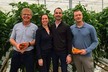
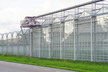
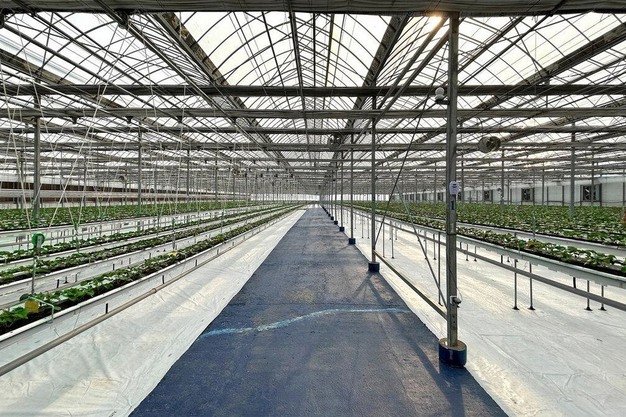
AKIS Smart Farm glass greenhouse interior
First-season performance and yield outlook
Despite delays that shortened the initial production window, the greenhouse produced approximately 30,000 kg of strawberries, generating $476,744 in revenue and achieving a gross margin of 76.4%.
Under full-season conditions, production is projected to reach 90,000–112,500 kg, with yields of 1.2–1.5 kg per plant.
Fruit quality remained consistent throughout the first season, with firmness ranging from 15.5 to 16.8 g/mm² and Brix levels between 11.5 and 13.0. Marketable yield reached up to 83%, meeting the requirements of premium retail channels.
"Consistency is not just a quality metric but a prerequisite for entering structured retail supply chains in Russia and Kazakhstan," he notes.
 © Firmmit
Permit1943 hydroponic cultivation system
Uzbekistan as an emerging export centre
Uzbekistan's climatic and geographic conditions provide a competitive advantage for greenhouse production. With over 2,700 hours of annual sunshine, high sugar content can be achieved without supplemental lighting, reducing energy requirements.
The country's location also supports efficient access to regional markets. A recent partnership with Uzagrostar Xolding is aimed at expanding production capacity and establishing cold chain logistics.
"Our objective is to position Uzbekistan as a central hub for premium strawberry exports, supported by consistent quality, advanced technology, and efficient logistics."
 © Firmmit
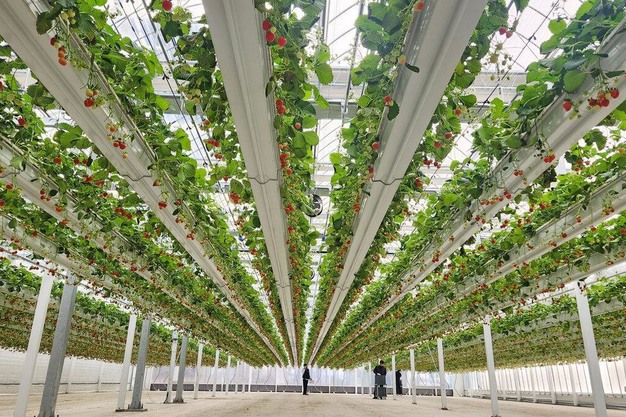
Yangpyeong Smart Agriculture Center — Permit1943 in elevated hydroponic greenhouse
Future optimisation, expansion and vertical farming integration
Future plans include aligning production cycles with peak market windows and expanding nursery operations to ensure timely planting. Additional improvements in logistics and postharvest handling are also expected to enhance export performance.
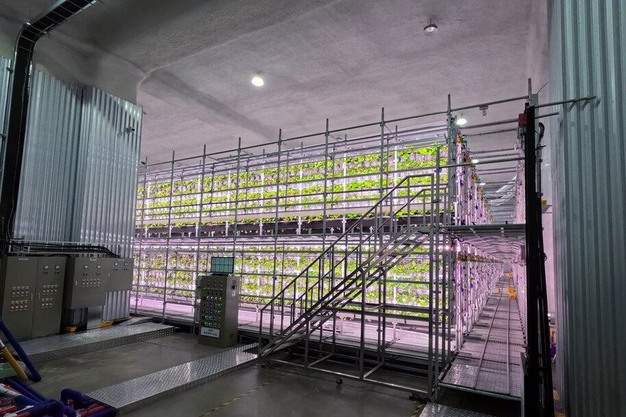
Alongside its greenhouse operations in Uzbekistan, the company continues to develop vertical farming systems in South Korea, where a multi-tier indoor facility is used as a technology validation and year-round production hub.
 © Firmmit
Korean 330㎡ plant factory — 10-tier vertical cultivation
"Our vertical farm in Korea functions as a testing platform where we validate nutrient strategies and environmental controls before applying them to international greenhouse operations."
 © Firmmit
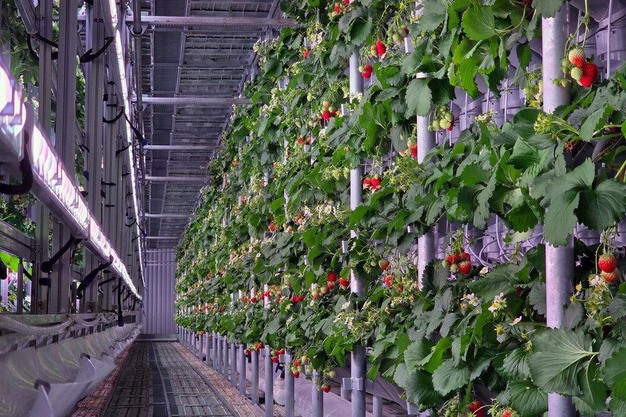
One of their multi-tier strawberry cultivation projects
He added, "The integration of data from both controlled indoor farms and natural-light greenhouses allows us to continuously optimise production models across different climates."
For more information:
Firmmit
Yunsun Lee, International Business Division
[email protected]
www.firmmit.kr