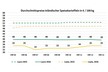
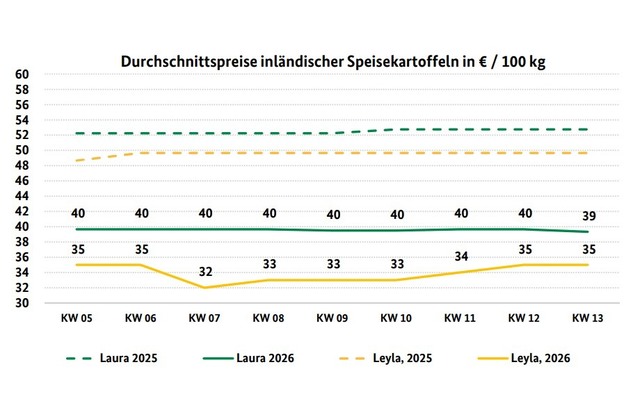
The increased availability of asparagus slightly accelerated the turnover of early table potatoes. These came primarily from Italy and Cyprus, with imports from Egypt and Morocco supplementing the range. According to the German BLE, prices generally remained at previous levels.
 © BLE
© BLE
This was also observed for storage potatoes. These continued to come predominantly from Germany, with a few French loads rounding out the supply. Business proceeded smoothly across the board, and demand was met without difficulty.
Bavaria:
At the start of the week, sales in food retail/discount stores were assessed differently by the packing companies. In some cases, a seasonal uptick was reported ahead of the upcoming Easter holidays; in others, sales remained subdued and fell short of expectations. With stock levels still more than sufficient, prices for table potatoes remained unchanged. There was still virtually no market for loose French fry raw material, so prices also remained unchanged. With a view to the upcoming planting season, there are increasing calls to align decisions on cultivation areas as closely as possible with sales opportunities.
North Rhine-Westphalia:
In the table potato market, additional demand is expected this week due to Easter sales. Direct marketing should also benefit from this. In North Rhine-Westphalia, retailers are still specifying demand for contract farming for deliveries from August through the end of October.
Lower Saxony:
The potato market remained largely quiet in week 13 as well, although demand picked up slightly in the run-up to Easter. At the same time, supply remained sufficient and did not decline in tandem with the moderate rise in demand, so there were no price changes.
Schleswig-Holstein:
The situation in the potato trade remains dire. Producers are still sitting on enormous stockpiles, while the first imported early potatoes are already finding their way onto grocery store shelves. Consequently, only flawless-quality potatoes can still be sold to retailers. Even with minor quality defects, the potatoes usually end up as animal feed or in biogas plants. So far, only a very slight increase in consumer demand due to Easter has been observed. One exception in this country, however, is demand from commercial kitchens and cafeterias in vacation regions. Here, the start of the Easter break is accompanied by a significant increase in demand. In some areas of the country, planting of early potatoes has already begun.
Rhineland-Palatinate:
Demand in the potato market has picked up somewhat in the run-up to Easter, but the prevailing supply pressure has hardly eased. Early potato planting is now complete. Since some crops are already about to emerge and further frosty nights are expected, frost irrigation is a concern. Meanwhile, processed goods continue to face pressure from rising energy and transportation expenses.
Brandenburg/Berlin:
According to the statistics office, some food items in Brandenburg and Berlin are currently significantly cheaper than a year ago. This includes potatoes, which are 12.7 percent cheaper in Berlin and as much as 21.3 percent cheaper in Brandenburg.
Hesse:
In the state of Hesse, there have been no significant price changes compared to the previous week.
Saxony:
In Saxony, too, there have been no significant price changes compared to the previous week. "Prices are currently so low that some German farmers are feeding their grain or potatoes into biogas plants. Polish colleagues are even selling their grain, which was produced for human consumption, just to make any money at all. You don't even know what to grow anymore. The proceeds don't cover the costs. Actually, it's pure suicide to grow crops. We only do it anymore because we need the straw for the animals," says Patrick Rückert, managing director of the Großdrebnitz Agricultural Company.