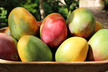
The U.S. mango market is entering its annual transition period, with supply gradually shifting from Peru to Mexico. While Peruvian mangoes are still present in the market, shipments are tapering off as the South American country approaches the end of its export season, leaving Mexico to take over as the dominant supplier in the weeks ahead.
 © Ten Acre Marketing"Peru still plays a role in the market right now, but the volumes are definitely declining," says Alejandro Guerrero, Grower Relations Manager for Continental Fresh. "At this point in the season, the transition toward Mexican fruit is already underway."
Peru's mango exports to the United States typically peak between December and February before gradually winding down through late March. Other offshore suppliers—such as Guatemala, Nicaragua, and Costa Rica—are also beginning shipments, although their total volumes are significantly lighter than Peru's. Peru's overall mango volume this season is expected to finish more than 25 percent lower than the previous season. It is important note that Peru's 21M cases for this season are more in line with a reasonable harvest compared to last season's record-breaking bumper crop of 29M.
Mango varieties
Currently, the earliest Mexican mango harvests are taking place in the southern growing regions. These areas are known primarily for Ataulfo mangoes, which are among the first varieties of the Mexican season to reach U.S. shelves. However, volumes of red Tommy Atkins mangoes have already been available for several weeks and continue to build. As the spring season progresses, additional mango varieties will begin arriving in greater numbers. Tommy Atkins volumes will increase first, followed later by varieties such as Kent and Keitt. Early shipments are reporting good quality, which typically improves as the season advances.
"As the season gets going, it always starts in the south," Guerrero explains. "Right now, we're seeing fruit coming out of Chiapas and Oaxaca, and over the next several weeks other growing regions will begin harvesting as well."
 © Ten Acre Marketing
Delayed start Michoacán
As of the week ending March 7th, Mexico had exported more than 5.2 million cases to the U.S. market, compared to 3.8 million cases at the same time in 2025. While supplies out of Oaxaca have been strong, production in Michoacán has been significantly delayed and is not expected to ramp up until April.
Production will gradually expand into additional states including Michoacán, Guerrero, Nayarit, Jalisco, and eventually Sinaloa later in the season. Many regions are showing signs of delayed starts, and it remains uncertain whether the staggered harvest across Mexico will provide a steady flow of mangoes into the U.S. market or create supply gaps later in the season.
The industry also experienced a moment of concern several weeks ago when inspections by the United States Department of Agriculture were temporarily suspended. Although inspections resumed quickly, the situation created uncertainty throughout the mango supply chain. Additional safeguards are now being implemented by Mexican security officials to help ensure the safety of USDA inspectors and maintain the continued flow of product to the U.S. market.
Competitive pricing
Looking ahead, mango volumes entering the United States are expected to rise as the Mexican season gains momentum. For retailers, this could present the first strong promotional opportunities in months. Offshore pricing has remained elevated since September 2025 due to tariffs and reduced supply.
 © Ten Acre Marketing"We are encouraging retailers to ask us about promotional pricing for March, April, and beyond," said Robert Cabili, Vice President of Sales for Continental Fresh. "These coming months should give retailers an opportunity to make up for lost sales and strengthen their produce category performance."
Pricing is the most competitive that it has been in months. As of March 9th, prices were hovering in the range of $6.00-$7.00 FOB TX for sizes 6/7/8 and $7.00-8.00 FOB TX for sizes 9/10/12.
Water For All
Continental Fresh continues to differentiate itself in the mango category through its Water For All™ program, a corporate social responsibility initiative that connects mango sales directly to clean water projects in underserved communities. Through the program, a portion of mango sales helps fund sustainable water systems for communities that lack reliable access to safe drinking water. Each Water For All labeled mango provides retailers with a unique opportunity to share a meaningful story with shoppers—connecting everyday produce purchases to life-changing impact. "Our goal has always been to do more than just sell fruit," Cabili explains. "With Water For All, retailers can offer consumers a product that not only tastes great but also helps provide clean water to communities that need it most."
 For more information:
Continental Fresh
Alejandro Guerrero
Director of Grower Relations
[email protected]
Robert Cabili
Vice President of Sales
[email protected]
www.continentalfresh.com