"We don't consider ourselves just a vertical farming company. We want to produce 'world-class' fruit in India, and we will use any technology to achieve that," says Harish Varadharajan, co-founder of Fragaria Fruits, a premium fruit producer with a pilot facility in Chennai, India, and plans to expand into Bangalore next.
Before co-founding Fragaria Fruits in 2024, Harish worked at Pure Harvest Smart Farms in Dubai for two years, then at SMARTKAS for roughly a year. While both markets have a strong appetite for CEA-grown strawberries, Harish and his co-founders, Timothy Chad van Niekerk and Damian Lopez Salazar, joined forces to tackle the Indian market, form Fragaria Fruits, and launch their premium fruit brand Oh! Fruits. © FragariaThe co-founders of Fragaria
"The quality of fruits is quite low in India, so we want to develop a fruit brand that develops high-quality fruits that deliver high quality all year round for the Indian market," says Harish. "For strawberries, we believe that vertical farming is the best technology. For blueberries and raspberries, we can use polyhouses."
Following a successful pilot farm in Chennai, Fragaria Fruits raised $2 million US in seed funding to officially launch commercial strawberry production, while also piloting blueberry and raspberry production. The company aims to produce 120 kg of premium strawberries with its expansion to Bangalore.
"Groceries want a consistent supply of strawberries, but we don't currently have year-round production in India due to significant cloud cover in the winter, extreme heat during the summer, as well as a lack of local knowledge (except a few pockets) on growing strawberries," says Harish.
As a result, prices can range from 6 EUR/kg during peak season and 10-20 EUR/kg during off-season. From a quality perspective, the Brix is reportedly only above 8 during one month of the three-month season. This means that Indian consumers currently only have access to high-quality, sweet, and locally grown berries for one month in the year. Through vertical farming, Fragaria is aiming to provide locally grown strawberries year-round, with a Brix of 10-11 and a minimum shelf life of 7-10 days.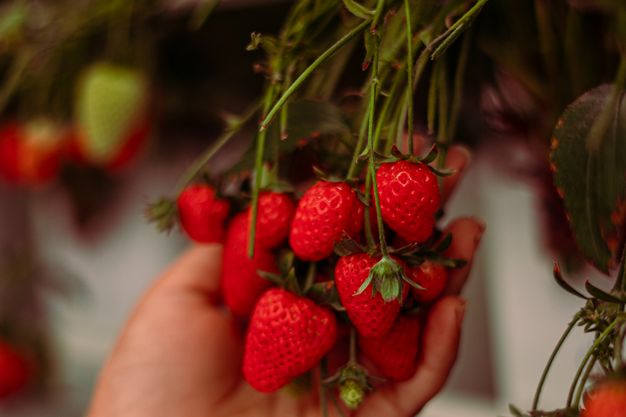 © Fragaria
Prioritizing production mastery over direct sales
According to Harish, Fragaria Fruits is mainly focusing on supermarkets and certain existing "quick commerce" platforms. Although they would be able to sell the berries at a higher price if doing direct sales, the cost of implementing a direct sales model may outweigh the benefits and slow the company's growth.
"At Fragaria, we want to expand quickly and focus on growing, not on supply chains and other such things. We know how to grow, and supermarkets know how to handle and sell our product," says Harish.
 © Fragaria
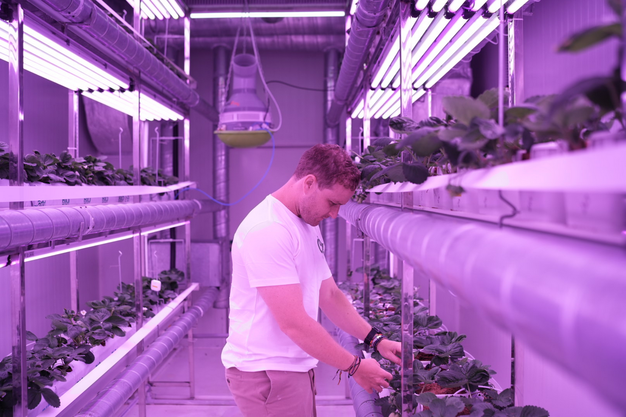
With a production area of 16.000 square feet (1486m2) on four levels and 20.000 plants, Fragaria Fruits is targeting 2.0-2.5 kg/plant/year. Its top-performing everbearing varieties, Sweet Sensation and Fandango, produced 500-700 grams per plant in their pilot facility, which, with 4-5 cycles per year, brings Fragaria Fruits to its target production level. The company reduces the cycle time in its facility by only bringing the plants into the facility at the beginning of the flowering stage.
By surrounding itself with partners like EMCO CAL, Fresh Forward, Mattivi Group, and Limgroup, Fragaria Fruits has tested multiple varieties in its pilot facility and hopes to show consumers that there is more to strawberries than just a sweet flavor. June-bearing varieties are performing well, but the company is also looking for an everbearer strawberry consultant, preferably Dutch, to visit every six weeks and help Fragaria get the most out of its everbearer varieties. © FragariaThe Oh! brand
Overcoming challenges for rapid expansion
The biggest challenges for production, according to Harish, are import regulations for plant material, followed by pollination, which is currently done manually due to restrictions on bumblebee import and the low efficacy of stingless bees. Educating consumers and accessing other agricultural inputs are also challenges that Fragaria Fruits is facing as it prepares its roadmap for expansion.
With the construction of its polyhouses nearly complete, Fragaria Fruits will be planting its first blueberry and raspberry plants in April 2026. The company will focus on these three small fruit crops, but hopes to explore grapes and mangoes in the coming years.
"At Fragaria, we plan to have four farms across four regions of India with each farm producing 20.000 kg/day and providing a variety of premium fruit to the nearest big cities," Harish explains.
 © Fragaria
For more information:
Fragaria Fruits
Harish Varadharajan, Co-Founder
+91 97899 11140
[email protected]
www.thefragaria.com