Summer pruning is wrapping up on early cultivar stone fruit orchards, soon to start shedding leaves, on Groundstone Farm, in Zebediela, Limpopo Province: these orchards ran a great race this season.
"For some two weeks or so, we were one of the few people up in Limpopo province already sending stock onto onto retailers' shelves before many of the early growers," says Dibesho Serage. "It was the first time in a long time that we were so early, usually we start picking by the first week of October. We started picking good volumes for Woolworths at the end of September already."
The rainfall, too, was of an unusual pattern. "We had rains since early last year. The rain persisted all the way into autumn. Around about April, the rains were stopping, which was a bit unusual because in our area, around about now, the rains are gone. And then as soon as the trees broke from dormancy - we were approaching spring around September - rains began again. So we had quite sufficient rains, especially in the seasons that ordinarily we would not have rain over the years."
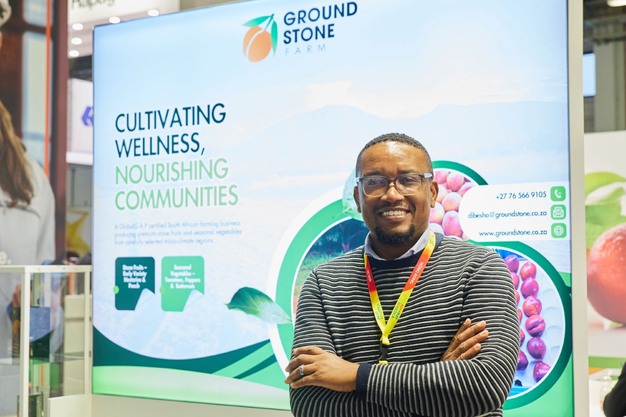 © Dibesho Serage Dibesho Serage of Groundstone Farm
Ongoing farm trials with low chill varieties
Apart from supplying Woolworths, the Groundstone Farm stone fruit go to the two large municipal markets in Gauteng, as well as to the Freshlinq market in Polokwane.
By the middle of December, they are done. "That is pretty much when about 90% of the stone fruit producers who are based in the Western Cape are coming into production."
Only low-chill nectarines and peaches, the dessert type and yellow cling peaches, and he's keeping it that simple, he says. "We paid significant school fees with regards to nectarines and peaches, so we want to keep it there. My intention is that whatever we spent years learning and mastering, we are going to just increase volume on that. We are trialling some stone nectarine cultivars that are low-chill already in our farm and we can see that they are doing well."
Significant expansion will most likely be slow where he's farming now, land which he leases from the Ndebele Tribal Authority; many financial institutions won't underwrite investment in tribal land because they have no security, and also because other community members, most of whom own cattle, also have usage claim to the holdings.
The size to be a commercially viable exporting stone fruit farm is about 40 to 50 hectares. That's where he'd like to be, he says, perhaps in the successful stone fruit area around Mookgophong which, moreover, lies midway between Groundstone Farm and OR Tambo international airport.
For more information: Dibesho Serage
Groundstone Farm
Tel: +27 76 566 9105
Email: [email protected]