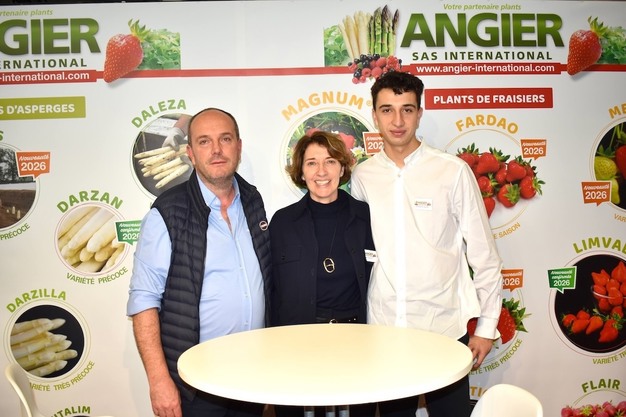
For 55 years, the family-owned company Angier International has been dedicated to finding the right solution for every grower, every region, and every market. Specialising in the production of strawberry and asparagus plants, the company has built a unique position within the French industry: that of an independent nursery that does not run its own breeding programme, allowing it to offer a particularly broad portfolio of varieties. "Our hallmark is this varietal diversity. We can provide the right solution for a grower in Nice just as easily as for one in Lille, and this applies to farms of all sizes. With us, a grower is a grower," explains Frédéric Angier, director of the company that bears his name.
 © Aurélie Pintat | FreshPlaza.com
Claiming independence in the service of varietal choice
Unlike many players tied to a single genetic programme, Angier has deliberately chosen not to operate as a plant breeder. "We did in the past, but we stopped breeding and now collaborate with several selection programmes, both French and international." This positioning allows the company to offer genetics from French, Italian, British, and Dutch programmes. "Our role is then to develop and propose the varieties that best match the needs of our customers."
In strawberries, this diversity is particularly pronounced. It enables the company to address a wide range of market segments, including earliness, yield, flavour quality, suitability for soilless cultivation, and very different soil and climatic conditions. "We offer a portfolio that can adapt to highly diverse environments. That's our strength."
In asparagus, the situation is more uniform. "In Europe, we work with programmes where the genetics are relatively similar. Asparagus is a crop with a much longer cycle than strawberries. Growers cannot change varieties every year, which naturally limits diversity. That said, hybrids have evolved significantly, and the value of asparagus has increased considerably."
A family business with an international outlook
While the company remains firmly rooted in a human-scale structure and continues to prioritise the domestic market, its reach extends well beyond France. Of the 50 million strawberry plants and 6 million asparagus plants sold each year, around 25% are exported. "This is quite distinctive for a French company. Very few players export at this level," emphasises Frédéric Angier. Europe is the main destination, but the company also works with several Central African countries, French overseas territories, and South Korea, either regularly or depending on opportunities.
Production relies on 80 hectares dedicated to strawberry plants—both in-ground and above-ground—and 35 hectares for asparagus crowns. The facilities are designed to serve diverse markets while preserving the company's family identity. "Our name is on the company. We're not a multinational, and we want to maintain close relationships with our customers as a key point of differentiation from large global corporations."
The evolution of strawberries: from bare-root plants to plants with built-in potential
The strawberry sector has undergone a profound transformation over the past three decades. "Thirty years ago, we mainly worked with bare-root plants for open-field cultivation. Today, the reduction (or even disappearance) of open-field production and the expansion of soilless systems have completely changed the landscape." Soilless cultivation requires plug plants whose productive potential is already developed in the nursery. "In the past, growers would complete part of the process themselves. Today, the plant's potential is largely built in-house. Quality requirements are therefore much higher."
Productivity, uniformity, plant health, and strict delivery schedules: expectations have intensified. "From order to delivery, everything must be perfectly controlled. We have to supply plants that meet increasingly strict phytosanitary regulations while also fulfilling growers' expectations in terms of productivity and quality."
At the same time, the number of industry players has dropped sharply. "The level of investment required today has nothing to do with what it was 30 years ago. There is a real financial risk in our profession—one that some companies are no longer willing to take." In strawberry nurseries, the sector has shrunk from 25–30 companies to fewer than ten today. The same trend is visible in asparagus, where the number of French players has fallen from eight to just two in 25 years.
A plant health context under pressure
Alongside these structural changes, the sector is also facing growing regulatory constraints. "The range of authorised plant protection products is shrinking year after year. The recent ban on Movento, for example, which was used to control aphids, is a major issue." Although exemptions have been granted for an alternative product in strawberry production, these do not apply to nurseries. "At the moment, we have no alternative for nursery production—and therefore no real solution. The government has addressed the needs of growers, but without taking the upstream part of the sector into account."
Frédéric Angier is therefore calling for greater European harmonisation. "Plants produced in other European countries can benefit from solutions that we are not allowed to use in France. This creates a real distortion of competition that harms our domestic industry. What we need are common regulations across all European countries."
Over the past half-century, the nursery profession has therefore undergone a profound transformation. Faced with shrinking phytosanitary solutions and increasingly severe climatic hazards, the sector has become more technical, more tightly managed, and more exposed to risk. It now requires greater anticipation and adaptability than ever before—a delicate balance that companies like Angier International strive to maintain in order to safeguard the entire upstream production chain.
For more information:
Frédéric Angier
Angier International
[email protected]