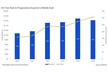
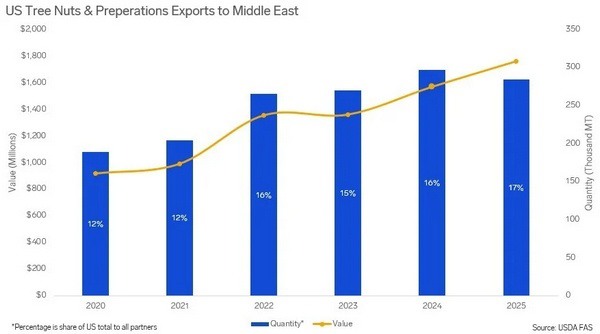
The Middle East remains an important destination for U.S. tree nuts, with 2025 shipments valued at US$1.76 billion and totaling approximately 284,000 tons, according to USDA Foreign Agricultural Service export data. Year-on-year value growth from 2024 to 2025 reached 12 per cent, while volumes declined by 4 per cent. Key destinations include the United Arab Emirates, Turkey, Saudi Arabia, Israel, and Jordan. Primary export products are almonds, pistachios, walnuts, and pecans.
Market participants report growing caution among U.S. exporters as regional tensions persist. Sellers are taking a "wait-and-see" approach to new commitments, citing concerns over logistics volatility and financial risk. Two issues are highlighted: logistics disruptions linked to the region's proximity to Iran, the Red Sea, and the Eastern Mediterranean, and credit or default risk among buyers.
 © Mintec/Expana
Carrier responses are becoming more restrictive. Multiple sources indicate temporary suspensions of new bookings to the region, along with schedule adjustments. Transit times are expected to extend, and freight rates may fluctuate depending on available capacity. Carriers are also applying War Risk Surcharges, "potentially even on shipments already in transit," leading to additional costs that may fall on exporters, buyers, or brokers depending on contract terms.
Several carriers have suspended bookings to destinations including the UAE, Qatar, Bahrain, Oman, Iraq, Kuwait, Saudi Arabia, Egypt, Jordan, and Turkey. These measures are contributing to uncertainty around shipment planning and forward sales.
Another factor is indirect trade with Iran. While the U.S. does not generally trade directly with Iranian buyers, traders in neighboring countries often resell U.S. products into Iran. Disruptions affecting Gulf, Red Sea, and Eastern Mediterranean routes are complicating these channels. Heightened geopolitical risk may prompt intermediaries to reduce exposure, limiting short-term demand visibility.
The combination of booking suspensions, surcharge adjustments, and credit tightening presents challenges for U.S. tree nut exporters. Although the Middle East has recorded steady growth in recent years, reported seller caution suggests that forward commitments and new bookings may remain limited until logistics conditions stabilize and buyer confidence improves.
Source: Mintec/Expana