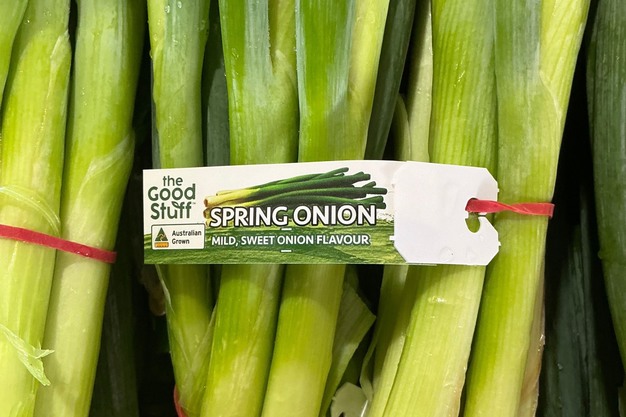
Although spring onions are a much-loved product with stable demand throughout the year, they just aren't viable for export, thanks to costs, tight margins, and the shorter shelf life of leafy vegetable lines. So says family-owned produce allrounder Carter & Spencer's James Christodoulou.
"Spring onions are a line where pricing has been generally consistent apart from extreme shortages for quite some time," says Christodoulou. "There's not a great deal of retail price movement at the supermarket level, and the market price only really reacts when supply tightens."
 © Spencer & Carter
But while prices have been consistent over recent years, costs have soared, making the leafy vegetable a hard line to make money in.
"All production costs have increased — fuel, power, diesel, transport, packaging, wages — but it is very difficult to apply CPI to produce because it's so supply and demand driven."
Those costs also limit the export potential, even to other states in Australia. Carter & Spencer is based in Brisbane, and it sources its supply largely from the Lockyer Valley, an hour or so to the west. As a leafy veg line that can't withstand treatment, given that it will lose structure and wilt, it cannot be exported overseas, while shipment to the southern states is, in normal times, not cost-effective.
"The difficulty is the cost of freight from Queensland, which makes it uncompetitive, with tight margins compared to locally sourced product," Christodoulou explains. "Occasionally, the product will go south if other areas are in short supply."
 © Spencer & Carter
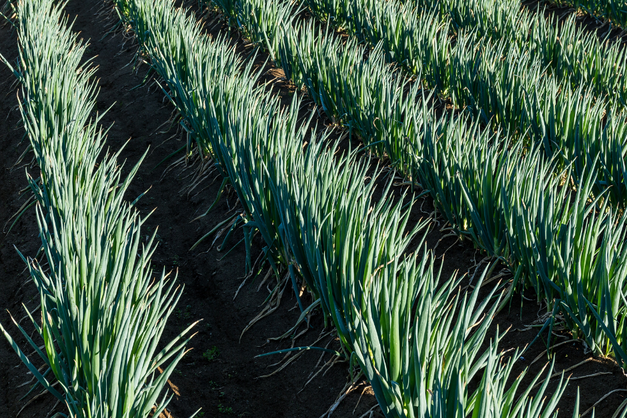
And vice versa, with shortfalls in Queensland, production is covered by spring onions generally from Victoria. But those shortfalls are not common, Christodoulou points out, with supply generally predictable and consistent from the Lockyer Valley supply base.
"Queensland-grown spring onions are reasonably predictable as far as the impacts of rain. The unpredictability is hailstorms, which can move through the region very quickly and quite destructively. They can impact the crop that's already planted and potentially ready for harvest, which can lead to the two main issues: planting gaps from excessive rain and direct impacts of weather on the current crop. Usually, it's quite predictable, and supply is very steady and relatively easy to forecast in good growing conditions."
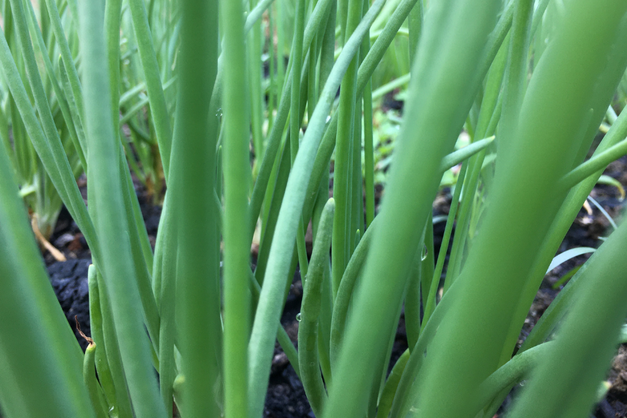
With planting to harvest done in as little as 10 weeks, these gaps have limited impact, and the short turnaround means that even if demand should see a surge, responding is possible for growers. This year, things have been going well with stable and favourable growing conditions.
 © Spencer & Carter
"It's been quite good. As I mentioned, the biggest impact in the region is the impact of storms, particularly hailstorms, but largely supply from the region is quite solid, and it's mostly the impacts of weather that may affect availability."
Heavy rain, when it occurs, can make the ground too waterlogged for machinery to get into paddocks to plant. This creates the planting gap of one or two weeks, creating a knock-on effect down the track.
"Growers will traditionally plant every week, and if they have a two-week gap, then somewhere eight-to-12 weeks down the track, you'll notice a tightening of supply."
Outside the weather though, spring onions remain consistent. "Spring onions are a very steady line 12 months of the year," says Christodoulou. "They probably peak in summer when more salads are consumed, but they're very stable throughout the year."
For more information:
James Christodoulou
Carter & Spencer
Tel: +61 407 629097
Email: [email protected]
www.carter-spencer.com.au