The first hearings of the Committee of Inquiry into Manufacturers' and Distributors' Margins began on December 17th. Set up at the end of October at the initiative of Antoinette Guhl, a senator from Paris (ecologist), the committee is due to complete its work by May 2026 at the latest. Its aim is to shed light on a highly 'opaque' price structure and, above all, to understand the gap between the price increases paid by consumers and the prices paid to farmers, which are too low.
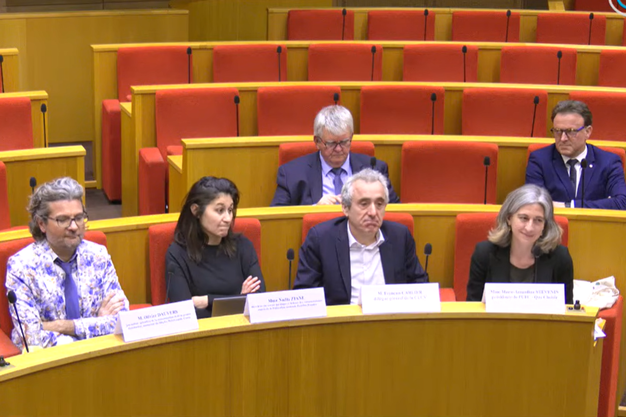 © Capture d'écran Sénat Hearing of consumer representatives, Wednesday, December 17th, 2025, with Marie-Amandine Stévenin, president of UFC-Que Choisir, François Carlier, general delegate of CLCV (Consumption, Housing and Quality of Life), Nadia Ziane, director of the Legal and Consumer Defence Department at the Familles Rurales federation, and Olivier Dauvers, journalist specialized in consumer affairs and supermarkets.
Very high margins on unprocessed raw produce
After drawing up a harsh assessment of supermarket margins, the consumer associations set out a series of levers to rebalance price formation. For Marie-Amandine Stévenin (UFC-Que Choisir), the first priority is transparency. "Supermarkets apply very low margins on ultra-processed convenience products, but charge very high margins of 30 to 40% on other products, particularly unprocessed raw produce." According to the Prices and Margins Observatory, "up to 40% margins are applied on fresh fruit and 67% on certain vegetables." This situation is all the more problematic as it directly affects public health issues.
Repeal of SRP+10
Given this situation, UFC-Que Choisir is calling for the repeal of SRP+10, which is deemed ineffective. "Clearly, it has missed its target," explains Marie-Amandine Stévenin, pointing out that neither farm incomes nor food accessibility have improved. The association is also calling for a detailed analysis of the formation of prices and margins, "category by category," distinguishing between raw and processed products as well as private labels and national brands, in order to verify the real application of the Égalim laws and to objectify the differences in margins between healthy products and ultra-processed products.
Displaying the price paid to producers
To make these mechanisms clearer to consumers, Olivier Dauvers puts forward a concrete and immediately applicable proposal. "In a few symbolic markets, such as dairy products, where the raw material component is easy to identify, the price paid to the producer should be displayed. According to the journalist, this measure would recreate a direct link between the price paid on the shelves and the farmer's remuneration, along the lines of initiatives such as C'est Qui Le Patron?, without jeopardizing the economic equilibrium of the sector.
This demand for clarity is also shared by François Carlier (CLCV), who is in favor of displaying the breakdown of the price, provided that it is not purely symbolic. "Displaying the breakdown of the price would be a good thing, provided that it is implemented seriously," explains François Carlier, referring to the precedent of the Nutri-Score, which has become an effective tool because it has been widely adopted by stakeholders.
Controlling prices and margins
Finally, Nadia Ziane (Familles Rurales) defends a more structural approach, based on targeted price and margin controls. "When are we going to reverse the current logic of making the healthiest products more accessible by increasing the margins on ultra-processed products? The federation supports the sacralization of a list of around 100 essential products, sold at cost price. "Regulating the price of one hundred of the six thousand products sold in supermarkets would already be a step forward." Nadia Ziane cites chains such as Système U, which already use this practice. "Without a legislative framework for prices and margins, we will not be able to solve the problem. Counting on the goodwill of retailers to achieve greater transparency seems pointless to me."
 © Capture d'écran Sénat
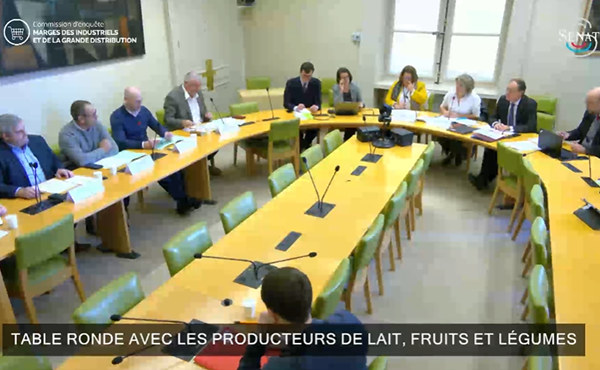
Hearing on Thursday, December 18th, 2025, with Stéphane Joandel, secretary general of the National Federation of Milk Producers (FNPL), Ronan Collet, tomato grower and board member of Légumes de France, Mickaël Mazenod, fruit grower and board member of the National Federation of Fruit Producers (FNPF), and Bruno Darnaud, president of the Economic Governance of Fruit and Vegetables (Gefel).
Concentration of Mass Retail
With regard to the formation of prices and margins, the fruit and vegetable sector has come to the bitter conclusion that there is a structural imbalance to the detriment of producers, exacerbated by the concentration of supermarkets, market volatility, and foreign competition deemed unfair.
"Distribution continues to become increasingly concentrated. We used to talk about six or seven distributors. Today, we are down to four," explains Bruno Darnaud, chairman of the Economic Governance of Fruit and Vegetables (Gefel). Faced with these dominant players, producers remain extremely dependent. "Depending on the product, supermarkets account for over 70%, 75%, or even 80% of outlets."
In such a context, prices are set on a day-to-day basis, with no safety net. Ronan Collet, a tomato grower and member of the board of Légumes de France, claims to be "dealing with an over-the-counter, day-to-day market, most of the time, with very few contracted volumes." This reality means that the Equalim laws are largely unsuited to fruit and vegetables. "The vegetable sector is hardly affected, as contractualization with buyers remains very limited."
Rising production costs
Added to this fragility is the continuing rise in production costs, which is difficult to pass on in prices. Mickaël Mazenod, an arboriculturist and director of the National Federation of Fruit Producers (FNPF), points out that "the main component of these costs is labor, which can sometimes account for more than 50% of production costs." Energy, transport, inputs, as well as climate change and changes in practices, all add to the bill, at a time when productivity gains have disappeared.
Very low margins on imported products
Competition from imports is crystallizing tensions. Bruno Darnaud points to a major asymmetry. "Distributors take little or no margin on foreign products, which they use as loss leaders." These imported volumes, which are sometimes marginal, are nonetheless enough to set a reference price that drags the whole market down. Ronan Collet illustrates this phenomenon with tomatoes. "Tomatoes of Moroccan origin are sold all year round for 99 eurocents a small tub," a price level that is incompatible with French costs.
"Consumers no longer understand how prices are set"
Another key issue is permanent promotions, which are accused of blurring the price signal. "The same product is on special offer one week, then advertised at three or four times the price the next week," observes Ronan Collet. "Consumers feel lost. They no longer understand how prices are formed. One week, they benefit from a promotion, the next they are faced with a 'back-of-shelf' price three or four times higher than the promotion price," explains Bruno Darnaud.
For Mickaël Mazenod, this mechanism undermines the economic equilibrium. "The 'back-of-shelf' part is what enables us to cover our annual costs. But this part is shrinking more and more."
Strengthening the role of POs and PDOs
Faced with these facts, sector representatives are calling for the role of POs and PDOs to be strengthened, while at the same time adapting competition law. "We still have the sword of Damocles hanging over us in terms of competition law," explains Bruno Darnaud, who is calling for the ability to "at least discuss stocks and trade with supermarkets," without being accused of a dominant position.
An underlying concern runs through all the discussions: the gradual loss of sovereignty. "Remuneration is falling," explains Mickaël Mazenod, pointing out that the reduction in surface areas and number of producers is a clear signal. For the fruit and vegetable sector, the challenge is now clear: to restore a clear and balanced economic framework, an essential condition for the survival of French production.