After years of challenges, the California almond industry is finally catching its breath. At this year's 53rd Annual Almond Conference, the mood amongst growers, handlers, industry partners, and allied supporters felt cautiously optimistic that a market rebound is on its way.
The conference theme, "Cultivating a Healthier Future," was a reminder that with innovation, stewardship, and expanded global demand, there is a promising outlook ahead. The conference also provided a moment to reflect on the past, as this year marked the 75th Anniversary of the Almond Board of California (ABC).
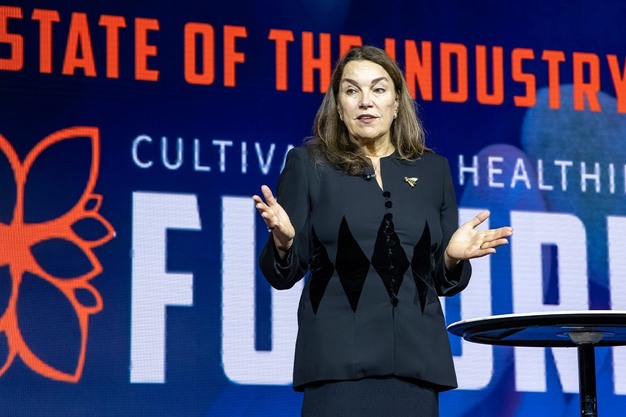
ABC President and CEO Clarice Turner addresses attendees at The Almond Conference 2025
"Over the last 75 years, the industry truly evolved," said Clarice Turner, CEO at ABC, during the State of the Industry session. "We remain focused on growing demand for California almonds, both domestically and globally, with new products, new markets, new innovations, and new partnerships, as well as equipping growers with practical tools and resources."
 © California Almonds
Signs of Rebound
That forward-thinking vision comes at a pivotal time in the industry, as the market begins to show signs of recovery amid ongoing economic pressures. According to UC Davis's Dr. Brittany Goodrich, in the last five years, operating costs have increased between 27 and 40%, who discussed these findings in detail earlier this year on the The Almond Journey podcast.
Encouragingly, the supply and demand balance within the California almond industry is returning to a point of equilibrium, prompting a market rebound. Total almond acreage has decreased for the fourth consecutive year, along with new plantings. Even with a reduced supply, the industry recorded its third-largest shipping year, signifying a healthy market.
"Average grower returns have improved from the $1.60s in the 2023 crop (average all varieties), to the $2.30s per pound in the 2024 crop (average all varieties)," said Bob Silveira, chair of the Board of Directors. "That's roughly a 40% increase."
While this improvement indicates good progress, it underscores the importance of having accurate data to back market fluctuations.
In July, market frustrations came to a head when the USDA National Agricultural Statistics Service (NASS) Objective Measurement Report was released. Although this year's crop size has yet to be fully determined, industry members are reporting that the measurement is off by a sizeable margin this season and improving the estimate is also not feasible, Silveira explained.
"With the size of the industry, getting a truly representative sample was just impractical, not to mention cost ineffective," he said.
After much deliberation and discussion with several stakeholders, on December 9, the decision was made by the Board of Directors who voted to cease funding for the Objective Measurement. The Subjective Forecast, however, will continue to be produced and released in May.
Economic Outlook: What's Driving Consumer Behavior
The challenges faced by almond growers over the last several years have not siloed to the almond industry alone. Across all sectors, farmers are facing hardships as a result of the broader economic landscape.
Scott Clemons, partner and chief investment strategist at Brown Brothers Harriman, explained that over the past several months, a slow labor market has weighed on consumer sentiment, a key driver of spending, which accounts for 68% of U.S. gross domestic product (GDP).
He attributes the decline in sentiment to three factors: expectations that the labor market will continue to weaken, rising inflation concerns among consumers and the increasing stress of household debt.
Positively, consumer spending remains relatively healthy, and it is expected that the Federal Reserve will gradually reduce interest rates by 1% over the next year. While a slowdown in the economy can be expected, Clemons does not anticipate a recession, though consumer sentiment will ultimately be the deciding factor.