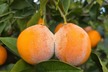
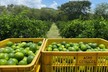
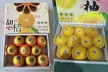
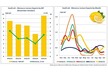
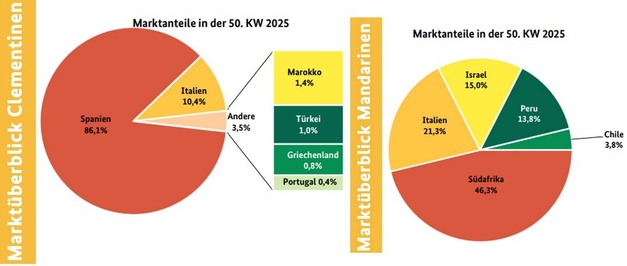
Spanish clementines formed the basis of the range. In addition, Italian offerings, mostly with leaves, were also available. A few imports from Morocco, Turkey, Greece, and Portugal rounded off the selection. The Mioro clementine from the Portuguese Algarve impressed with its sweet, aromatic, premium quality. According to the German BLE, satsumas came exclusively from Turkey and gained some importance.
 © ble
© ble
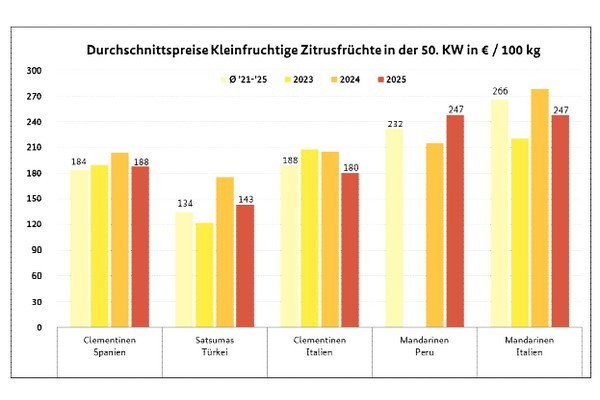
In terms of mandarins, there were still some South African loads available, with remaining quantities from Peru and Chile completing the range. The relevance of Italian and Israeli imports expanded, with Israeli Minneola in particular leaving nothing to be desired in terms of its organoleptic properties. Prices often tended to fall: on the one hand, a certain degree of customer saturation was undeniable after St. Nicholas Day. On the other hand, the quality of South African fruit was no longer consistently convincing. However, the discounts granted did at least accelerate subsequent sales.
 © ble
© ble
Click here for the full price and market report.
Apples
German loads continued to dominate the supply. Demand was quite favorable, with the large number of Christmas markets also playing a role.
Pears
In general, demand was rather subdued. Retailers had reduced their supply slightly so that supply and demand were sufficiently balanced.
Table grapes
Peruvian imports had now displaced Italian loads from the top of the range. Demand was quite favorable but could ultimately be met without any effort.
Oranges
The range was clearly dominated by Spanish Navelina oranges. Their availability had increased once again. The relevance of South African imports, on the other hand, continued to decline.
Lemons
Spanish Primofiori lemons dominated the product range and were available in a monopoly-like fashion in some places. Demand was quite favorable. Nevertheless, storage capacity was limited in some areas.
Bananas
Supply and demand were generally in harmony with each other. As a result, retailers were mostly able to confirm their previous propositions.
Cauliflower
French and Italian arrivals dominated the market and were occasionally flanked by Belgian, Dutch, and Spanish shipments.
Lettuce
Lettuce came from Belgium, Italy, and, in very small quantities, Germany. Belgian loads often became more expensive due to purchase costs, which immediately reduced subsequent storage options.
Cucumbers
Spanish cucumbers dominated. As a result of weather-related difficulties in cultivation, availability had reduced noticeably, causing initial demands to rise sharply.
Tomatoes
Although business was uneven, demand could certainly be described as favorable. Provided the quality was convincing, previous assessments were mostly confirmed.
Bell peppers
Spanish deliveries dominated over Turkish ones. The high prices of the previous week continued, which is why customers were rather cautious.
Source: BLE