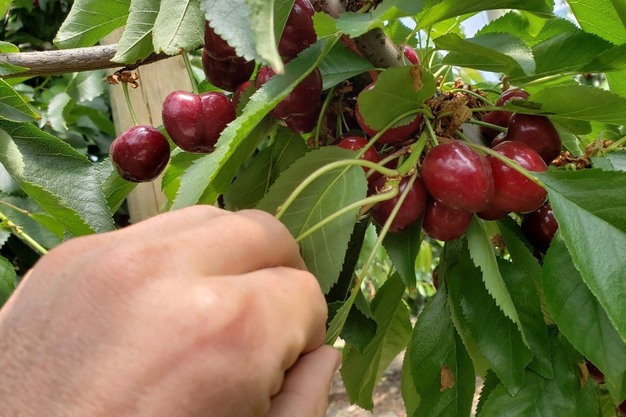
The Chilean cherry season is progressing, with lower volume estimates and earlier harvests and shipments. According to Nicolás Michelini, the commercial manager at Quelen Fruit, the Cherry Committee's original forecast of 131 million boxes is no longer realistic. Current projections now range from 115 to 120 million boxes, compared to 126 million last season.
"The factors behind this decline include frost, more aggressive pruning after a year of high volumes, complex pricing, and staleness affecting some Chilean orchards. We should have known that this year the trees would not produce as much fruit as last year," said Michelini.
 © Quelen Fruit
Although the total volume is lower, shipments are significantly ahead of schedule. "At an industrial level, 85% more fruit has been exported by this date, a phenomenon linked to earlier harvests rather than increased fruit availability. In the case of air transport, there has been a 40% increase in cargo compared to last year," he mentions.
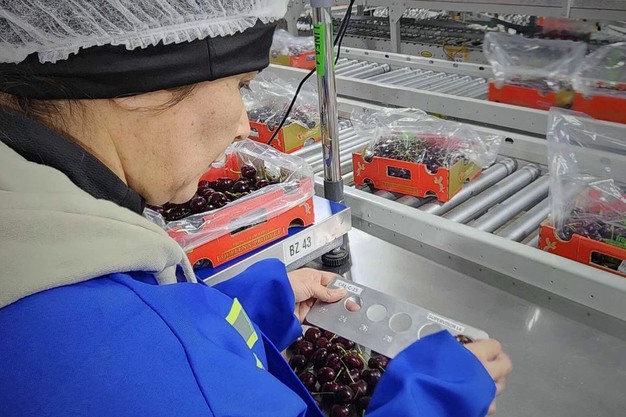
"Quelen Fruit's first air shipments show promising results, with improved quality, firmness, and size, especially in early varieties like Santina, where the average size shifted from Jumbo-2J to the profitable 2J Jumbo size," Michelini stated.
 © Quelen Fruit
Market prices are lower than those during the same period last year, mainly due to increased airfreight volume. However, the situation remains stable thanks to market diversification, available air capacity, and improved fruit quality. "The orchards exhibit better size distributions and increased firmness, qualities that are highly appreciated by the market," he said.
 © Quelen Fruit
Despite the early harvests, logistics remain smooth. There have been no harvest peaks or plant congestion, and both land and sea operations "have worked quite well," Michelini noted. Additionally, the Cherry Express service remains essential for reaching ports like Hong Kong and Shanghai with higher freshness, as well as for connecting to Taiwan, Korea, and Vietnam.
Global retail is increasingly shifting toward end-consumer formats, ideally under 500g, gradually moving away from the traditional 2.5kg box. Markets are also becoming more familiar with new varieties cultivated in Chile, such as Sweet Aryana and Areko. There is also strong interest in bicoloured fruit, larger sizes, and crisper textures. These trends are evident in other species, such as grapes.
Table grape production in Chile is lower and less competitive than in Peru.
Chile's grape season is expected to be 5-10% lower in volume, while Peru's production might increase, according to Michelini. Quelen Fruit, based in the late VI Region, starts exports at the end of February, benefiting from a less congested market and improved price prospects.
Michelini mentioned that, following the suspension of the Systems Approach, they still need to fumigate their crops. This impacts post-harvest quality and diminishes competitiveness against Peru. "We hope that, someday, Chilean fruit won't need fumigation or that alternative procedures will be validated, benefiting the postharvest process," he stated.
 For more information:
Nicolás Michelini
Quelen Fruit
Chile
Tel: +569 56797837
Email: [email protected]
www.quelenfruit.com