Online supermarket Picnic has raised 430 million euros in a new round of funding from existing investors. Most of the capital is earmarked for growth in Germany, where Picnic is now the market leader. Expansion into new regions and cities will require significant investments in distribution centers, among other things.
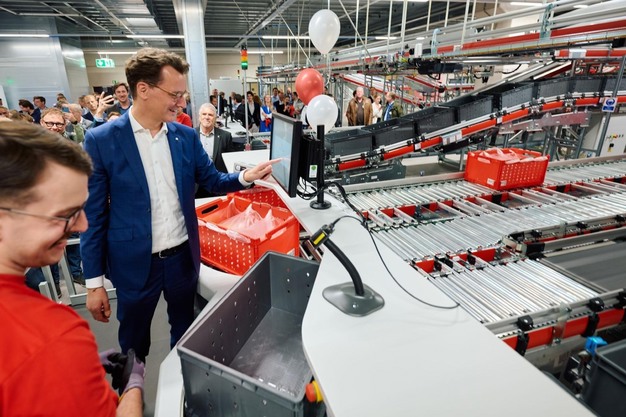 © Picnic Prime Minister of North Rhine-Westphalia, Henrik Wüst, opened the robotised distribution centre in Oberhausen in June
Picnic was founded 10 years ago by a group of experienced entrepreneurs who spent three years developing the concept quietly before launch. Free, minute-by-minute delivery quickly gained ground in the Netherlands, and Picnic now serves two million customers in 200 locations across the Netherlands from seven distribution centers. In 2018, Picnic also launched in Germany and in 2021 in France.
Growth in Germany faster than in the Netherlands
Germany has almost five times the population of the Netherlands and nearly nine times the land area. "We want to be able to deliver to the doorstep of a large proportion of households in Germany as well, so it requires major investments from us to roll out the same infrastructure there as in the Netherlands. Since launch, we have been growing even faster there than in the Netherlands, so the outlook is positive." In the Netherlands, Picnic is currently operationally profitable.
The new investment round will be officially announced this afternoon during the 120th anniversary celebration in The Hague of the German-Dutch Chamber of Commerce. Attendees will include Economy Minister Vincent Karremans and German State Secretary for Economic Affairs and Energy Frank Wetzel. Muller: "The cooperation between software developers and operational staff from both countries shows how well they are working together across borders and building a European market leader in online groceries."
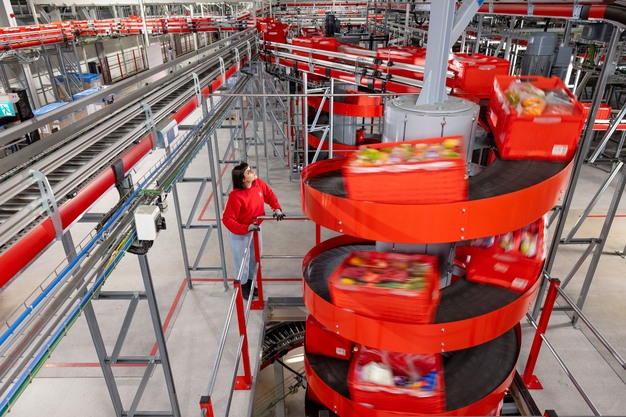 © PicnicPicnic opened a 50,000-square-metre robotised distribution centre in Oberhausen in June
Three years ago, Picnic opened a robotised distribution centre in Utrecht. The recently opened Oberhausen distribution centre goes a step further, experimenting with robot picking, where robots place groceries into crates for customers. This is a complex process, as the more than 15,000 products in the range each require different handling. Muller: "A box of eggs has to be grabbed differently than a bottle of olive oil. To do this, we use visual AI, which imitates the human way of looking at things. Artificial intelligence understands what it sees and acts accordingly."
Source: Picnic