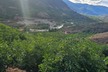
In Majes, a fertile agricultural hub in southern Peru with around 16,000 hectares under cultivation, the family-run business Terramajes J&J has carved out a niche in garlic and paprika processing and export. It combines its own production with partnerships involving local farmers.
"We started in 2021 with minimal infrastructure, but we knew there was demand for a high-quality product," says Leidy Caso, the company's commercial manager. Today, Terramajes J&J manages 30 hectares across six plots, where they grow mainly Napurí and Spring (also known as Chinese) garlic, along with Queen and King varieties of paprika.
 © Terramajes J&J SAC
The choice of garlic variety depends on market demand. "This year, we focused more on Napurí because of strong demand from Mexico. Last year, it was mostly Chinese garlic," explains Jorge Nina Feria, one of the founders and father of the current general manager. Under optimal conditions, each hectare can yield between 15 and 20 tonnes.
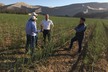
But not all the garlic is grown in-house. To meet export volumes, Terramajes J&J sources from around 50 external producers. "We've worked with many of them for years. For those nearby, we also provide support, like drip irrigation supplies", says Caso. Two agronomists regularly visit the fields to ensure consistent product quality.
Exporting from the Peruvian Andes
Majes' main garlic season runs from September to December. After that, the company purchases garlic from other production zones in the Arequipa region, such as the Tambo Valley, La Joya, and surrounding areas, until January. Their export model is designed to fill supply gaps in the Northern Hemisphere.
 © Terramajes J&J SAC
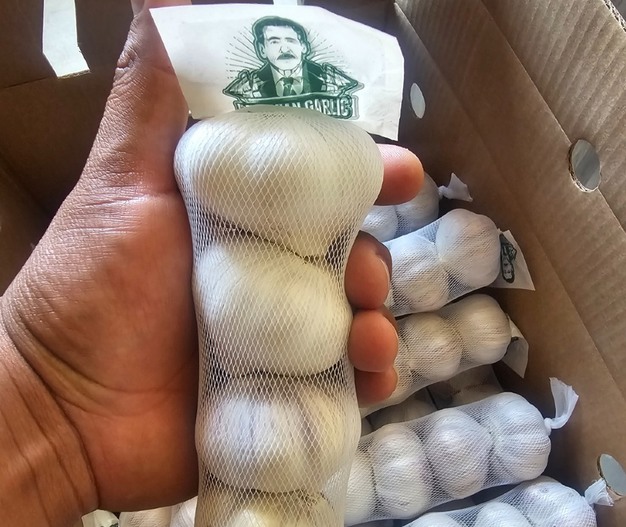
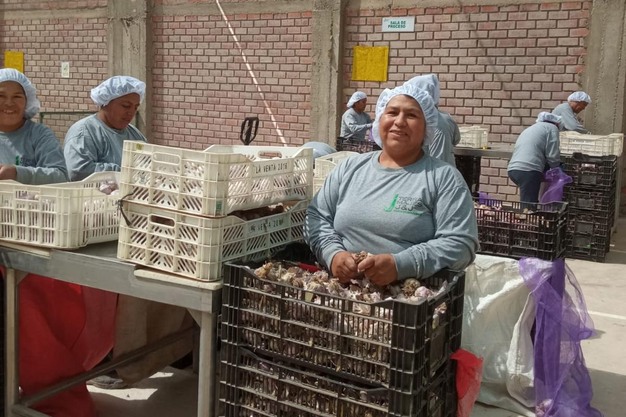
Once harvested, garlic goes through a series of steps: cleaning (removing outer layers, roots, and soil), manual sizing using sorting holes, boxing (in cardboard or plastic, 10 kg or 30 lb), weighing, labeling, and then storing in naturally ventilated areas (without refrigeration) for up to 15 days before being loaded into reefer containers at –1°C.
Mexico is by far their largest market, taking in about 70% of their garlic exports, mostly Napurí. The rest goes to Spain (primarily Chinese garlic), the U.S. East Coast, Colombia, and, more recently, Australia. "Last year we exported 64 containers, at a pace of four per week during peak season," Caso notes. Shipments leave from the port of Callao and reach Manzanillo, Mexico, in around 11 days.
Paprika production is concentrated between March and July. "We introduced it to avoid shutting down the plant during low months and to keep our team employed," says Caso. "This year marks our first paprika exports, with Mexico again as the main destination."
Processing, not supply, is the bottleneck
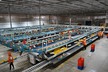
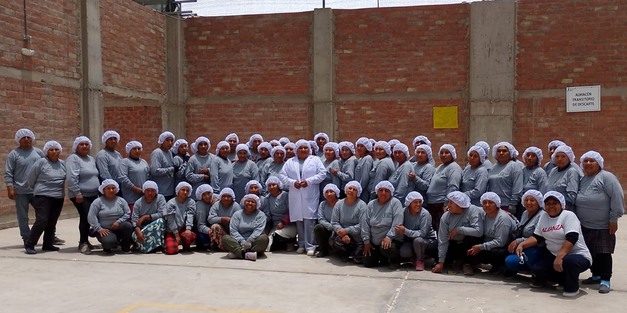
Although there's room to increase garlic procurement, the real limitation is on the processing side. "We have the orders, but we can't always take more due to staffing shortages," Caso admits. During the main season, the plant employs 70 to 80 people. Most of the work is done by hand: cleaning, sorting, weighing, and packing.
 © Terramajes J&J SAC
Since its inception, the plant employs between 70 and 80 people during the campaign. "We strive to create a family environment," Jorge Nina Feria comments.
A sizing machine was recently purchased to streamline operations, but it's not yet in use. "It shakes the garlic too much and causes damage. We're working on fixing that," says Nina. Besides equipment, retaining skilled workers is essential. "Many of our employees have been with us from the beginning. We put effort into maintaining a family-like environment," Nina adds. Year-end celebrations and gifts for employees' children are now a company tradition that helps strengthen loyalty.
A mid-sized operation with room to grow
With its own land and external suppliers, Terramajes J&J exports around 1,200 tonnes of garlic per season, similar to other mid-sized firms in the region. "There aren't any companies around here exporting 200 containers a year. We're all more or less in the same range," says Nina.
Majes itself is a major player within Peru. Together with the neighbouring Tambo and Pedregal valleys, it accounts for about 6,000 hectares of garlic, more than half of the national total (roughly 9,000 ha). Chinese garlic dominates, though Napurí is valued for its stronger aroma, thicker skin, longer shelf life, and larger cloves. "The original Arequipeñan Napurí had even more aroma but required a nine-month growing cycle."
 © FreshPlaza
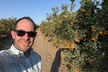
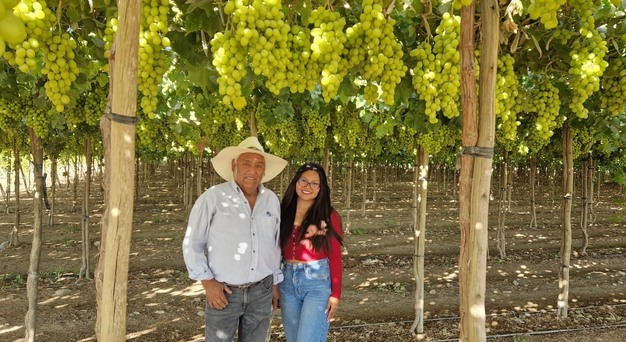
Jorge Nina Feria and Leidy Caso in a field of Sweet Globe grapes that Terramajes J&J cultivates on an area of 2.5 hectares. "The goal is to reach 50-60 tons per hectare," says Nina.
To put the region in context: Arequipa's garlic area is triple that of all of Chile and about a third of Brazil's or Argentina's (roughly 13,000 and 15,000 ha respectively). It also represents a quarter of Spain's garlic area (about 25,000 ha). Globally, only three countries surpass Spain in garlic acreage, and by a large margin: Bangladesh (approx. 70,000 ha), India (over 400,000 ha), and China (over 800,000 ha). These figures are from 2023 (source: FAOSTAT).
Customer-first farming
Unlike the traditional local approach, where farmers plant without knowing if they'll have a buyer, adjusting acreage based on the previous season's profitability, Terramajes J&J prefers to secure deals before planting. "It gives us predictability. With some clients, we lock in agreements up to a year in advance," says Caso. New buyers are found through international brokers and referrals from satisfied clients. "Word of mouth works. If you deliver well, clients recommend you," adds Nina.
 © FreshPlaza
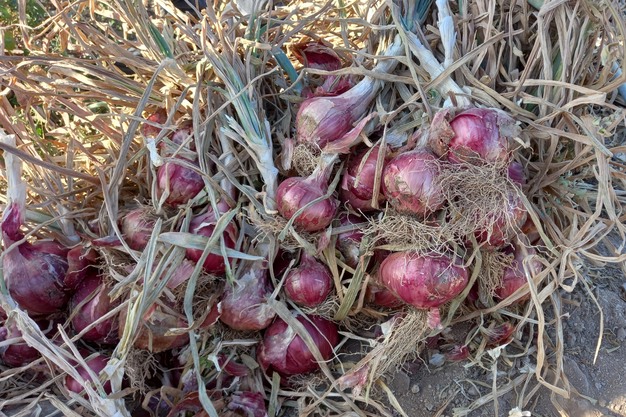
In the Majes area, red onion cultivation also does very well. "We achieve productions of up to 50-60 tons per hectare," comments Nina. "The onions are left to dry in the field for 6 days."
Terramajes J&J has a clear goal: Triple its export volume within five years. To achieve this, the company is investing in processing automation and expanding its supplier network. "It's not just about growing more. We need to process faster and better," says Caso.
While Mexico will remain its main market, the company is actively exploring new destinations. Their ambition is to become a solid reference in southern Peru's garlic sector. As Nina puts it: "We're growing steadily, one step at a time, but with purpose."
For more information:
Cristian Jorge Nina Champi (Director)
Terramajes J&J SAC
C.P. El Pedregal (Arequipa) – Peru
Tel.: +51 973 586 655
[email protected]