The IAB-IBD trade show, held in Bordeaux at the beginning of October, was once again an opportunity to showcase innovative, eco-responsible packaging solutions for the fruit and vegetable sector. Among the exhibitors, SoFruPak came to present its complete range of plastic-free packaging, based on cardboard and cellulose. But the company's philosophy goes beyond offering an alternative to plastic. At SoFruPak, packaging becomes a tool for enhancing the value of the product and making it stand out on the shelf.
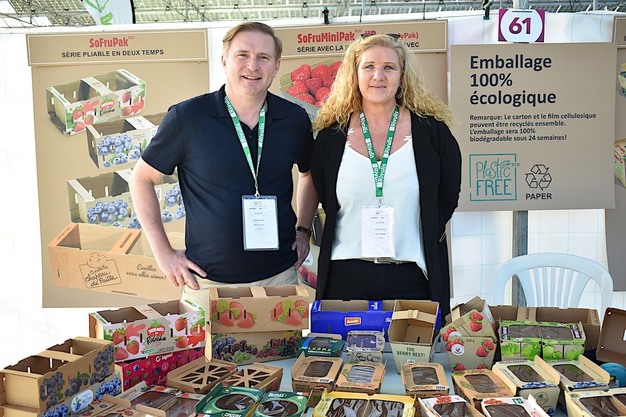 © Aurélie Pintat | FreshPlaza.com
Adam Sikorski and Isabelle Allain at the IAD-IBD show
A two-speed market, but unchanged convictions
The company, which originated in Poland, has worked hard in recent years to develop tailor-made solutions for private labels. But the current economic climate has slowed the momentum. "We can see a real setback for 2025. Many players are returning to plastic, mainly for cost reasons. Supermarket customers are primarily focused on price," explains Isabelle Allain of SoFruPak.
However, while supermarkets are somewhat reluctant to give up plastic, those who have already introduced this eco-responsible packaging to their shelves are sticking to their commitment. "Those who have taken the plunge are not going back. They are convinced of the benefits of this type of packaging, both in terms of the product itself and in terms of differentiation, especially as consumers are now used to seeing them on the shelves."
Eco-responsible packaging as a tool for highlighting and storytelling
At SoFruPak, each tray is designed not just as a container, but as a genuine communication lever. "We are not just offering alternatives to plastic. Each tray is designed to highlight the product and reinforce the brand's identity. Thanks to high-definition offset printing, the packaging becomes a storytelling medium. It allows the producer or brand to tell its story, to promote its expertise, its territory, or its commitments."
The act of buying is based on the visual aspect of products on the shelves, so this approach makes perfect sense. "The visual remains the primary criterion for consumer attention, and the ability to stand out is more crucial than ever."
Tailor-made, deeply human support
One of SoFruPak's major assets is its personalized, collaborative approach. "I take the time to listen to our clients, to understand what they want to highlight, their constraints, their world, their values. We work with a designer in order to come up with several tailor-made graphic designs that make sense for the client." My role is to link the marketing vision, the reality on the ground, and the technical possibilities for production. At SoFruPak, we sell more than packaging: we offer a collaborative experience, where each player-producer, distributor, processor - feels supported, listened to, and valued."
Local production and fruit-friendly solutions
Founded by Adam Sikorski, SoFruPak is based in Poland, where it manufactures its trays from local raw materials located within a 20km radius of the factory. "The trays are delivered and assembled in France, Spain, and other European countries. In Corsica and Spain, some partners receive them flat-packed for assembly on site, which saves 1.5 times the volume on shipping. We are currently in discussions with a French company to set up this system in mainland France.
SoFruPak packaging also has a number of technical advantages. "It respects the packaged fruit, without accelerating its ripening. The fruit can breathe while remaining visible thanks to the cellulose film or perforation. On fragile products like strawberries, they have proved to be a real asset, combining preservation and protection."
From grapes to clementines: Ongoing development
Following its success in the grape segment in 2024, Sofrupak is continuing its expansion to the citrus fruit segment. "We are tackling the clementine market this year, with the first trays due to arrive in less than a week," explains Isabelle Allain.
And the trend looks promising. "At the last Fruit Attraction in Madrid, we noted a real desire to return to eco-responsible packaging by 2027, even if 2026 will be a transitional year."
For more information:
Isabelle Allain
SoFruPak
[email protected]