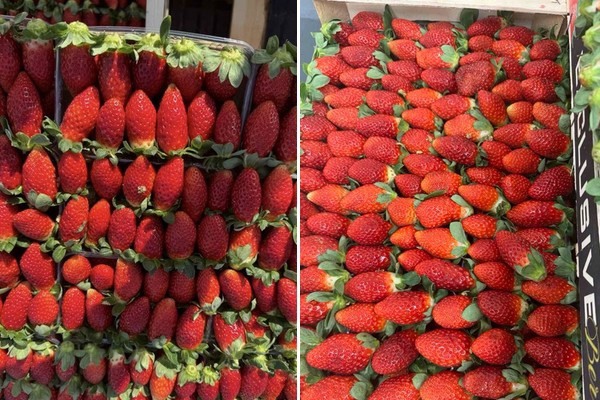
With the first shipment from the source in week 45, the Greek strawberry season has officially begun. "The produce is of excellent quality and also has a convincing taste. Further shipments with increasing volumes will take place in week 46, enabling the first programs with German food retailers to begin. Due to the early planting dates and good weather conditions, we are starting the season around two weeks earlier than last year," reports Christian Vogelsang, purchasing and sales manager at ExPa-Frucht GmbH.
 © ExPa-Frucht GmbH
The Fortuna variety usually marks the start of the season. From week 4, the packaging will generally switch from 250 g to 500 g punnets.
Expa-Frucht GmbH offers a wide range of strawberry varieties, including the tried-and-tested Fortuna, Arwen, Victory, and LLosana. New this year is the Calinda variety, which is also expected to be available in German food retail outlets by the end of the year. According to Vogelsang, it will primarily be listed as a premium strawberry in 400 g punnets. "Overall, we expect a larger harvest than in previous years, thanks in part to the expansion of our producers' acreage by around 10%."
 © ExPa-Frucht GmbH
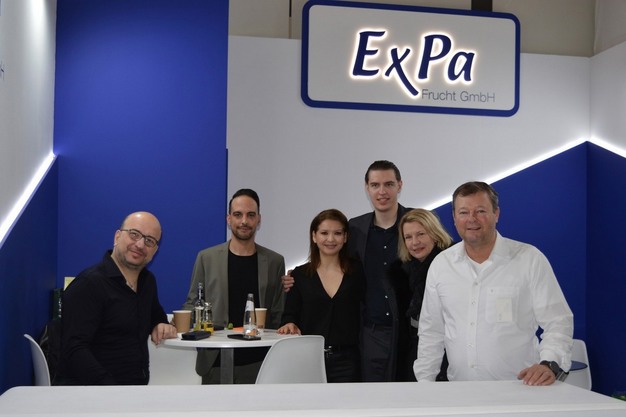
ExPa-Frucht GmbH was represented with its own stand at Fruit Logistica for the first time this year. Right: Christian Vogelsang.
Greece gains market share
Right at the start of the season, the management of ExPa-Frucht observed high demand for Greek strawberries from German food retailers. "Spanish strawberries are typically only available in significant quantities after the turn of the year. Egyptian air freight is increasingly being avoided for environmental reasons. This means that Greek strawberries are currently competing primarily with Dutch greenhouse produce." The price differences between Greek and Dutch produce are minimal. Vogelsang goes on to say that current entry-level prices are roughly at the same level as last year.
The Greek strawberry industry has tended to gain market share at the expense of Spain in recent years. Vogelsang: "In previous years, the Spanish always had a good December, followed by heavy rainfall in January. This led to corresponding yield losses in the first half of the season. Due to the good, stable quality, many food retail customers have increased their volumes from Greece, with most accepting the slight surcharge." Another competitive advantage over Spain is the Spring certificate held by ExPa-Frucht's contract producers. "This demonstrates the excellent water management of the Greek fruit-growing industry with reservoirs and other resources."
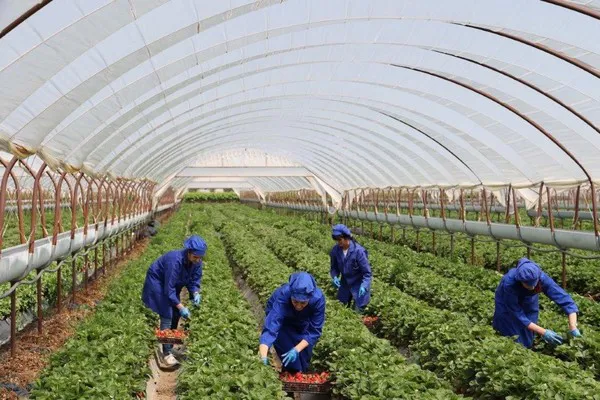
In addition to berries, ExPa-Frucht will also start the new citrus season in week 46 with the first deliveries of clementines (Clemenules) and oranges (Navelina). Normal yields are expected this year, although this is a smaller product category in terms of volume.
ExPa-Frucht GmbH's contract producers are mainly located in the Patras area, Greece's most important berry-growing region. The company has its own sorting and packing station here. The freshly harvested produce is packed at the source and delivered to customers in southern Germany within two days. In addition to the German domestic market, the company also counts food retail customers throughout Central Europe and Switzerland among its customers. "We have also made considerable investments in blueberry and raspberry production so that we can continue to be a strong partner for our customers in this area in the future. We have also recently opened an office in the northern Greek port city of Thessaloniki. From there, we want to expand further, especially in Eastern Europe," he concludes.
For more information:
Christian Vogelsang
ExPa-Frucht GmbH
Finsinger Field 5
85521 Ottobrunn
Phone +49 89 720 18 87 80
[email protected]
www.expa-frucht.de