The future of citriculture depends on sustainable intensification, and the Agromillora group, a global leader in plant innovation, has taken a significant step with the launch of CIVAC 19, a new citrus rootstock that combines productivity, sustainability, and technological adaptation.
Developed in partnership with the IVIA (Valencian Institute of Agricultural Research) and tested by the IFAPA Las Torres (Seville), CIVAC 19 results from over twenty years of research dedicated to redefining the citrus production model.
 © Agromillora
"CIVAC 19 offers a genetic trait that enables us to intensify our plantations. Previously, the available materials were too vigorous, hindering progress toward more profitable and sustainable models," explains Gerardo Brox, head of Agromillora. "For us, sustainable intensification is the most intelligent way to produce, as it helps growers increase profitability while minimizing resource use."
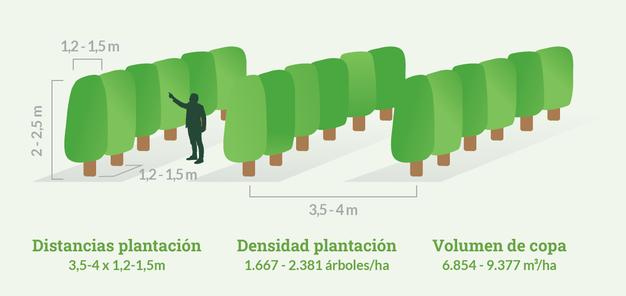
CIVAC 19 is already listed in the European catalog of commercial rootstocks, allowing its full use in citrus plantations across the continent. Its main feature is its moderate vigor, which enables denser and more controlled planting systems without sacrificing productivity per hectare.
"It's not a dwarfing material, but it is less vigorous than traditional rootstocks. This makes it possible to reduce the woody structure of the tree, with a smaller crown volume and, therefore, less water, nutrients, and phytosanitary products consumption, while maintaining the same yield per surface area," Gerardo stated.
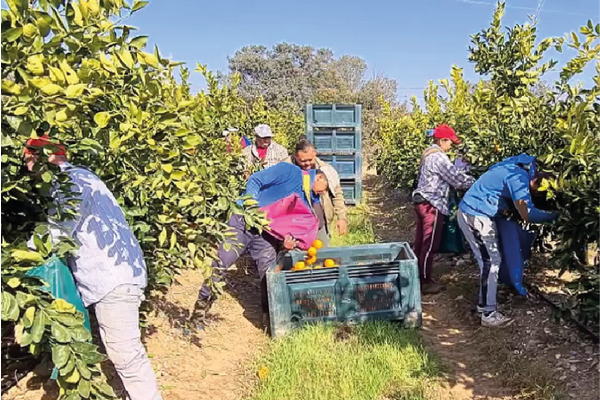
"The result is a more balanced tree that optimizes water and nutrient resources and greatly reduces maintenance and harvesting costs. Having a smaller-sized tree makes it easier to harvest the fruit for fresh consumption, reducing labor needs and increasing fieldwork efficiency," he added.
Towards a more automated and competitive citrus industry
The move towards intensification isn't limited to citrus. Agromillora has previously implemented similar strategies in woody crops like olive, almond, and stone fruit trees. Now, it is applying this experience to the citrus industry, focusing on mechanisation and robotisation.
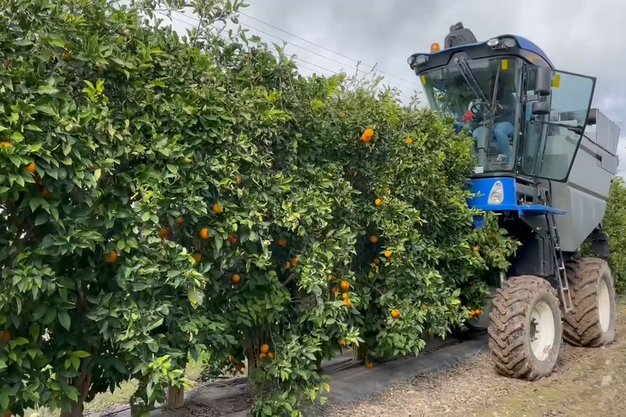
"CIVAC 19 enables two-dimensional orchard design, resulting in more compact and accessible trees. This is especially important with the upcoming robotisation of agriculture," Gerardo explains. "Automated harvesting is already used in crops like apples, and it will soon extend to citrus. Those who adopt mechanised plantation models now will gain a significant competitive edge in the future."
"For plantations targeting the juice industry, CIVAC 19 enables the development of productive walls designed to work with riding machines. This technology, already tested in Brazil, where Agromillora operates nurseries and has an established presence, aims to enhance efficiency in harvesting industrial citrus."
 © Agromillora
Twenty years of research and collaboration
The development of CIVAC 19 has been a lengthy and challenging process. Agromillora and its institutional partners have spent twenty years testing the material across various soil types, climates, and varieties, both in Spain and Latin America, to build a strong understanding of its agronomic performance.
Gerardo stated that evaluating a rootstock involves years of testing and observation. "You need to identify promising materials, adapt them to various conditions, and gather data across multiple productive cycles. After over twenty years, we now have the technical foundation to provide growers with a dependable, sustainable, and profitable option."
"CIVAC 19, developed through this research, exemplifies Agromillora's dedication to genetic innovation in sustainable agriculture. It aims to provide solutions that address key sector challenges such as labor shortages, increasing costs, environmental concerns, and the demand for mechanization," he stressed.
A necessary paradigm shift that will require time to implement
Although CIVAC 19 has generated significant interest among technicians and growers, Agromillora acknowledges that adopting new cultivation models requires a gradual transition. "The citrus sector has been operating in the same way for decades, and it's logical that it will take time to adopt new strategies," Gerardo comments. "There will be growers who will adopt this model immediately, others who will do so in a few years, and some who prefer not to change. But the pressure on labor and costs will mean that, sooner or later, these systems will become essential."
 © Agromillora
In this context, the company emphasizes the need to synchronize genetic innovation with technological progress. "If we aim to introduce robots or intelligent harvesting machines in the near future, we need to begin planting with suitable structures today. You can't expect technology to operate effectively on a cultivation model developed 50 years ago," he concluded.
Because of this, the new rootstock is considered a central part of Agromillora's strategy to modernize citriculture and foster more efficient, profitable, and sustainable farming systems. Its development aligns with a long-term vision that integrates genetics, mechanization, and digitalization to craft the agriculture of the future.
Gerardo chuckles, saying, "At Agromillora, we've always been a bit disruptive. We enjoy suggesting ideas that others haven't, even if they spark debate. What matters most is that people discuss innovation, as it ultimately propels the sector and helps us progress."
 For more information:
Agromillora
T.M, El s/n, Carrer del Rebato,
08739, Barcelona
Tel: +34 93 891 21 05
Email: [email protected]
https://www.agromillora.com