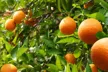
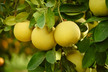
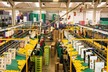
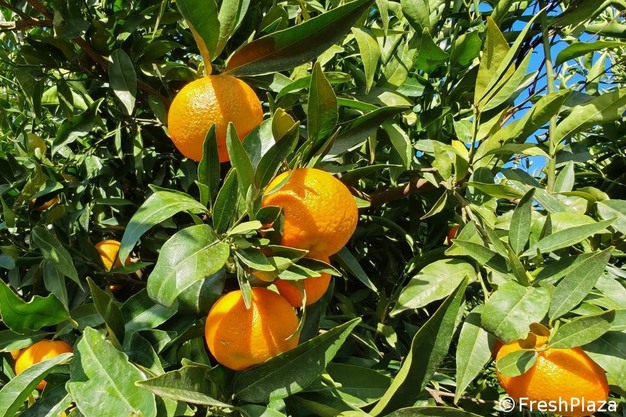
When we think of Calabria, and of Piana di Sibari in particular, the image that often comes to mind is that of a small, orange, fragrant, and very sweet 'sun': the clementine. But this fruit is much more than just a treat for the palate. For this area, it is a true 'identity product', the economic engine that has driven the local community for generations.
Imagine generations of families who, thanks to clementines, have been able to grow, study, and build a future. Every aspect of the local economy is linked to this crop. Although their goodness is known all over the world, the road they take to get from the groves to our homes is full of obstacles and complex challenges. But what makes getting this orange treasure from the plant to our table so difficult?
 © Maria Luigia Brusco | FreshPlaza.com
This was discussed in Corigliano-Rossano, the largest city in the province of Cosenza in terms of both surface area and number of inhabitants, which became the Italian capital of this special citrus fruit thanks to the 'Clementina Festival', held from 23 to 25 October 2025. In addition to a round table, the three-day event included a morning of B2B meetings between foreign importers and buyers from Poland, Estonia, and Lithuania, and Calabrian companies involved in the production and marketing of clementines.
In addition, alongside the specialist press, the delegation of buyers and importers visited five local companies (Ortofrutta Malagrinò, Grillo Ful, La Capricciosa, Carpe Naturam/Biosybaris, and Coop Agricola Morgia). FreshPlaza will publish further insights and a special photo report in the coming days.
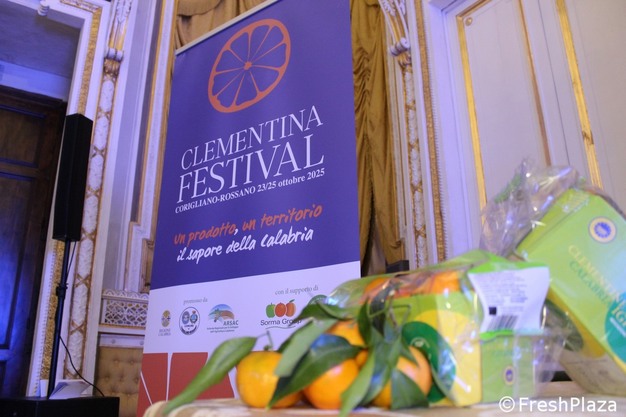 © Maria Luigia Brusco | FreshPlaza.comThe municipality's agriculture and tourism departments are working on the project in collaboration with local producer organisations, the Clementina di Calabria PGI Consortium, and the Omnibus agency, particularly for national and foreign relations. The event received the contribution of the Calabria Region through ARSAC (Azienda Regionale per lo Sviluppo dell'Agricoltura Calabrese - Regional Agency for the Development of Calabrian Agriculture), and the support of the Clementina di Calabria PGI consortium itself and the technology company Sorma Group.
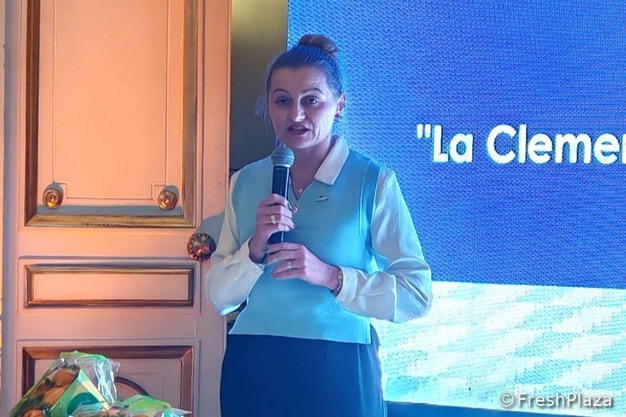
During the round table, Agnieszka Klimczak, a buyer from Consorfrut Polska, stressed her personal bond with Calabria - the land where she took her first steps with the Italian language - and brought the perspective of one of Europe's leading players in the year-round distribution of fruit and vegetables. Klimczak explained how Polish consumers are accustomed to clementines with a full colour, while, for years, the company has been trying to educate the market to accept even fruits with 80% colouring, which are already perfectly suitable for marketing.
Klimczak then warned of the risks weighing on Italian clementines, starting with the strong downward pressure on prices in November and December, a period when supermarkets compete for customers with aggressive promotions, and moving on to the effects of climate change, which has shortened the campaign in recent years, forcing importers to look elsewhere. That is why she suggested that Calabrian producers invest in late varieties, which would be able to extend their market presence beyond December and guarantee greater profitability opportunities in a competitive and unstable environment.
 © Maria Luigia Brusco | FreshPlaza.com
Agnieszka Klimczak, buyer at Consorfrut Polska
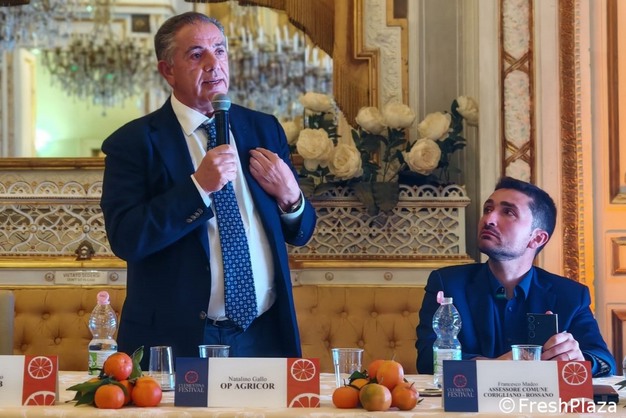
Natalino Gallo, president of Op Agricor, gave his testimony starting from a family history that is now in its fourth generation and that has always lived on agriculture, recalling how in the past the citrus fruits from Sibari were considered 'prized' and how today, the sector finds itself instead squeezed between rising costs and a race to the lowest prices. Gallo pointed out that the main challenge is to extend the production calendar, overcoming the concentration in November and December and covering the period from October to late March with new varieties, in line with the changing consumption dynamics that increasingly reward the winter months. The entrepreneur also mentioned a missed opportunity: "Ten years ago, we missed a historic opportunity due to a general mistrust: We could have planted 500 hectares of new early varieties in Calabria, but that chance was not taken and today we are paying the consequences."
 © Maria Luigia Brusco | FreshPlaza.com
Natalino Gallo, President of Op Agricor
"Staying on the market now requires large investments in innovation, packaging technologies, and modern structures, without forgetting the growing weight of climate change and of the phytosanitary restrictions imposed by Europe, which clash with the imports of over-treated fruit from other countries. So it is no longer enough to say that Calabrian clementines are the best - they must be promoted as a premium product linked to the PGI, guaranteeing high quality standards and presenting them in a unified way on international markets. Only in this way, with a compact and aware supply chain, will it be possible to face global challenges and restore competitiveness to a fruit that combines unique organoleptic qualities with a strong identity value."
 © Maria Luigia Brusco | FreshPlaza.com
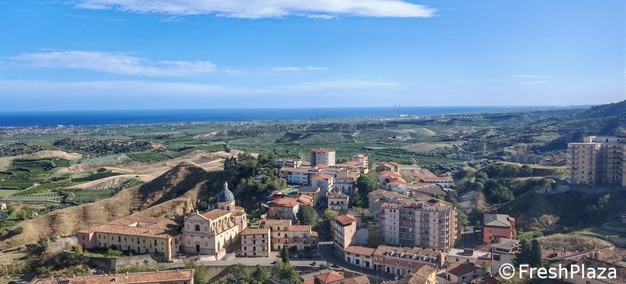
Panoramic view from the tower of the Ducal Castle, which hosted the Clementina Festival. Vast citrus fruit groves can be seen beyond the buildings, most of them clementines.
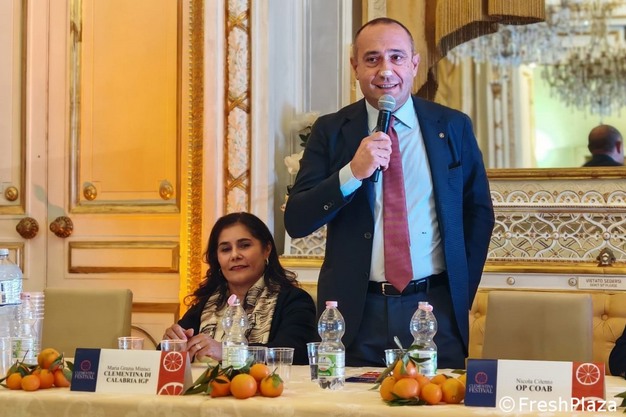
Nicola Cilento, president of Op COAB, gave an intense and personal talk that intertwined life memories with strategic reflections on the future of Calabrian clementines. He recounted the time when, as a young student in Florence, he found himself experiencing the mistrust towards Calabrians, to the point of having to present references to rent a house, only to discover signs at the local market proudly advertising 'clementines from Corigliano'. A paradox that left its mark, and which he still considers a symbol of the intrinsic strength of this fruit, capable of winning over consumers well before marketing tools or promotional strategies existed.
"In the 1980s, in fact, clementines were sold easily, they were appreciated and paid well, while today the sector is having to deal with completely different dynamics: fierce international competition, European policy choices that often penalise local agriculture with strict rules and 'ideological environmentalism', in a global market that leaves no room for improvisation."
 © Maria Luigia Brusco | FreshPlaza.com
Nicola Cilento, president of Op COAB
Cilento acknowledged the progress made with the creation of the Clementine di Calabria PGI. However, he reiterated that "precious time was lost in past years, so, today, we need to make up for it with more incisive action, because it is not enough to appeal to tradition or to boast about a superior quality if you are not able to convey it and defend it on the markets." According to Cilento, the PGI is an essential tool, but one that must be accompanied by strong and shared communication that brings the unique value of Corigliano clementines back to the centre, without fragmentation or dispersion.
"The real challenge is therefore to relaunch a clear and cohesive image, capable of making both Italian and foreign consumers perceive that a fruit that has no equal in terms of taste, fragrance, and sweetness is produced here." Cilento also emphasised the competitive advantage linked to labelling, which by law requires the place of production and packaging to be indicated: such a constraint appeared to be a nuisance in the past, but today represents a powerful tool for identifying and promoting the territory. Hence, the plea to transform initiatives like the festival into a stable and structured opportunity to attract visitors, illustrate the story of the area, and make Corigliano clementines not only an agricultural excellence, but an identity symbol to be passed on to new generations. "Our fortune is that, when our clementines reach the market, Spain stops, because consumers prefer them. This is our winning feature, and we must use it to the fullest with courage, unity, and vision."
 © Maria Luigia Brusco | FreshPlaza.com
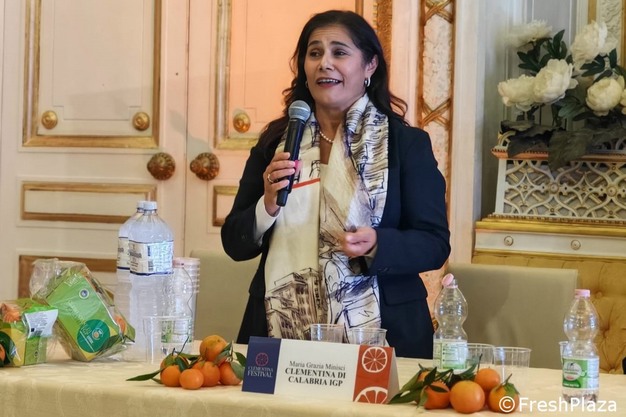
Maria Grazia Minisci, a member of the board of directors of the Consorzio di Tutela delle Clementine di Calabria IGP and the new president of Confagricoltura Cosenza, brought the greetings from the new president of the Consorzio, Maria Salimbeni, and reiterated the new board's desire to give an innovative outlook to its activities. Minisci emphasised that the challenge today is twofold: "On a microeconomic level, we need to plan production to extend the campaign and guarantee fair prices while, on a macroeconomic level, we need to look at the European and global market with more structured tools, investing in research, technology, and communication."
She also stressed the importance of raising the quality standards, so that Clementina di Calabria PGI can always be recognisable and consistent with the values conveyed by the brand, from its unique taste to the healthiness of the product. This commitment must be accompanied by an aggregating vision that involves all Calabrian producers, because only by joining forces is it possible to face a globalised market that does not cut anyone any slack. In her speech, Minisci used an effective image: that of Corigliano as a 'capital without a kingdom'. She explained that, while the Piana di Sibari remains the beating heart of production and deserves to be the capital of clementines, this role only makes sense if the whole of Calabria becomes its kingdom, united under the PGI umbrella and able to guarantee uniform and recognisable quality in every province. Without this collective effort, the capital would remain isolated, while, with a broader vision, Calabria could truly become the 'California of Europe' capable of attracting tourism, generating an economy, and transforming clementines into an international symbol of agricultural excellence.
 © Maria Luigia Brusco | FreshPlaza.com
Luigi Bianchi, Director of Cesena Fiera and Chief Operations & Chief Sales Manager of Macfrut, stressed that: "The success of the Region lies in its modernity and inventiveness in promoting Calabrian fruits and vegetables. This broader vision is vital, often led by councillors, presidents, and officials who have a broader perspective, because things would take a turn for the worse without the public administration alongside the producers. At Macfrut, for example, the presence of Regione Calabria with the slogan 'Calabria Straordinaria' really changed the way of thinking and interacting of the other Italian regions of the fruit and vegetable sector."
Bianchi reiterated that trade fair events such as Macfrut and meeting moments such as the Clementina Festival serve a crucial purpose for professionals: to create business opportunities, to meet the big retail chains, and to address cohesion issues. Promotion is the key: "Many foreign operators who buy fruit do not know the territory. Taking them there to make them understand, for example, that they are not buying just any citrus fruit, but a Calabrian clementine, generates a vision that is entirely different and provides the necessary added value. After all, the aim is to give all operators a voice, because unity is strength, always."
 © Maria Luigia Brusco | FreshPlaza.com
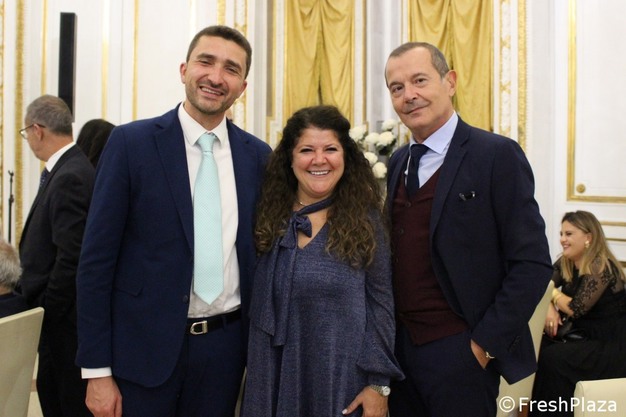
Francesco Madeo (Councillor in charge of Agriculture of the Municipality of Corigliano-Rossano), Fulvia Caligiuri (Commissioner of ARSAC), and Luigi Bianchi (Director of Cesena Fiera and Chief Operations & Chief Sales Manager of Macfrut).
Francesco Madeo, councillor for agriculture of the city of Corigliano-Rossano, defined Calabrian clementines as the true economic and identity pillar of the Sibari area, a product that is not only a resource for the territory, but also an integral part of its culture and tradition. Madeo emphasised how, despite its internationally recognised quality, this citrus fruit is currently going through a difficult phase due to two crucial issues: Weak communication and the concentration of production in too short a period, which floods the market and lowers the bargaining power of producers.
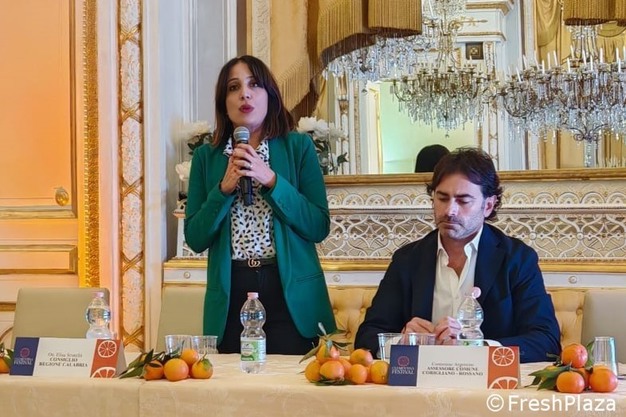
"In order to turn the tide, a three-pronged strategy is needed: planning production through a regional citrus cultivation plan that favours varietal diversification and a longer harvest period, strengthening the link between the product and experiential tourism, turning visitors into ambassadors, and, above all, teaming up within the supply chain through Consorzio di Tutela della Clementina di Calabria IGP. Only in this way will it be possible to build a future in which clementines are no longer an undervalued product, but the strong and recognisable symbol of Calabria in the world," concluded Madeo, who worked closely with tourism councillor Costantino Argentino (pictured below).
 © Maria Luigia Brusco | FreshPlaza.com
Elisa Scutellà (side photo), a member of the Calabrian Regional Council, stressed the importance of Calabria, which produces two-thirds of all Italian clementines, but also focused on the need to attract new forces and modernise the production system to ensure the sector's longevity. "Clementines are not just a citrus fruit, but they represent history, value, and the future. We must make the product and the market more attractive, especially for young people, by improving the agri-food supply chain through digitisation, innovation, and leaner mobility."
Fulvia Caligiuri, ARSAC commissioner, recalled how entrepreneurs with passion, vision, and courage manage to unite around a small yet extraordinary fruit, transforming work into business and giving value to an entire supply chain. ARSAC, the operational arm of the Region of Calabria and the Department of Agriculture, plays a central role in promotion but, as Caligiuri stressed, "this action is only possible thanks to the good work of entrepreneurs, which allows them to present themselves at international fairs with an agri-food basket of the highest level, with nothing to envy from other regions or countries."
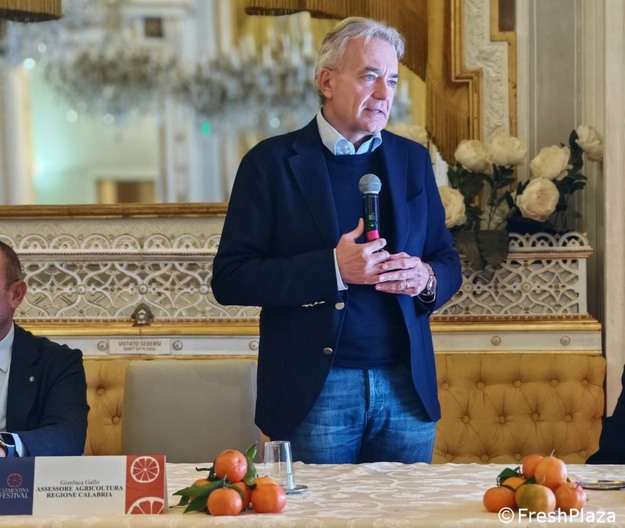 © Maria Luigia Brusco | FreshPlaza.comFinally, Regional Councillor Gianluca Gallo (side photo) highlighted the historical role of PGI clementines as an engine of socio-economic progress, insisting on the need to overcome internal fragmentation given the amount of non-associated production, and to strategically plan for the future. "If those in the sector want to, we must design the future through a scientific approach and a Regional Citrus Plan, also investing in processing such as the use of the peel, which we currently undervalue." Gallo made it clear that the Regional Citrus Growing Plan will have to be linked to European funds to support reconversion and give the supply chain greater bargaining power.