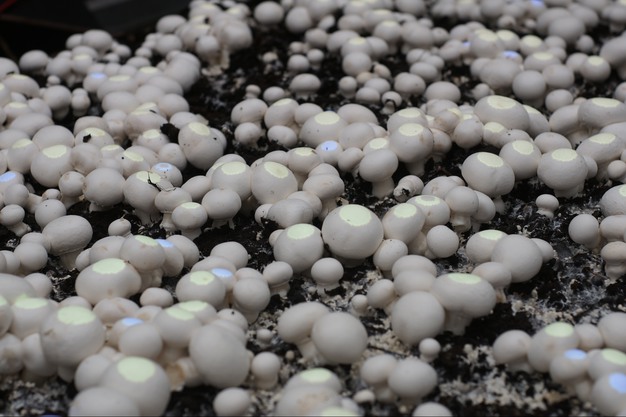
In the Middle Ages, mushrooms were considered supernatural because of their astonishing growth rate. One day, there was nothing to see, and the next morning, a fully grown fungus had appeared. "That must be witchcraft!" people thought at the time. Today, we know better. Still, that ability to grow remains something special, says Niek Franzmann of Mobichamp. "There really is something magical about it!"
 © Mobichamp
That's why his company is eager to maximise that growth rate. "Mushrooms develop at lightning speed, respond to the slightest change in conditions, and no two mushrooms are ever exactly the same. That's precisely what makes them such a fascinating crop, and at the same time, such a huge challenge to cultivate optimally."
Picking advice to maximise growth potential
To better understand and guide that process, Mobichamp developed the Smart Harvest system: a combination of cameras, data analysis, and artificial intelligence that monitors and improves the entire mushroom harvesting process. "We built a system that can literally see what's happening on the beds," Niek explains. "An intelligent camera scans thousands of mushrooms, recognising their shape, colour, and growth rate, and predicts exactly when they are ripe for picking, maximising that magical growth potential."
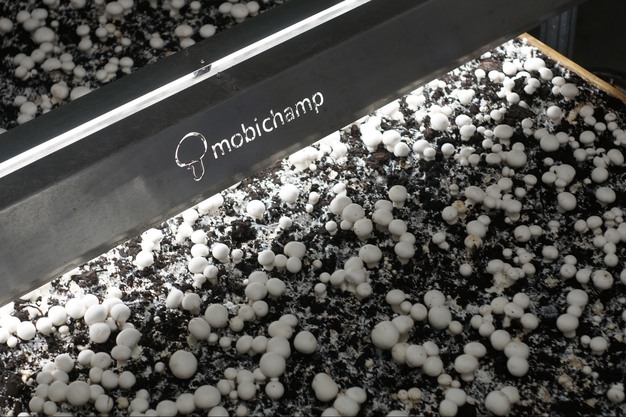
That information is not only stored but also applied instantly. Using a projector, the picking advice is displayed directly on the cultivation bed: mushrooms ready for harvest are marked in colour. "This way, pickers can see at a glance where to start," says Niek. "The result is more consistent quality and a higher yield, as fewer mushrooms are picked too early or too late."
Because the system determines the optimal picking moment, growers using Smart Harvest see yields increase by around 10% in practice, according to Niek. "But we've already shown that the yield can be even higher. When everything is optimally aligned, a 20% increase is achievable in practice. We've demonstrated that in test setups."
Valuable data
The Smart Harvest system also collects valuable data for growers. Through a digital dashboard, they can closely monitor the growth, uniformity, and quality of their mushrooms. "You can see exactly how the crop is developing and adjust the climate or planning accordingly," says Niek. "Data-driven cultivation is the future, especially in mushroom production."
According to Niek, Smart Harvest delivers clear, measurable results: higher yields, less waste, and more efficient labour allocation within the growing space. "Growers can achieve more kilos per square metre, while pickers can maintain a more consistent pace. The technology helps people perform better."
An intermediate step towards full robotisation
Still, Niek sees Smart Harvest mainly as an intermediate step toward the next phase: full robotisation. "Today, our technology assists humans, but tomorrow the same technology will guide robots," he predicts. "In the future, autonomous systems will be able to recognise and harvest mushrooms entirely on their own. I'm convinced of that, and it will require the same intelligence we're already developing."
 © Mobichamp
At the same time, the moment for that has not yet arrived. "There are still important hurdles to overcome before we can replace human pickers. For example, humans can detect diseases early and skip affected mushrooms. A robot, on the other hand, wouldn't recognise the problem yet and could spread the disease to other beds. Only when smart systems like ours can handle such challenges will a robot be able to take over."
There will always be a need for skilled workers
That doesn't mean people will disappear from cultivation, Niek emphasises. "There will always be a need for skilled workers. Technology mainly takes over repetitive tasks and provides continuity in a sector where labour shortages are a major challenge."
According to Niek, the Netherlands is a global leader in mushroom technology. "We have unique knowledge and innovation power here. By combining that with data and AI, we can make cultivation not only more profitable but also more sustainable and future-proof. And that's not a distant vision; we're already proving it in practice. But this will only continue to grow in the years ahead, I'm sure of it."
For more information
Niek Franzmann
Mobichamp
Straatsebaan 6
5757 PX Liessel
[email protected]
www.mobichamp.nl