This article discusses the impact of weather conditions throughout the U.S. this year on fresh produce crops.
Mixed east coast weather
Starting on the U.S. east coast, weather has been quite mixed in recent months. In the spring, there were periods of dryness, threatening crops. Citrus and several other fruit and vegetable crops in the southeastern U.S. were stressed during this time and irrigation was in strong demand. Fortunately, timely rain showed up before the situation became critical. Early summer followed with a good mix of rain and sunshine and at times, the amount of rain was heavier than desired. Late summer on the other hand turned quite dry in northern Florida, southern Georgia, southeastern Alabama, and in the Carolinas at times. "Crop moisture stress did evolve for some unirrigated crops in the southeastern states during late summer, but it wasn't long before timely rainfall resumed," says Drew Lerner with World Weather, Inc.
All in all, it wasn't a perfect summer, but most of the fresh produce escaped extremes. "Each time the weather was getting a little tough on crops it would change to induce improvement." The alternating pattern of rain and sunshine became a huge benefit to fruit and vegetable crops in the region, and this part of the country is expected to end up with a mostly average production year.
 © World Weather
U.S. topsoil moisture. Source: World Weather, Inc.
Dry conditions in the Midwest
Moving over a bit further west, drought has been expanding across the lower and eastern Midwest into the Mid-South (Delta and Tennessee River Basin) regions since August. This has resulted in a huge drain on soil moisture and notable rise of crop moisture stress, quick crop maturation as well as early harvesting. "On a positive note, most of the key fruit and vegetable crops had already moved through their largest production season before it became notably dry and warmer than usual," said Lerner. "However, in unirrigated fields and orchards, the size of late-season crops will be smaller than usual. In addition, crop quality will be reduced as well in areas that were subject to the most stressful conditions for the longest period of time."
Less chronic heat in California
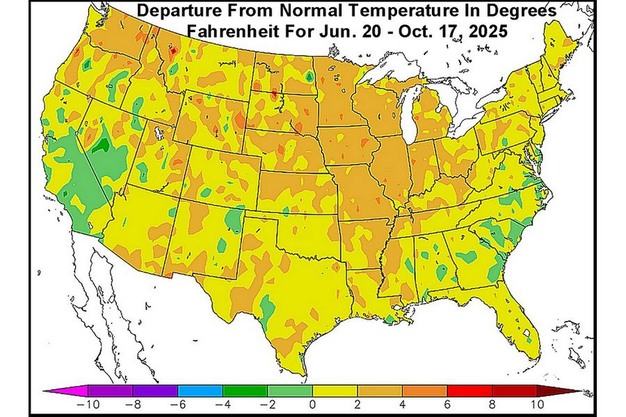
Over in California, weather has seen remarkable improvement this year with much less chronic heat. Temperatures were much kinder to fruit and vegetable development and as a result, most fruit sizes have been notably greater than those of 2024. Last year, excessive heat prevailed for a long period of time, having a significant impact on crops throughout the state. Due to more favorable conditions this year, production of most fruit, vegetable, and tree nuts is likely to be very good. Looking ahead, California precipitation in the coming winter may not be as good as it has been in recent years. While this could slightly reduce water reservoir levels for 2026, no crisis is expected.
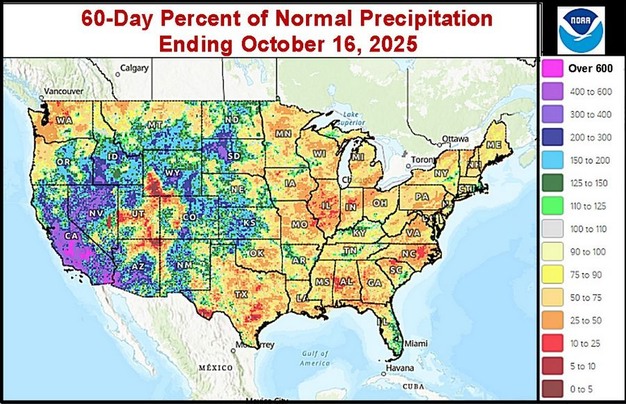 © U.S. National Climate Prediction Center/NOAA
Source: U.S. National Climate Prediction Center/NOAA.
Dry conditions Pacific Northwest
In the Pacific Northwest however, drought has been a problem in recent months. The Yakima Valley of Washington as well as northern Oregon have been particularly impacted. These areas are largely irrigated, and water supply has carried most crops through the drier weather mainly because of infrequent bouts of heat that never lasted more than a few days at a time. Only areas that ran out of irrigation water were faced with serious production cuts. The water supply situation in the northwestern U.S., however, will need to be closely monitored. A good snowfall year is needed in the Cascade and northern Rocky Mountains to ensure a favorable restoration of water supply for 2026 crops.
In the northeast, frost and freezes are starting to have an impact, but these conditions are not unusual for this time of year. If anything, they should be expediting crop maturation and harvesting.
 For more information:
Drew Lerner
World Weather, Inc.
Tel: (913) 383-1161
[email protected]
www.worldweather.cc