No hoes, but lasers. No workers lying on their stomachs planting seedlings by hand, but a fully automatic planting machine. During the BASF | Nunhems demo days (link in Dutch) in week 39, it wasn't just about new varieties, but also about mechanization. Several suppliers were invited to showcase their innovations during Top of the Crops, with two live demos held each day.
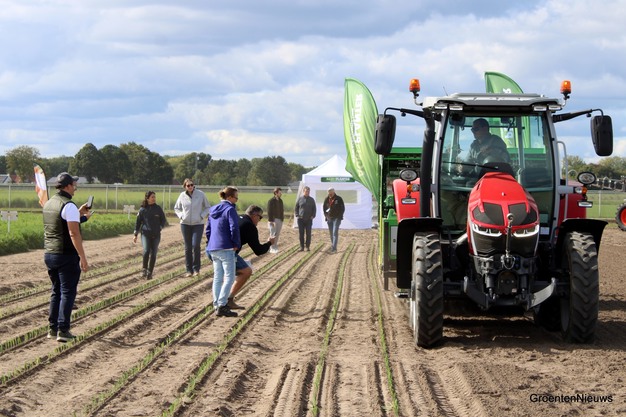 © Thijmen Tiersma | FreshPlaza.comDemonstration Agriplanter on leek field
Automatic leek planting
One of the exhibitors was Agriplanter, working together with Ellepot. Agriplanter's machine, mounted behind a tractor, helps growers automatically plant various tray and plug plants. On the demo field that Tuesday afternoon, all eyes were on leek planting.
The small leek seedlings were automatically pushed out of their trays and neatly planted in rows in the soil. The machine worked impressively fast and precisely, even sorting out any empty plugs on its own. This ensures the grower's field is perfectly and efficiently filled.
The type of crop being planted determines the planting speed. For leeks, the tractor moves at about 1.5 to 2 kilometers per hour. Cauliflower can be planted faster, at around 5 to 8 kilometers per hour, partly because of the wider spacing required for that crop. When planting leeks, the machine can handle between 11,000 and 14,000 plants per hour.
The model on display was equipped with two robotic arms mounted on a platform. However, setups with up to six robots in a row have already been built. In total, 14 different chassis types have been produced so far, depending on market needs. For instance, in North America, larger and wider machines are in demand.
There are now about 200 of these planting machines operating worldwide. The very first one went into the field about eight years ago, developed for a Northern Italian grower specializing in processing tomatoes. Interestingly, tomato cultivation remains the main crop where these machines are used most extensively today.
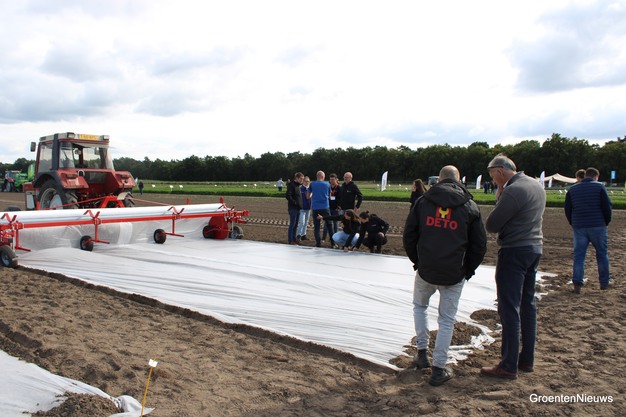 © Thijmen Tiersma | FreshPlaza.comFoil layer Deto Mechanization
Cloth laying no longer manual work
Elsewhere on the demo field, another tractor could be seen, this time pulling a system from Deto Mechanisatie designed to lay protective film over crops. This type of film is used to shield plants from weather conditions, encourage earlier growth, and extend the growing season.
For the demonstration, the films were supplied by Cropshop, available in various widths and thicknesses. To make mechanical film application possible, the edges of the films need to be reinforced—an important detail that ensures the material can be rolled out smoothly and without tearing.
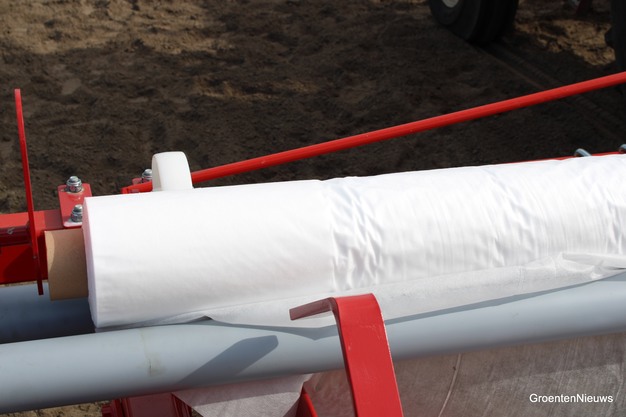 © Thijmen Tiersma | FreshPlaza.comReinforced edges of foil make mechanical rolling easier
Laying film over crops is still mostly done by hand, but growers are finding it increasingly difficult to find workers for this heavy task. In practice, there are already five machines operating in the field, showing that mechanization is well underway. Work is also being done on automating the collection and rolling up of the film. The first tests have already taken place, and the results look promising. Films that are neatly rolled up after use can be recycled, making the process not only more efficient but also more sustainable.
 © Thijmen Tiersma | FreshPlaza.com
Weed control with a laser
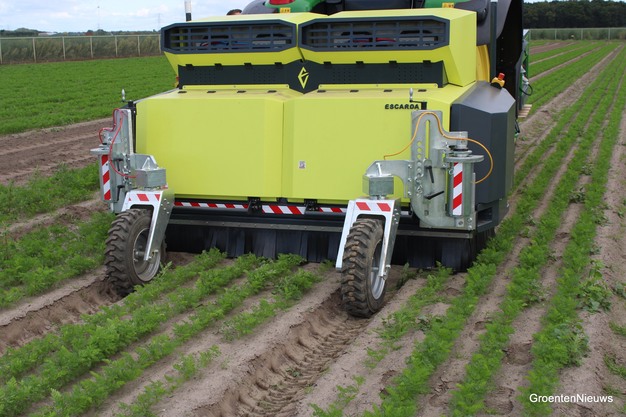
The third machine showcased at Top of the Crops came from Escarda, a company whose product officially hit the market earlier this spring. Representatives from Homburg, the dealer, demonstrated how this innovative machine uses thermal energy to combat weeds. It fires a focused laser beam directly into the center of each weed, effectively destroying it. To distinguish weeds from crops, the system relies on advanced vision technology.
The AI is currently trained to recognize crops such as carrots, sugar beets, and tomatoes. Development is ongoing to expand its capabilities so that, in the near future, it can also identify onions, garlic, asparagus, parsnips, and strawberries. The system is already being used successfully by pilot customers, including Morningstar Inc., the largest tomato processor in California.
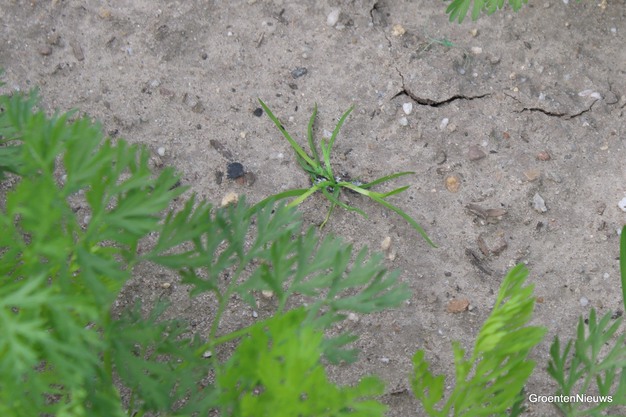 © Thijmen Tiersma | FreshPlaza.comThe Escarda camera can already identify weeds from a size of 3 mm, allowing for early removal.
Ecorobotics and Coenders from Lottum also gave live demonstrations. Ecorobotics showcased a precision spot sprayer that applies crop protection products only where needed, helping growers save on chemicals and reduce environmental impact. Coenders, meanwhile, demonstrated an innovative system for cleaning and trimming leeks, showing how post-harvest handling can be made faster and more efficient.
For more information:
Agriplanter
[email protected]
www.agriplanter.com
Deto Mechanization
[email protected]
www.deto-mechanisatie.nl
Cropshop
[email protected]
www.cropshop.nl
Escarda
[email protected]
www.escarda.tech
Homburg Holland
[email protected]
www.homburg-holland.com