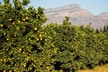
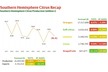
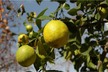
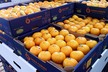
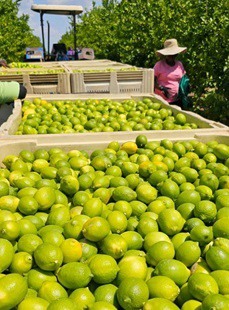
 © SunfedNormally, by the end of April, observes Jacobus van Staden of Sunfed, the marketing division of Hoedspruit-based Soleil Citrus, they'd be over halfway through their lemon crop: this year, they've so far, given the unprecedented amount and duration of the rain, only been able to pack and ship 20% of a crop that's in high demand.
Right: it's been a long, frequently interrupted lemon harvest
The good news has been the imminent removal of tariffs on fruit going to China. That is going to be a boon, definitely, he says, although the time frames are still under negotiation. Soleil Sitrus, whose fruit is wholly managed by Sunfed, is packing lemons and grapefruit at the moment.
Lemon price expected to trend downwards
China takes basically no South African lemons due to the rigours of the required cold treatment and the colour at which the lemons would need to be picked.
The rain has really been odd this season, he says. "The most rain I would say we've ever experienced, and we've fallen behind especially on lemons." The lemon harvest, frequently delayed by rain, has already been a long one, and they expect a long stretch ahead still.
And while they have been catching up on the harvest when the rain allows (avoiding oleo at all costs), their compatriots in the Eastern Cape started their lemon harvest.
"We sent a lot to Europe, but it's been really difficult with citrus black spot and the amount of rain we had. It's tricky; we take it from week to week. Demand has held strong, and the prices for lemons have held firm, but as the Eastern Cape starts and more volumes arrive," he observes, "I think the situation will change somewhat. I don't expect the price to plummet, but it will doubtless be affected."
 © Sunfed
Last pre-war containers still arriving
General industry figures show that South Africans have raised the proportion of lemons to Europe this season from 12% to 19%. The Middle East's market share of South African lemon exports stands at 33% now, versus 2025 YTD 55%.
There are some pre-war containers still on the water, whose contents are due to be offloaded, and they avoid the Strait of Hormuz now, but shipments to the Middle East go on regardless, he affirms, although it's a bit more complicated and a bit pricier than before.
Rising shipping costs have hitherto been absorbed downstream by clients in the Middle East and Southeast Asia.
In China, grapefruit sales shift to processing
Grap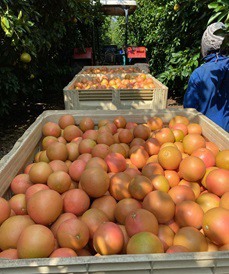 © Sunfedefruit feels a little bit more difficult to sell with every year passing, Van Staden says, noting that, at least, the volumes aren't getting bigger. There remains an indispensable role in the food chain for the amount of grapefruit grown by South Africa, of that he's certain. The clients for the minute amount of Marsh grapefruit they still grow are all based in Europe.
Europe takes two-thirds of South Africa's class 1 and class 2 grapefruit, and Russia is the second-largest recipient with 13% of the market share YTD. Russia became quickly saturated with citrus, he remarks, but it was not as a direct result of diversions from the Middle East.
"We send a lot of grapefruit to China, but this year the amount we've sent has been much lower," he says. Industry figures ending week 17 2026 show that the market share of South Africa's processing grapefruit exports is dominated by China, so far this year receiving 80% of South Africa's processing-grade grapefruit.
In years gone by, grapefruit exporters were cautioned against sending PP fruit in bins to China, but that is, in fact, the way in which business has increasingly moved. Sending citrus duty-free to China is a heartening prospect, he says.
 © Sunfed
Valencias won't be plain sailing
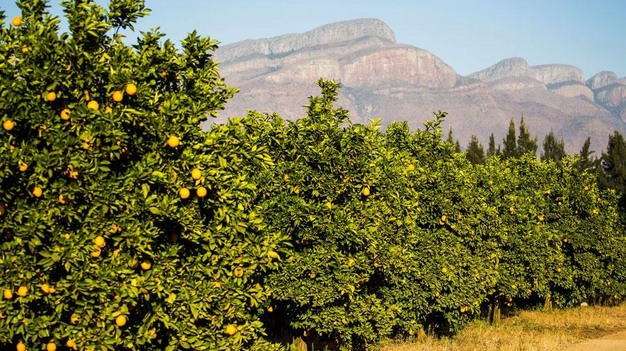
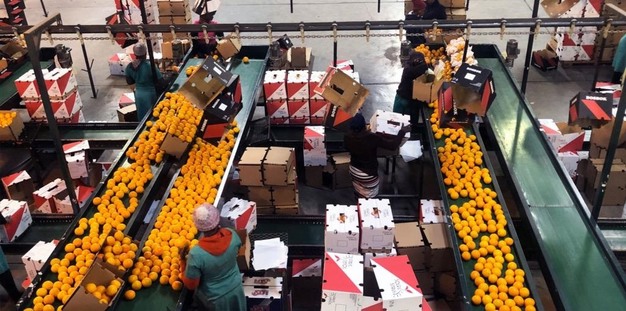
Valencias will commence in roughly two weeks to a month. "I'm a bit sceptical about Valencias. Hopefully, Egyptian product will be mostly absorbed by that stage, though I expect we'll see an overlap at the start of our season."
It concerns him that South Africa's Valencia crop, across all regions, is larger than last year's; it had ended badly last year with a complete orange oversupply in India and Bangladesh. On the bright side, the United States exempts Western Cape oranges from tariffs, keeping that fruit out of the northern provinces' traditional markets.
"Europe does look strong; there are opportunities for Valencias," he remarks. "Later during the season, when we get to the Valencias and the middle section of the grapefruit crop, I expect a more difficult season."
 © Sunfed

For more information:
Jacobus van Staden
Sunfed
Tel: +27 73 015 7011
Email: [email protected]
https://www.soleilsitrus.co.za/