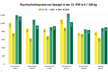
Brazilian melon exports declined again in March. Compared to February, export volumes dropped 47 per cent to 21,800 tons, according to Comex Stat. Export revenues followed the same trend, falling 53 per cent to US$17 million (FOB). The main destinations were the Netherlands (35.9 per cent of total shipments), Spain (34.79 per cent), and the United Kingdom (26.02 per cent).
The decline in volume is linked to the end of the 2025/26 harvest in Rio Grande do Norte/Ceará, Brazil's main melon-exporting region. According to Hortifrúti/Cepea sources, harvesting activities were completed by the end of March, despite rainy conditions throughout the month. Mossoró, the leading producing municipality, recorded approximately 139 mm of rainfall in March.
However, when analysing partial results for the season from August through March, compared to the 2024/25 campaign, exports showed gains in both volume and revenue. Shipment volumes increased 10 per cent year-on-year to 257,400 tons, while revenues rose 25 per cent to US$220.6 million (FOB). This growth was supported by stronger European demand, production issues in competing regions such as Central America, and increased output in Brazil linked to expanded planted area for the 2025/26 season.
During Brazil's off-season from April to June, some producers began harvesting and exporting as early as March. Current expectations point to shipment volumes in line with the past two years, which recorded growth during the off-season period. This outlook remains despite improved production in Central America, as supply from those countries is expected to decline by the end of the current month, alongside Brazilian supply, with the start of the Spanish season.
Persistent rainfall in Rio Grande do Norte and Ceará may affect shipments during this period. In addition to disrupting harvest operations, excess moisture has affected fruit quality, preventing it from meeting export standards and increasing volumes directed to the domestic bulk market.
Regarding contracts for the 2026/27 Brazilian season, initial negotiations originally scheduled for late March have been postponed due to the ongoing conflict in the Middle East. This has created uncertainty around freight costs on maritime routes used for exports. Despite potential delays in contract finalisation, the start of the next harvest is not expected to be affected.
With rising freight costs, particularly on maritime routes to Europe, and concerns among Brazilian exporters about potential saturation in the European market, alternative strategies are being considered. These include expanding shipments to new markets such as Asia and increasing volumes to destinations like Canada, with the aim of reducing dependence on Europe while maintaining export levels.
Source: HFBrasil