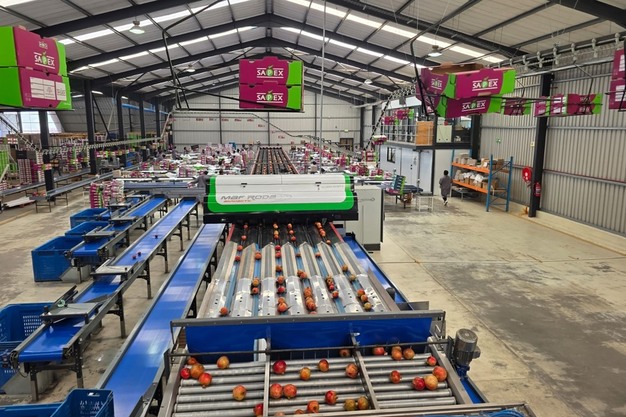
When the war broke out, there were some containers of Sapex pomegranates – fewer than twenty in total; it's the start of the pomegranate season – across three vessels on the way to the Strait of Hormuz. "Most of the affected vessels were diverted to India, where they were offloaded. The containers had to be transshipped from there to the original destinations. We're still busy arranging it with the help of the shipping lines and clients," says Kobus Louw, SAPEX general manager.
"None of the containers has reached their original destination as yet. Every hour it changes, and that is our job now every day: keeping track of the scattered containers."
On 28 March, some of these pomegranates were offloading in Port Salalah, Oman, when they came under drone attack. Maersk has halted operations in the port. "We are still unsure regarding the whereabouts of these containers. Everything seems to be fine with it, but the actual whereabouts must still be confirmed. It takes a day or so for the real facts to come through to us. What we can say is that the shipping lines are doing their very best under very challenging circumstances."
 © Sapex
"They're all saying: at all costs, get it here."
War has not dampened the pull for pomegranates in the Middle East region. In the month leading up to the war, prices had already been rising and are still, a month into the war, holding firm.
"There's a demand for pomegranates in the Middle East, and it's growing every year. No one has told me: Sorry, let's hold off on the order. They're all saying: at all costs, get it here."
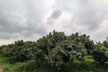
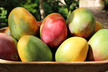
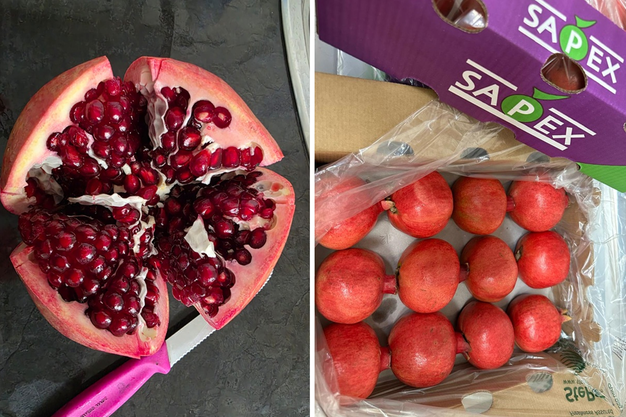
South Africa's pomegranate season started earlier this year, and an early end, by a week or two, is expected, Louw says. "Sizing is smaller than usual, which translates to lower volumes. The relative quality is similar to last year, with this distinction: general colour is significantly better, internally and externally."
Diesel availability is everyone's worry, but he's not heard of anyone in the pomegranate supply chain whose tanks have run completely dry.
 © Sapex
Improved colour on last year's crop, inside and out
Air freight skyrockets
As for satisfying the demand for pomegranates from the Middle East, it's been a matter of coming up with new plans to get the fruit to keen buyers. Air freight has stepped in, although at a steep cost.
Sapex has flown out 60 pallets of pomegranates for two clients (about 60 tonnes) from O. R. Tambo International over the past two weeks: last year, during the whole season, they flew out four pallets.
"There is a good possibility that prices can increase even more, but as with everything, there will be a ceiling above where it is no longer sustainable."
The problem, he explains, is that higher prices will be negated by higher logistical costs. Circuitous routes to safer ports, like Mersin in Türkiye, take longer, by as much as two weeks, and cost a lot more.
Fortunately, pomegranates can handle the longer transit times. He reckons it is fairly certain that Europe will receive a greater proportion of the pomegranate crop as a result of the percentage that cannot go to the Middle East at war. "How that will influence prices in this region," he says, "remains to be seen."
 © Sapex
 For more information:
Kobus Louw
Sapex
Tel: +27 21 883 8280
Email: [email protected]
www.sapex.co.za