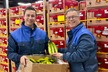
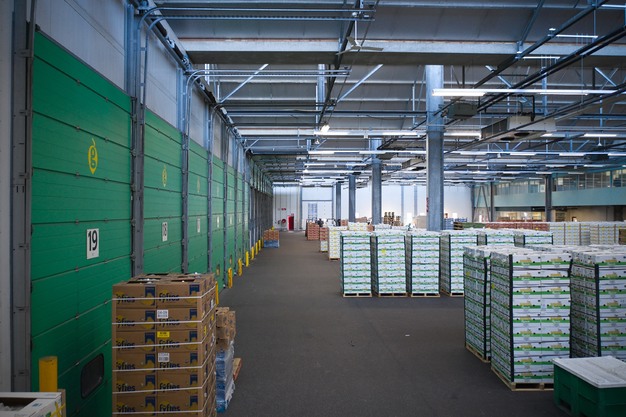
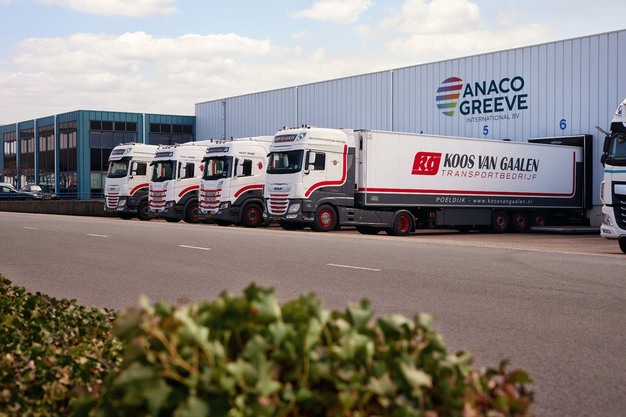
"Though trading is in our blood, trading , in itself, is changing," says Mark Greeve of Anaco Greeve. From ABC Westland in Poeldijk, the company supplies fresh produce year-round to wholesalers, food service companies, retailers, and green grocers in Europe and beyond. In the fruit segment, the focus is on bananas, and Anaco Greeve has its own ripening facility with a capacity of 50,000 boxes per week.
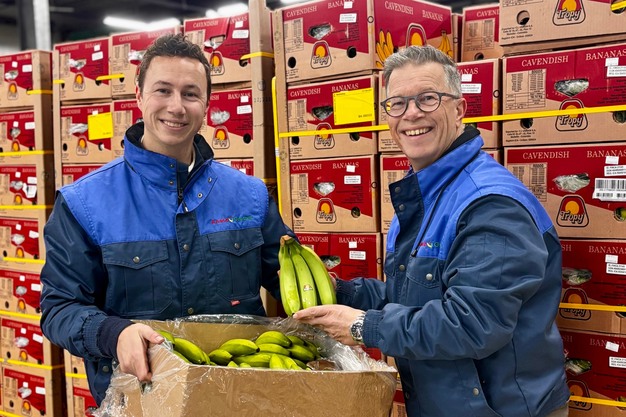 © Anaco Greeve
Partnerships
According to Robert Greeve, banana trading has changed significantly in recent decades. "In the 1980s and 90s, free trade accounted for almost three-quarters of turnover. Back then, everything was open," he says. Today, around 80% of trade is under contract, mainly with retailers.
The trader's role has, thus, changed, too. "You used to buy and sell. Now you meet with customers and suppliers and talk partnerships. Everyone earns something that way." Free trade, however, is still vital, adds Mark. Bananas are a natural product, so weather fluctuations regularly affect supply and demand.
"Being a trader these days means fighting for your supplier's product and ensuring you have a good grip on the chain," says Mark. The company used to work via large multinationals; now, Anaco Greeve imports about half its bananas itself. It is also looking into launching its own brand.
Each market has its preferences
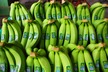
Tastes vary by region. In Western Europe, Anaco Greeve mainly supplies ripened Colombian bananas, while in Eastern Europe, green bananas from Ecuador are popular. "That has to do with things like size. Colombian bananas are more manageable, while Ecuadorian bananas are often larger," Robert notes.
 © Anaco Greeve
Logistics are changing, too. Containers are increasingly going directly to ports like Klaipeda (in Lithuania) and Helsingborg (in Sweden), instead of via Rotterdam or Antwerp.
India, Venezuela, and Africa
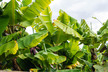
While South America is the top region of origin, the company is exploring new sources. Trial containers from India show quality comparable to that of South American bananas. Here, though, the longer shipping routes make logistics challenging.
Anaco Greeve is also looking toward Brazil and Venezuela. "The first trial containers from Venezuela are on their way, and should compare well, quality and flavor-wise," Mark explains. On the sales side, too, new markets are being explored. Mark considers Africa a region with growth potential due to its young population and increasing demand for fruit.
 © Anaco Greeve
From stunt to sustainable
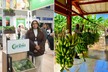
Robert adds that the time of supermarkets using bananas mainly as a sales gimmick seems to be gradually ending. "Countries of origin are exerting pressure for more realistic prices." Increasing attention to sustainability and social responsibility plays a role in that.
Although specialties like plantains are more commonly found on store shelves, Anaco Greeve's focus remains clear. "Specializing in a single product allows you to remain flexible and deliver quality. It's that focus that drives banana segment growth," Mark concludes. (PB/PDC)
For more information:
Anaco Greeve International B.V.
ABC Westland 666
2685 DH Poeldijk
Tel.: (+31) 174 638 666
[email protected]
www.anacogreeve.nl