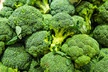
Progressive farmers in Pakistan's Punjab province are increasing broccoli cultivation as demand grows among upper-income consumers. Although broccoli remains a niche crop compared to cauliflower and cabbage, it is now available at major supermarkets, specialized vegetable outlets, and online platforms.
Production is concentrated on the outskirts of major cities, particularly Lahore, as well as in Sheikhupura, Kasur, Sahiwal, and Pakpattan districts.
"This is a profitable crop. There is a strong demand for broccoli in Lahore, Islamabad, and Karachi," said Pir Mehmoud Chishti, a grower from Pakpattan district.
He noted that despite attractive prices, growers face uncertainty due to an underdeveloped marketing network. "The retail price of broccoli ranges between US$0.71 and US$1.24 per 500 grams, which is significantly higher than cauliflower or cabbage," he said. However, imported seed represents the highest cost in cultivation, and marketing remains a constraint due to limited consumer familiarity.
According to Chishti, the main buyers include high-end hotels, departmental stores, and selected vegetable shops in Lahore, Karachi, and Islamabad. Some farms sell directly to households through online platforms. "You cannot supply broccoli in large quantities. Sending small volumes is more profitable because the demand is limited. In case of oversupply, growers face losses," he said.
Several varieties are grown in Pakistan, with the green type the most common. The crop is produced during the cool season from September to March.
All seed is imported from countries including Holland, Japan, China, and Thailand. A 10-gram packet costs around US$10.71. "A 10-gram packet costs around Rs3,000, making broccoli cultivation an expensive venture," said Tahir Saleemi, a vegetable seed dealer. He stated that local variety development could lower production costs.
"The seed production phase of broccoli falls in late March and April. Because of high temperatures during this period, we have not yet succeeded in developing a local variety," said Wajeeha Khan of the Vegetable Research Institute in Faisalabad. She added that researchers are testing different sowing windows. "Hopefully, we will succeed in developing a local broccoli variety in the future."
Broccoli requires low temperatures for optimal production, making Punjab suitable during winter. It is often cultivated on small plots, sometimes on less than 0.40 hectares, alongside cauliflower and cabbage.
Nutritionists cite fiber, vitamins C, K, and A, and sulforaphane as factors behind increasing consumer interest.
Source: APP