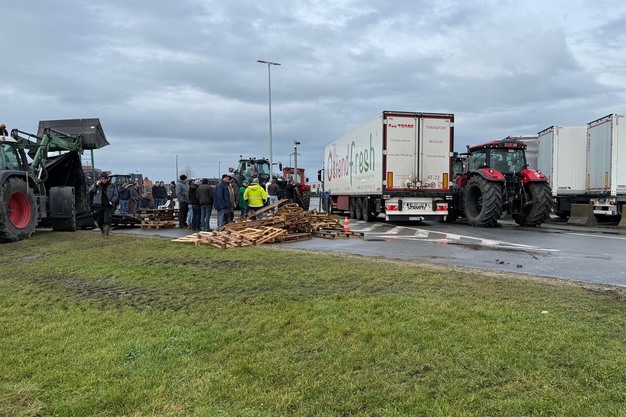
Some 60 farmers have been blocking the Ostend International Airport since Monday morning. The activists are members of the General Farmers Syndicate (ABS) from West Flanders. With their protest, they are targeting the EU-Mercosur agreement, which was approved by most EU member states and still has to be approved or rejected by the full European Parliament later this year.
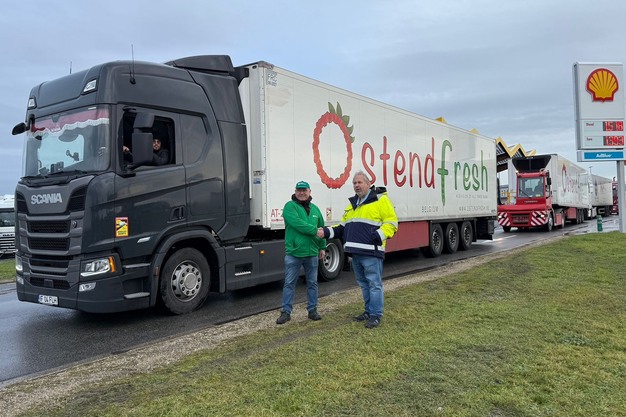
Alain Tulpin of Tulpin Group, which specialises in air transport of fruit and vegetables and Egyptian strawberries in particular via Ostend Airport, met with them yesterday afternoon. "In the end, they opted for a filtered blockade, allowing five of our refrigerated trucks carrying Egyptian strawberries to leave around 2 p.m."
 © Tulpin Group
Bruno Vincent, chairman of ABS, with Alain Tulpin, CEO of Tulpin Group
Unfair competition
Belgian farmers do not object to certain products imported from Mercosur countries, such as grapes, mangoes, and melons. However, they are very concerned about products such as meat, sugar, grains, or soybeans; they stress to Alain. "In countries like Brazil, for example, sugar can be produced much more cheaply than by European farmers."
Belgian beef comes from the Belgian White-Blue breed, which is characterised by a high proportion of quality lean meat. This contrasts with Mercosur meat, which typically has a much higher fat content. The fear among Belgian farmers is that this lower-quality Mercosur meat will be sold on the European market at a lower price, especially to the meat processing industry. In addition, cereals and soybeans are grown in Mercosur countries using several glyphosate treatments, which are no longer allowed in Europe. This enables grains and soybeans to be produced significantly more cheaply there, they indicate.
Belgian farmers oppose this uneven playing field, where Belgian farms, mostly family farms of around 30 hectares, have to compete with large-scale Mercosur farms of thousands of hectares. This, they say, leads to unfair competition, making it difficult for Belgian farmers to survive at these low Mercosur prices. According to the farmers, it is particularly regrettable that regional, Belgian, and European politicians attach more importance to the benefits that the EU-Mercosur agreement offers to the European car and chemical industry than to the adverse effects on Belgian agriculture. For this reason, the agreement is also mockingly referred to as the "car-for-cows deal".
 © Tulpin Group
Incidentally, the farmers indicate they receive a lot of sympathy and support from the population, which seems increasingly unaware of the origin of the food on their plates. "To date, however, no politician has joined the blockade to listen to or act on the farmers' concerns. Therefore, the blockade continues unabated."
Political responsibility
Since the start of the blockade on Monday, passengers have been given free passage at Ostend Airport, but no cargo has been allowed to enter or leave the airport. Ostend Airport CEO Nathan De Valck has been in discussions with representatives of the General Farmers Syndicate since the start of the blockade to obtain free passage for perishable goods.
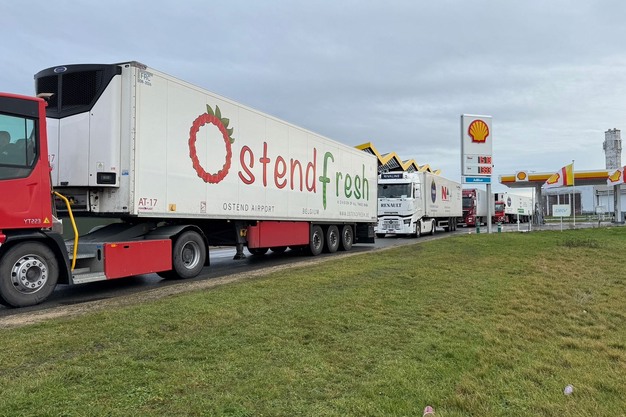
"On Tuesday morning, Mr De Valck and I held talks with farmers and their representatives," Alain says. "At that time, 22 refrigerated trailers carrying Egyptian strawberries destined for the UK were blocked at Ostend Airport. Incidentally, the airport does not receive flights from Mercosur countries. I listened carefully to the concerns of the farmers and their representatives and explained that most strawberries in Egypt are grown by family farms and young growers, and are mainly destined for the UK market. I also stated that I share the farmers' views regarding the EU-Mercosur agreement and support their call for more political responsibility regarding this agreement."
 © Tulpin Group
The first trucks were allowed to leave
"At the same time, I did want to stress the importance of solidarity between farmers. Egyptian growers should not lose their crops either. After all, Egypt produces strawberries from late November to late February, exactly in the period between the end of the Belgian season and its restart in early April," he continued.
Solidarity
"After lengthy negotiations, the farmers of the General Farmers Syndicate recognised the importance of solidarity between family farms. They decided to turn the full blockade into a filtered blockade, allowing refrigerated trucks carrying Egyptian strawberries to leave in groups of five trucks each. Around 2 p.m., the first five trucks left Ostend Airport heading for England, in the presence of both television and print media."
"Nathan De Valck of Ostend Airport and I would therefore like to thank the farmers and the representatives of the General Farmers Syndicate for this kind gesture, which prioritised solidarity between farmers and allowed the strawberries to reach their destination in good condition after all." However, the blockade will not be lifted and will continue, while respecting the departure of already landed shipments of fruit and vegetables.
For more information:
Alain Tulpin
Tulpin Group
Kapellestraat 2A bus 6
8460 Oudenburg, Belgium
Tel: +32 (0) 59 80 66 33
[email protected]
www.tulpingroup.eu