The South African citrus season has entered its final phase. What stands out are the substantially higher export volumes. High production levels and a favourable exchange rate for exports to Europe have ensured large shipments to this market. "Overall, exports of tangerines to Europe, for example, were 25% higher throughout the season, but even more than 40% in the last three weeks," says Andres Ribas van Oosterom of FruitOne Europe. This created the necessary stock levels, yet he is not complaining about the market. "Although prices were somewhat lower, the extra production per hectare partially offset producers' returns. Moreover, we are currently seeing very healthy citrus consumption on the European market." 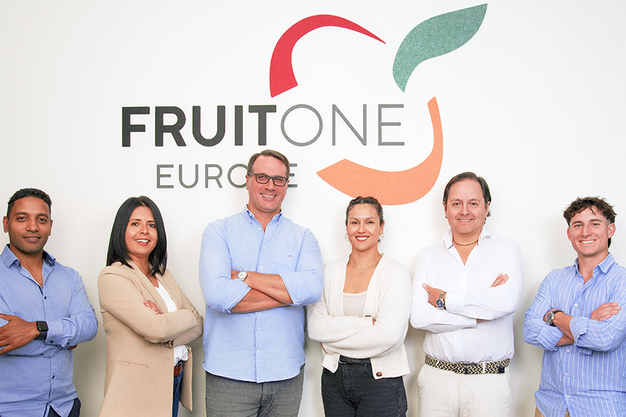 © FruitOne EuropeTeam FruitOne Europe, with third from left, Andres Ribas
"The lemon market has actually been good all season. Consumption has been stable, and South Africa and Argentina have had good prices throughout. This remains the case because Spain has fewer lemons, and Turkey also has fewer due to frost at the beginning of the year," says Andres. He also describes the grapefruit market as unusually stable. "South Africa may have sent more grapefruit, but the price never really collapsed, which has happened frequently in other years. You do see that grapefruit imports are increasingly concentrated among a few established players, with growers increasingly choosing to programme most of the volume."
"Production of Navels in particular was very high in South Africa, and virtually everyone sent more oranges to Europe. Often, Mercadona is decisive when the Spanish switch to overseas supply, and you see them continuing with local production until it really becomes impossible. In 2023, they switched overseas in week 32, in 2024 in week 33, and this year, not until week 34. Because Egypt, Morocco, Greece, and Spain were all on the market longer than expected, the initial period was somewhat challenging. Adding to this was that at the beginning of spring, due to rainfall in Spain, all melons and watermelons were planted at the same time. These then arrived on the market simultaneously, leading to heavy promotions mainly for stone fruit, which also ripened earlier due to the June heatwave."
"The overseas mandarin season did not start easily either. There seemed to be fewer fruits on the market, but Peru entered the European market with large volumes of Satsumas and Primosoles because the local market was weak and exports to the United States were not yet attractive. The idea was that the European mandarin market was empty, but Moroccan mandarins were still present. Soon after, Clementines and Novas arrived from South Africa, consumption lagged behind, and that created a snowball effect in the market," Andres continues. "Although the managed numbers remain high, we now see good quality overseas mandarins on the market, and the market is also picking up, supported by the necessary promotions. Finally, prices are now also rising, but in my view, this should have happened three to four weeks ago. The first Turkish Primosoles mandarins do not yet taste good, and the Spanish supply has been affected by the climate, including hail in Castellon months ago, so we foresee a smooth seasonal transition."
"For oranges, too, we do not expect a major crash during the transition of the season. Europe will receive Valencias from South Africa for at least another month, while the Navelinas in Spain will only be packed in export volumes toward the end of the month. So, there too, I foresee a few problems for juicing oranges, especially for juicer sizes. If you had asked me a fortnight ago, I would have thought there would be more pressure, but now I think it is not that bad. All in all, we have faced bottlenecks this season, but the favourable exchange rate and high volumes still make it a satisfactory season in my view."
 © Izak Heijboer | FreshPlaza.comFor more information:
Andres Ribas van Oosterom
FruitOne Europe
Peterselieweg 110
2988 DH Ridderkerk
[email protected]
www.fruitone-europe.com