Italy has traditionally been one of the most important peach producers, with Emilia-Romagna in a leading position. However, factors such as the Russian ban, climate change, and rising costs have caused part of this production to be moved to other regions with lower labor costs and better climatic conditions. In any case, peach consumption in Italy is three times higher than in Spain, which results in a solid domestic demand.
 © Agromillora
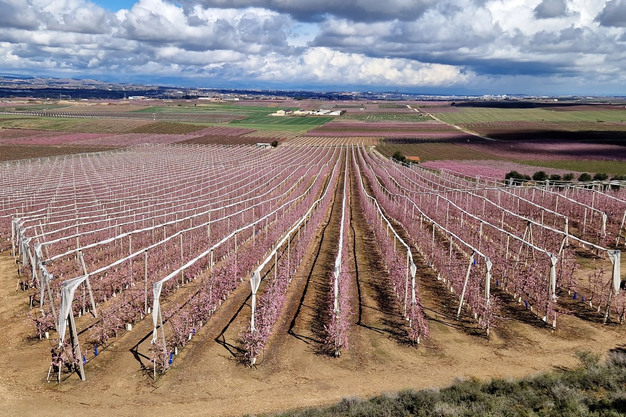
In such a competitive context, it is essential to improve production efficiency, focusing on reducing costs and raising quality. The proposal to use Rootpac®40 rootstock and two-dimensional (2D) shapes is emerging as an effective strategy. Both tools allow a smooth entry into production, efficient mechanization, cost reduction, and improved fruit quality.
The situation of standards and training systems in Italy
"In Italy, the most widespread rootstock is GF-677, which has medium-high vigor and is well-adapted to calcareous soils, but faces difficulties in heavy soils, with nematodes, or replanting. In addition, it delays the ripening and can negatively affect fruit quality in early varieties. It's high vigour makes it necessary to resort to more complex cultivation methods, such as bi-axis or triple axis, as the use of regulators such as Cultar is restricted," says Dr. Ignasi Iglesias, of Agromillora.
"The second most important rootstock is Adesoto-101, originally from Spain. It has 25-35% less vigor than GF-677; it improves fruit quality, adapts well to suffocation conditions, and is immune to nematodes, but is sensitive to resprouting in sandy soils.
Rootpac40 appears as an innovative alternative with better vigor control, fruit quality, and adaptability to different conditions."
As far as training systems are concerned, the axial, palmette, and triple axis have been used in Emilia-Romagna, while in the south (such as Bari), the Spanish Vase system predominates, as it's well adapted to the vigor of GF-677.
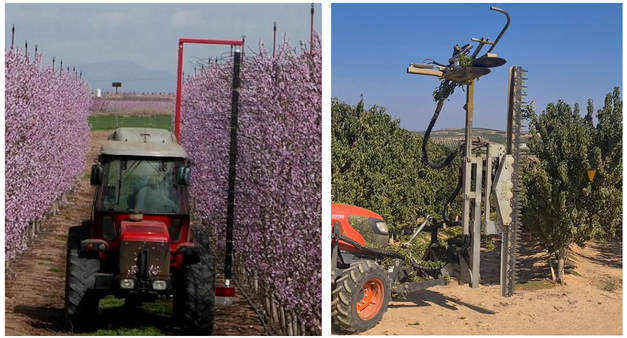
"The mechanization of key operations (thinning, pruning, harvesting) is becoming increasingly important due to rising costs and labor shortages."
 © Agromillora
Rootpac40 Rootstock
Rootpac40 is an almond x peach hybrid, developed by Dr. Jorge Pinochet at Agromillora. It has a more limited vigor (25-30% less than GF-677), with no resprouting, and it offers good varietal compatibility and tolerance to nematodes. It also adapts well to calcareous soils and to winter cold conditions, although it needs well-drained soils and adequate management (irrigation, pruning, organic matter).
"It is ideal for intensive plantations in central axis, double axis, or small volume vase systems," he says.
Experiences in Spain and results
"In Spain, after more than a decade of use, Rootpac40 has been shown to improve calibers, allowing for earlier ripening compared to Garnem or GF-677. In the municipality of Carlet, a higher proportion of A and AA fruit has been obtained with the Pamela variety, and the production's economic value has increased by 30%."
"In a 9-year trial in Lleida with the Noracila and Luciana varieties, Rootpac40 allowed us to bring the production forward in the first two years and obtain more than 100 additional tons per hectare compared to GF-677 in a vase system. This higher production makes up for the additional investment of intensive planting (+10,000 €/ha)."
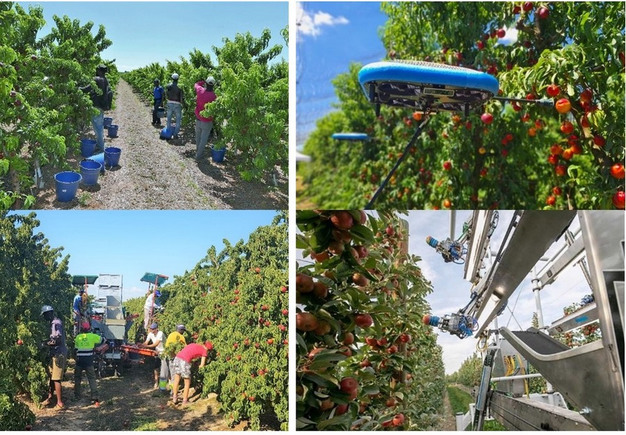
Cost analyses show that labor accounts for almost half of the total costs, especially for the thinning and harvesting. "With Rootpac40, the central axis structure makes it possible to mechanize these tasks, reducing the cost by 14 cts/kg, as well as reducing labor hours per ton of fruit."
The two-dimensional canopies allow better visibility and accessibility to the fruit, facilitating manual harvesting without ladders and allowing the use of platforms. This will also play an essential role in the future implementation of robotic harvesting, as shown by the systems of Tevel (Israel) or Advanced Farm (USA).
 © Agromillora
Proposed production model for the Rootpac40 standard
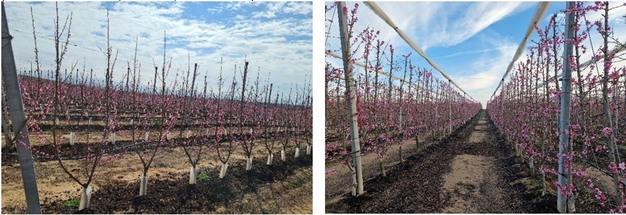
1. Central axis
It uses a structure with a top wire and 2-meter posts. It is the most affordable and easiest system to implement in the first two years and allows efficient mechanization and quick entry into production. It is recommended to leave 3-3.5 meters between rows and 0.8-1.2 meters between trees, depending on varietal vigor and soil fertility.
2. Double axis or bi-axis:
It requires more initial training, but from the second year onwards, the costs even out with those of the central axis. It doubles the number of axes per hectare and flattens the canopy, making mechanization even easier. Recommended spacing: 3-3.5 meters between rows and 1.0-1.3 meters between trees.
 © Agromillora
"The need to reduce costs, optimize labor, and guarantee quality requires changes"
In Italy, the GF-677 and Adesoto-101 rootstocks are still the most widely used, but they have limitations in the current circumstances. "The need to reduce costs, optimize labor, and guarantee quality requires changes," he says. "The use of rootstocks such as Rootpac40, in central axis or bi-axis systems, allows intensive and efficient production that can be more easily mechanized, without the need for growth regulators. This offers a viable and sustainable alternative for the future of peach cultivation, aligned with digitalization, automation, and precision fruit growing."
 For more information:
Agromillora
T.M, El s/n, Carrer del Rebato,
08739, Barcelona. Spain
Tel.: +34 93 891 21 05
[email protected]
www.agromillora.com