Supply chains in Europe faced a number of challenges throughout 2022, with disruptions and bottlenecks impacting services across the continent. In 2023, logistics operations – including European inland routes – will continue to be tested.
Such tests can lead to critical consequences, particularly for temperature-sensitive cargo such as fruits and vegetables. Delays in the supply chain or failure to maintain correct temperatures can potentially spoil products and ultimately result in financial losses. Therefore, speed is of paramount importance in the reefer market, but also available alternative solutions to circumvent bottlenecks.
When it comes to fruits and vegetables, Europe is a large and mature market with stable demand for year-round availability. Due to the climatic range, the continent is both a consumption and a production area.
Spain is by far Europe's leading producer and exporter of fresh fruits and vegetables, accounting for 40.1% of fruit production and 17.3% of vegetable production (CBI). Naturally, the resulting flow of goods into the rest of Europe leads to great amounts of truck and overland transport. In fact, according to Eurostat, more than 1,400 temperature-controlled trucks cross the Spanish border daily on their way to Europe. If both dry and refrigerated transports are considered, the figure is closer to 10,000.
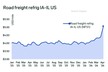
Goods flowing at such high numbers means any disruption puts a strain on supply chains – and the current state of the European market means challenges are coming from a multitude of factors. Rapidly rising food, gas and energy prices have driven inflation to a 40-year high and had a major impact on logistics globally, but looking more closely at the route from Spain to the UK brings several other issues into account.
New reefer rail product connecting Spain with the UK
Sealand – A Maersk Company recently launched a new reefer rail product to support affected customers and provide a valuable solution to the current market challenges. The product connects Spain with the UK and is specifically designed for temperature-sensitive goods such as fruits and vegetables.
It initially offers three weekly departures from Valencia to London, ensuring exporters have their cold chain products delivered to their final destination in a timely manner. On the southbound journey back to Spain, the trains will also carry non-refrigerated cargo.
The new rail product is a response to the demand and needs of our customers. Now we are offering an efficient and environmentally friendly alternative for overland transport. Thanks to flexible capacities, significantly lower CO2 emissions and a focus on temperature-sensitive Spanish exports, we simplify supply chains for all customers.
Visit Sealand at the leading event for worldwide trade of fruits and vegetables, Fruit Logistica, from 8-10 February 2023 in Berlin. Hall 26 / Booth D-40 at Messe Berlin, Messedamm 22, 14055 Berlin, Germany
For more information: sealandmaersk.com