The Spanish clementine season is currently underway with good prices for all links in the value chain, both because of this year's smaller production and the low supply from the southern hemisphere, as well as the good demand in the markets.
"There are no stocks of mandarins or clementines from the southern hemisphere left in the markets, as they have been withdrawn from the market earlier than last year, since their campaigns also ended earlier. The transition has therefore been quite smooth this year," says Juan Bautista Juan, commercial director of the Valencian company Frutas Tono, based in the town of Benifairó de la Valldigna.
 © Foto: Frutas Tono
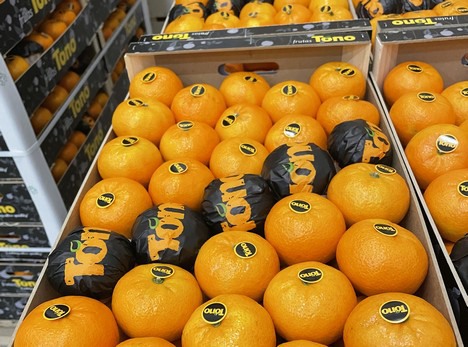
The Orogrós, Oronules, Arrufatina and Marisol varieties are the ones currently being marketed. These will be followed by the Clemenules, the most common variety in the Region of Valencia. "According to official estimations, this year's production is 10% lower than last year. The mandarin and clementine campaign has aroused interest in buyers since the start, and this year's lower production, together with the good demand, is translating - for the time being - into higher buying and selling prices. The truth is that the clementine campaign is starting with optimism," said Juan Bautista.
"In any case, although the citrus production will be lower this year, whether there is too much or too little will be determined by consumption. The market will tell whether the lower volume will lead to prices reacting positively, or if consumption will continue to fall. Just as the demand for clementines and mandarins keeps growing every year, the demand for oranges continues to shrink," said the commercial director of Frutas Tono.
The first Navelina oranges have already started to be harvested in the earliest producing areas, but there won't be consistent volumes available until late October or early November. "Spanish oranges will also enter the market with little overlap with southern hemisphere productions. The sector has learned from what happened last year and there won't be such a clash between volumes as in other years, when there were great tensions in the markets," said Juan Bautista.
In general, oranges are expected to reach mostly small or medium sizes due to the dry weather during the spring and summer months. "It has not rained as much as necessary and when it was necessary for the varieties that are harvested between October and December to reach more commercial sizes. However, the rains of the last few weeks will have a beneficial effect on the Lane and Navel sizes. What is clear is that, if consumption is good, large oranges will be more expensive this season. Also, it will be important to be able to pass the outrageous cost increases, both in the field and in the plants and logistics, on to the final prices," he said.
With regard to competition from third countries such as Morocco, Turkey or Egypt, Juan Bautista Juan said that "based on the information we have, the reduction in the production has not happened only in Spain, but in most producing countries of the Mediterranean arc, which have been affected by heat waves and lack of rainfall."
For more information:
Juan Bautista Juan Gimeno
Frutas Tono S.L.
C/ Camí Pinar s/n.
46791 Benifairó de la Valldigna, Valencia. Spain
T: + 34 96 281 03 26
[email protected]
www.frutastono.com