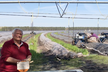
The 2026 French asparagus season got off to a good start, according to Christian Befve, an international expert in the asparagus sector. Despite initial delays in several French regions due to heavy rain, the campaign got off to a positive start. "We had an excellent start to the season, although the impossibility of entering the fields to carry out ridging operations before the start of the season caused concern and delayed the start of the season." But once these difficulties were overcome, production quickly got into gear, for an overall successful start to the season. Unfortunately, this situation did not last, as the market is now suffering from an imbalance in favor of supply.
A widespread heatwave has led to an explosion in volumes
Everything came to a head with the arrival of the very warm weather in recent weeks. "All French regions started producing at the same time," explains Christian Befve. "Normally, yields hover around 150 kg/ha/day, but they suddenly shot up to 200, sometimes even 300 kg/ha/day." This simultaneous acceleration in all production areas has led to a massive influx of asparagus onto the market. As a result, supply far outstripped consumption, which did not follow the same dynamic.
Consumption on the back foot in the face of saturated supply
"While production has suddenly doubled, consumption has obviously not been able to keep pace." This phenomenon has been amplified by a number of factors. "The school holidays may have acted as a brake, of course, but asparagus are not the only produce to have hit the shelves in droves following the heatwave. Strawberry production has also risen sharply. Strawberries are abundant on offer at attractive prices, and I think that this has led to consumers making trade-offs."
Pressure on prices and increased European competition
The excess supply has logically led to a drop in market prices, but the situation was exacerbated by foreign competition. Greece exported heavily to Germany, which itself redirected some of its volumes to France. "Germany, which is in full production, is sending significant quantities to the French market at prices up to €2.20 [2.6 USD] per kilo, which is totally unprofitable. There is also asparagus from Belgium and Holland arriving on the French market at particularly low prices," according to the expert. This phenomenon has increased the pressure on French operators, particularly in the wholesale segment, which is considered to be the most affected. "Producers who sell directly, at markets or to the catering sector, are less affected by this drastic price drop. Producers who sell to supermarkets, even with long-planned promotional campaigns, are also less affected. Those suffering most from the situation are operators who sell their produce to wholesalers. It is in this sector that foreign competition is strongest and prices have fallen the most."
Impact on quality and pressure on the workforce
This overproduction has also had an impact on quality. With harvests that were too large, farms were sometimes overwhelmed. "Some growers have even stopped producing asparagus because of labor shortages. To ensure optimum quality, 1,2 workers per hectare were needed, instead of 1." This resulted in a drop in the first category rate and an increase in second category products, accentuated by buttings that could not always be carried out properly due to wet spring conditions.
A market in gradual recovery?
At the start of this week, however, the market seems to be entering a phase of rebalancing. "It is clear that in recent weeks, some asparagus has sold below the cost price. But the situation seems to have improved very slightly since the start of the week. Volumes are now decreasing due to the cooler temperatures and the fact that some farms have stopped producing. Prices are stable at the moment, but at least stocks seem to be gradually emptying, which is a good sign."
For more information:
Christian Befve
Christian Befve & Co
[email protected]
www.befve.com