How do you drive sustainability when the largest share of your company's emissions occurs not within your own operations, but across your supply chain? That question was central to a presentation by Marissa van Adrichem, Sustainability Manager at Dutch fresh produce trading company Best Fresh Group, at the Tuinbouw Footprint Event 2026 (link in Dutch). The company has calculated that its own operations account for just 4% of its total carbon footprint. "Most of the impact is in the chain — in the links outside our business. We need to work with our suppliers, our customers, and other companies in the sector to make real progress."
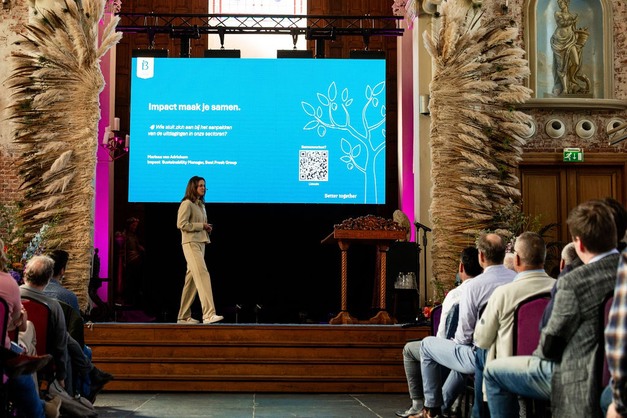 © Sharon SchoutenMarissa van Adrichem during the Tuinbouw Footprint Event 2026
Complex supply chain
Best Fresh Group is a family-owned business based in the Netherlands with more than 400 employees, active across multiple segments of the fresh fruit and vegetable (F&V) trade. Its activities include primary production, trading companies supplying retail, foodservice, and industry, and logistics operations covering ripening, storage, and sorting. Given this complexity, a detailed analysis was required before any footprint calculations could begin.
The decision to start that process three years ago was driven by several factors. First, the organisation established a new strategic positioning built around a future vision of responsible products. Second, efficiency played a role: reducing energy consumption delivers cost savings over time. Marissa emphasised the importance of working closely with the finance department to make sustainability tangible in business terms.
The third driver is growing pressure from legislation and customers. Buyers are increasingly requesting scientifically grounded commitments, such as those aligned with the Science Based Targets initiative (SBTi), which requires companies to set out a reduction plan covering the next 10 to 20 years.
Environmental impact outside the company
Analysis confirmed that the greatest environmental impact lies outside Best Fresh Group's own operations. Of the total footprint, the company's own activities account for just 4%. Within that share, roughly half of the energy consumed is purchased externally, with the remainder generated on-site, including through solar panels.
The remaining 96% is spread across the supply chain, transport, and product processing. The largest portion, around 40%, comes from purchased products: the cultivation of fruit and vegetables worldwide. Transport adds a further 30%, covering multiple modes including road, sea, and air freight, both for incoming flows and outbound distribution to buyers. Processing and packaging account for the rest. Processing includes cutting, packing, and handling residual streams. "When you cut produce and discard peel or other residuals, there is an environmental impact attached to that too," Marissa explained.
The three pillars of the strategy
Best Fresh Group aims to maintain a solid position within what Marissa described as the "F&V peloton", the leading group of sustainable companies in the sector. She characterised the company's sustainability strategy not as a fixed destination, but as a direction: "A dot on the horizon is very specific, you know exactly where you're going. A line is different: you know roughly where you're headed. You don't know exactly how you'll get there, but you know the direction, and that's enough."
The sustainability approach is built on three pillars: healthy people, a healthy planet, and healthy businesses. Internal teams work on themes including emissions, packaging, and working conditions. "It doesn't matter how small your step is; every step counts," she said.
Obstacles and challenges
Marissa pointed to departmental silos as a persistent obstacle within organisations. "The idea that sustainability belongs to one department needs to be broken down. It has to play a role in every decision." She also noted that profit maximisation is frequently still prioritised above sustainability goals. The ambition is to make sustainability an integral part of the business model, factored into all commercial and operational decision-making rather than treated as a secondary objective.
Data availability remains a significant bottleneck. At present, the company relies heavily on assumptions and sector averages. Marissa views this as an unavoidable phase: "We don't have all the data yet. In fact, we don't have most of it. That means we work with assumptions. That's fine, it's what we have right now. It gets better every year."
While the company initially looked at reporting under the Corporate Sustainability Reporting Directive (CSRD), Best Fresh Group now applies the Voluntary SME Standard (VSME), a European framework that supports structured sustainability reporting. "It helps us enormously to maintain clarity and structure in our reporting. We work closely with GroentenFruit Huis and other companies in the sector to align on data points, so results become comparable."
Advice to the sector
Marissa's message to the broader industry was straightforward: don't wait for perfect data, start with what you have. Steering by data is essential to avoid subjectivity, but it is precisely by starting that gaps become visible. She also stressed the value of keeping projects small and manageable. "It makes far more sense to tackle a small project or pilot with a high chance of success. That builds confidence, and the lessons you draw from it feed directly into the next project."
Ultimately, she returned to her central point: collaboration with suppliers and customers is the only way to meaningfully reduce impact across a chain responsible for 96% of total emissions. That includes openly sharing information on production processes and social certifications. "In supply chains as dynamic as ours, where everything can change from one day to the next, you have to seek out collaboration. You learn from each other, and you can help each other. That also makes it easier to take the next step."
For more information:
B est Fresh Group
ABC Westland 100
2685 DB Poeldijk
Tel: +31 174 479 550
[email protected]
www.bestfreshgroup.com