Any conversation about the global pineapple trade begins — and largely ends — with Costa Rica. The country accounts for roughly 10% of world production yet leads the global rankings and handles around 49% of all international pineapple trade, according to Faostat data. Within that landscape, Grupo VISA has established itself as one of the sector's benchmark players, combining production scale, vertical integration, and a clear value-added strategy.
"Founded in 1989, the company today operates as a fully integrated organization, with complete control over its chain from field to end customer. Its evolution has not been linear—it's the result of strategic decisions made at pivotal moments," says CEO Jorge García Ramírez.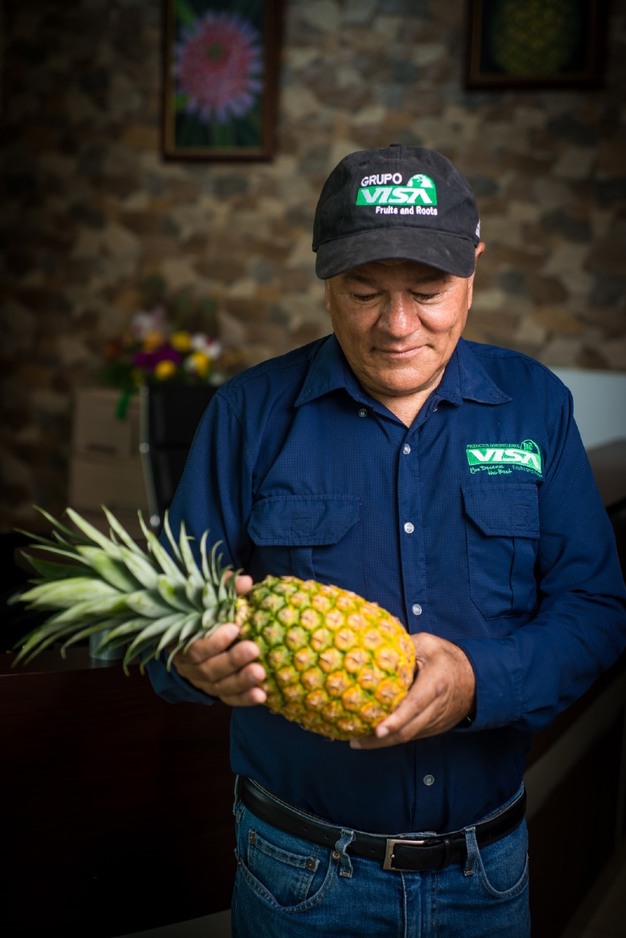 © Grupo VISAA turning point that reshaped the strategy
During a period of global oversupply, Grupo VISA found itself having to discard export-grade fruit that couldn't be absorbed by the market either. "It was a watershed moment," says the CEO. "From that point on, the owners and board committed to building a model that would reduce our exposure to that kind of situation." That episode became the catalyst for a strategy built on diversification and higher value-added products.
(photo on the right: Don Gerardo Villalobos, founder of Grupo VISA)
Taking control: full vertical integration
Grupo VISA today farms 3,600 hectares of pineapple and sells exclusively fruit of its own production across fresh, frozen, and dehydrated channels. "We don't buy pineapple from third parties," explains Commercial Manager Max Paniagua Chacón. "That gives us full control over quality, traceability, and planning."
The operation ships around 13 million boxes of fresh pineapple per year — approximately 7,000 containers — split between two core markets: roughly 60% to the United States and 40% to Europe.
Close to the customer: direct presence in the US
The company sells directly in the United States through its VISAFruit office, managing sales of fresh, frozen, and dehydrated pineapple as well as root vegetables. "Being in the market lets us understand customers better, react faster, and offer tighter logistics solutions," says Paniagua Chacón. That proximity has been key to building long-term commercial relationships.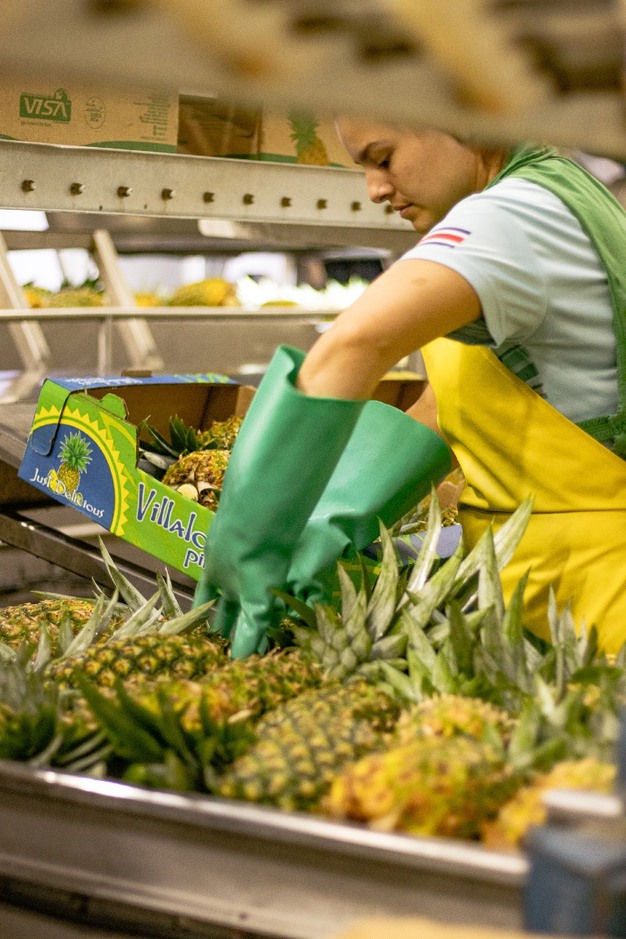 © Grupo VISAProcessed products: from idea to competitive edge
The group's value-added ambitions took concrete shape in 2021, when it broke ground on its own freezing plant. The first export shipment went out in May 2023, marking the operational launch of its IQF business. By the end of 2025, the plant had surpassed 11,000 metric tons of frozen product, making Grupo VISA Costa Rica's largest IQF pineapple producer. Alongside this, in 2022 the group bolstered its processed-product platform by acquiring Fruta Sana Costa Rica, an established dehydrated pineapple company.
Fresh-cut and crownless pineapple: meeting the modern consumer
Another growth area is fresh-cut and crownless pineapple, squarely aligned with convenience-eating trends. "Demand for ready-to-eat fruit keeps growing, especially among younger consumers," says Paniagua Chacón. The company works closely with its customers to deliver fruit with better color and superior internal quality, optimized for these formats—even when that means adjustments in the field.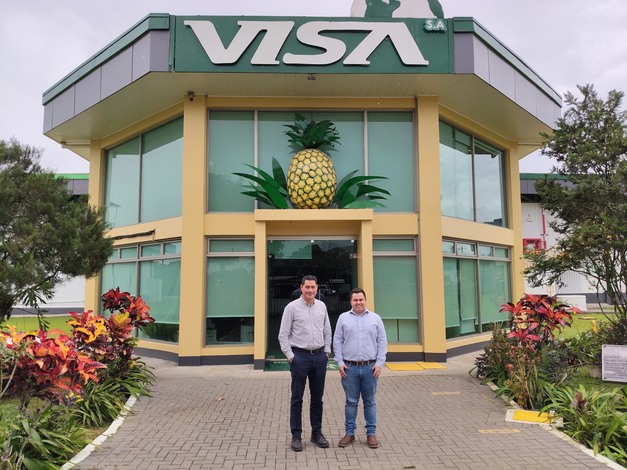 © FreshPlaza
Jorge García Ramírez, CEO of Grupo VISA, and Max Paniagua Chacón, Commercial Manager.
Root vegetables: a solid foundation
Root vegetables actually came before pineapple. Grupo VISA started out as a cassava company serving the local market and was a pioneer in exporting the product to the United States using paraffin wax coating. Today, the company continues to produce and export cassava, malanga, and yam, with dedicated packing and freezing lines. "Root vegetables are an ethnic product with growing demand in both the U.S. and Europe," says Paniagua Chacón. Cassava accounts for 70–80% of export volume in this segment.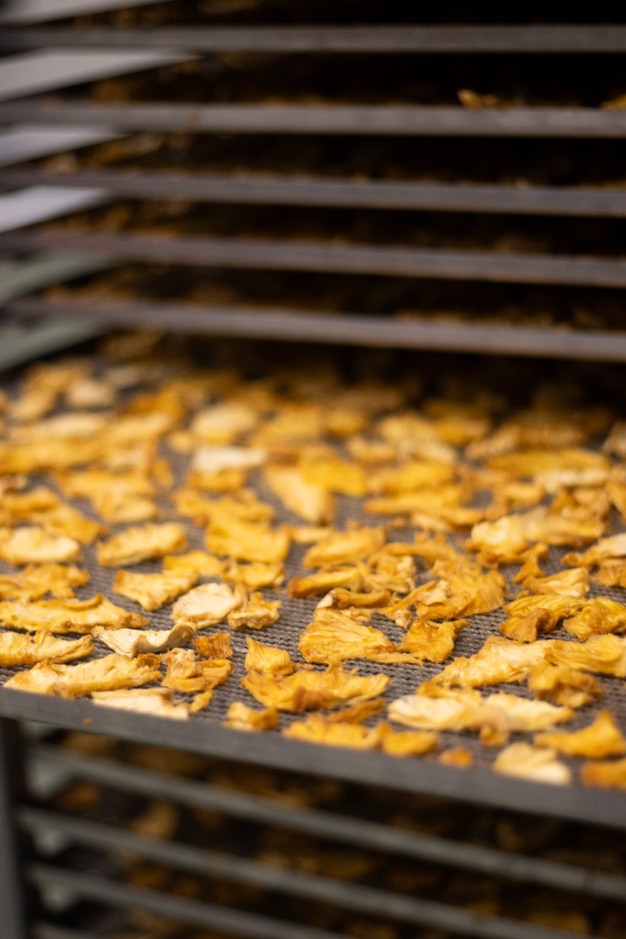 © Grupo VISAOperating in a challenging environment
The external environment presents real headwinds: the appreciation of the colón against the dollar, climate risks, and labor availability. Grupo VISA employs more than 1,000 people and is exploring mechanization options — particularly for planting — though it acknowledges the current limitations. Moreover, heavy rains at the end of 2024 and into early 2025 delayed planting and could affect volumes in the first half of 2026.
The company holds GlobalG.A.P. certification, additional social certifications, and full chain traceability. All production — fresh, frozen, or dehydrated — is grown to the same quality and food safety standards.
 For more information:
Max Paniagua Chacón
Grupo Visa SA
2.5 km North of Banco Nacional
21006 Pital (San Carlos) – Costa Rica
Tel.: +506 2473-3112
[email protected]
www.visasa.com