The cherry campaign in the Jerte Valley, in the Spanish region of Extremadura, has just started with the harvest of the earliest varieties and with very good prospects both in terms of volume and quality.
"The first few kilos of cherries arrived yesterday," says Mónica Tierno, Director General of the Jerte Valley Cooperative Association. "During the first few weeks, the fruit will mainly go to the domestic market. Volumes will gradually increase over the next few days, and from the second week of May onwards, we hope to have enough supply to be able to open export lines and continue shipping until the end of July," she says.
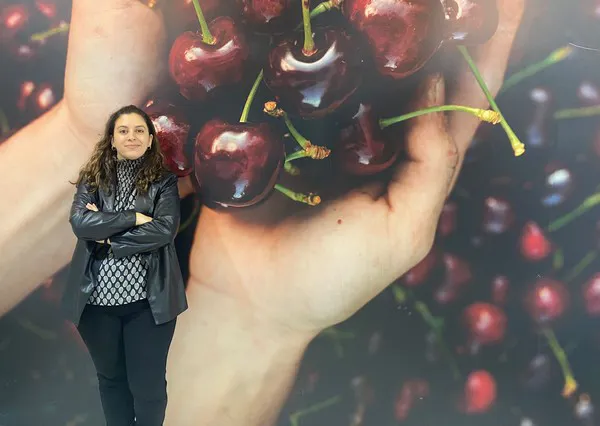
The weather conditions recorded during the winter and spring have, in general, been favorable for cherry growing. "We've had a colder and rainier winter than in recent years. The cherry trees have had enough hours of cold, and we've had no serious meteorological incidents in the spring, which has allowed for a good flowering and proper fruit growth," says Mónica Tierno.
In this context, the Jerte Valley Cooperative Association expects the cherry production to reach between 18,000 and 20,000 tons, a volume that would allow both growers and cooperatives to face the season with optimism. "The crops are grown at different altitudes, ranging between 400 meters above sea level and 1,200 meters for the later areas. For the time being, we have very good prospects for the season, with a good balance between yields and calibers," says the general manager of the organization.
The Association is made up of 15 cooperatives and has 2,500 producing members. It sells cherries both on the domestic market and for export to various European countries. During the campaign, promotional activities will also be carried out in Spain, Sweden, Denmark, and the United Kingdom with the aim of boosting cherry consumption in the main markets.
"This year, Chilean and Argentinian cherries had problems in the Chinese market, and their presence in European markets was extended, although there is still a gap between the two hemispheres, which is allowing us to start the season with good demand and interesting prices," says Mónica Tierno.
Waiting for Chinese authorities to open their market to Spanish cherries
"Although the protocol to export cherries to China has been signed, and we have already completed the necessary preparations and certification processes and have established commercial contacts in the country, we are waiting for Chinese authorities to formally open the market so that the first exports of the season can be carried out. Still, volumes will be limited at the start, since this is a process to be taken step by step," says the Director General of the Jerte Valley Cooperative Association.
Instability of raw material and logistics costs in a campaign that lasts just a few months.
The war in Iran has led to variability and instability in raw material and logistics costs. "We have felt the effects of the conflict from day one. Prices can't be guaranteed until the last minute, and this has been making things very difficult, considering that our season takes place within such a short period of time," says Mónica Tierno.
"In fact, to export to China, we hadn't considered shipping by boat because of the impact on maritime routes. Thus, since the protocol with China includes cold treatment, we had planned to ship by plane, with a stopover in the United Arab Emirates, where we could have setbacks at certain times as a result of the current conflict in the Middle East."
Investments to become more productive and automation in response to labor shortages
Although there has been a slight increase in the area planted, the acreage in the Jerte Valley remains stable because of limitations due to the mountainous terrain. "Productivity continues to increase every year thanks to the adoption of new varieties, the rethinking of planting frames, and improvements in agronomic management, which are allowing us to obtain larger sizes," says Mónica Tierno.
The company continues to invest in new projects to implement automation in the handling and packaging plant. "We are resorting to automation and robotization to alleviate the problem of the lack of specialized labor and its rising cost in recent years. We hope to continue making progress in this in future campaigns."
For more information:
Mónica Tierno Díaz
Jerte Valley Cooperative Association
Ctra. Nacional 110, km 381
10614 - Valdastillas, Cáceres. Spain
Tel.: +34 927 471070
[email protected]
www.ac-vallejerte.es