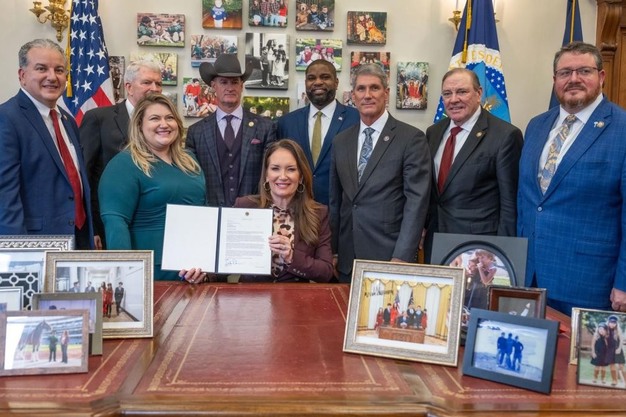
Congresswoman Kat Cammack joined U.S. Secretary of Agriculture Brooke Rollins at the U.S. Department of Agriculture headquarters as the Secretary signed a disaster declaration for Florida counties impacted by this year's historic winter freeze, beginning the federal process to deliver relief to farmers suffering catastrophic losses.
The declaration comes after a bipartisan letter led by Rep. Cammack and signed by all 29 members of Florida's congressional delegation urging USDA to act quickly after freezing temperatures struck the state during peak harvest in late January and early February.
 © Cammack House
Several members of the Florida delegation attended the announcement, including Reps. Scott Franklin, Byron Donalds, Neal Dunn, Randy Fine, Greg Steube, and Dan Webster, who each outlined the damage farmers in their districts are facing not only from the historic freeze but also from storms and drought conditions that have compounded challenges for Florida agriculture.
"On behalf of all of us, I can say it's incredibly refreshing to have a Secretary of Agriculture who is not only willing to listen, but willing to act," said Cammack. "Every single one of us in Florida has a district that's been affected by this freeze, which is why today's declaration is so important."
Preliminary estimates from the Florida Department of Agriculture and Consumer Services place total agricultural losses at more than $3.1 billion statewide, making it one of the most damaging freeze events in Florida agriculture in decades. The freeze hit a wide range of crops, including $1.15 billion in sugarcane losses, $674 million in citrus, $307 million in strawberries, $255 million in sweet corn, and $240 million in greenhouse and nursery crops.
Cammack thanked Secretary Rollins for moving quickly on the disaster declaration and recognized the leadership of Florida Agriculture Commissioner Wilton Simpson, along with the rapid work of the University of Florida Institute of Food and Agricultural Sciences and Florida producers who quickly conducted economic damage assessments that helped federal officials understand the scale of the disaster.
"Florida is one of the most diverse agricultural states in the country, with more than 300 commodities, massive cow-calf operations, aquaculture, and more," Cammack said. "When I was traveling across the state meeting with producers ahead of the Farm Bill, the freeze had just happened, and the devastation was already clear."
"This freeze didn't just damage one crop or one season," Cammack continued. "We are seeing total losses in some areas, including sugar and blueberries, and for crops like citrus and blueberries those trees and bushes won't be productive for three or four years. That means farmers could be facing years of impacts and full replacement of their operations."
The disaster declaration begins the federal process that will make relief programs available to impacted agricultural producers as they work to recover from the devastating freeze.
For more information:
cammack.house.gov